Showing posts with label Pudding. Show all posts

Friday, March 8, 2013

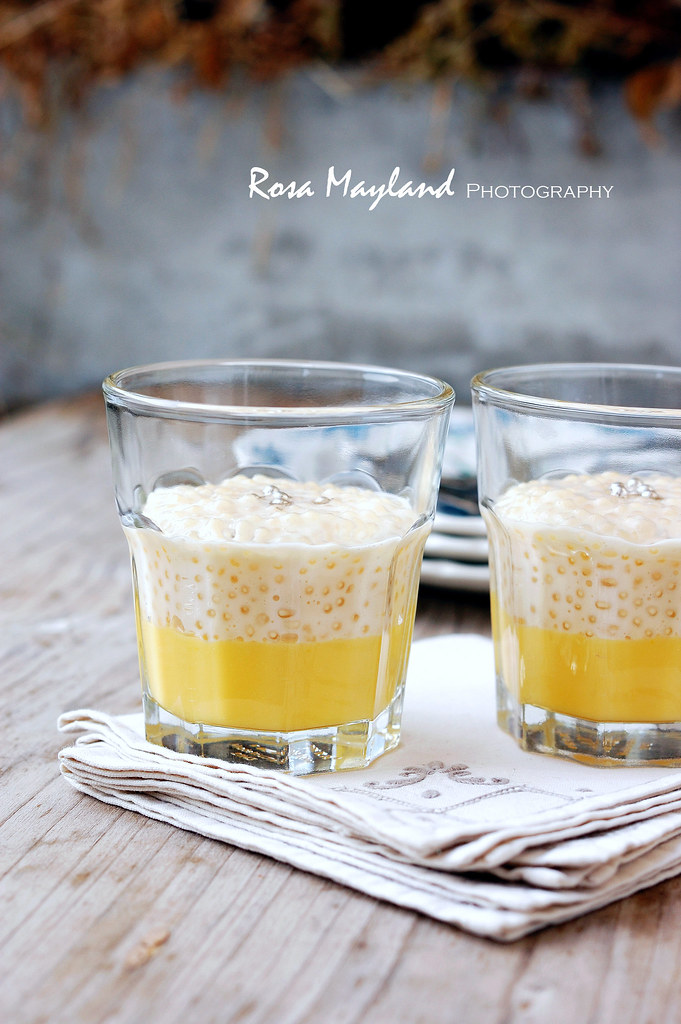
WAITING FOR SPRING... HONEYED TAPIOCA AND ORANGE CURD PUDDINGS - PUDDINGS DE TAPIOCA AU MIEL ET À L'ORANGE CURD

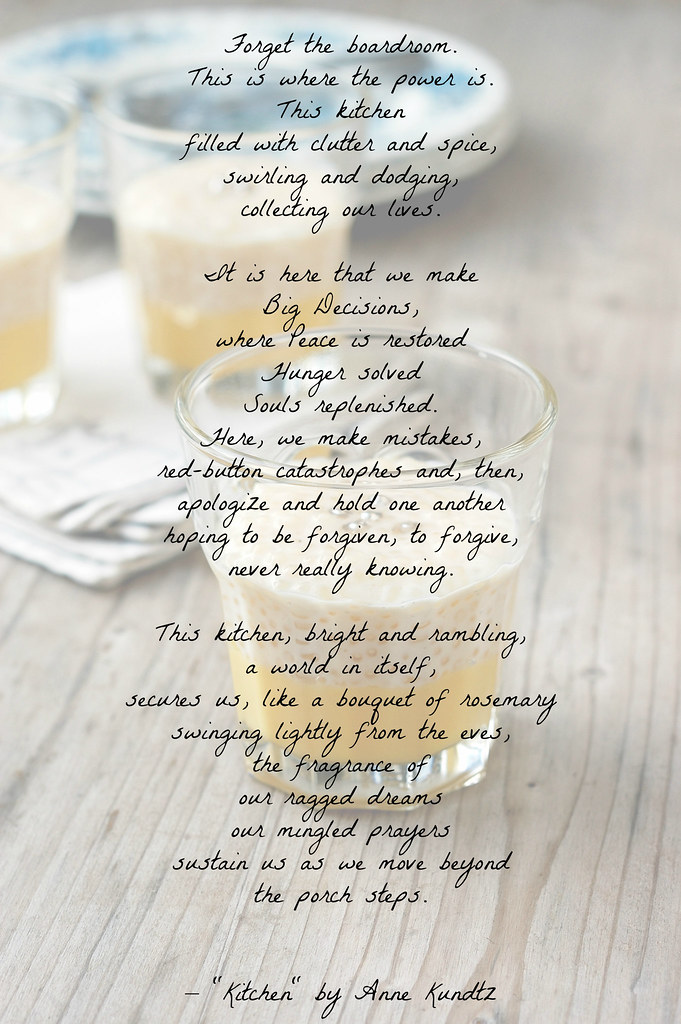
Tapioca Verrine 8 7 bis
To be interested in the changing seasons is a happier state of mind than to be hopelessly in love with spring.
- George Santayana
If we had no winter, the spring would not be so pleasant: if we did not sometimes taste of adversity, prosperity would not be so welcome.
- Anne Bradstreet
Being someone who tends to feel easily stressed out about nothing and overwhelmed by upsetting situations, I guess it will not come as a revelation if I told you that, very much like cats, I am a creature of habit with little taste for radical or excessive change. Hence, I need stability and don't mind repetitiveness as it gives me a sense of comfort, security and it lets me achieve a certain control over life and helps me focus on what is important.

Of course, adding small amounts of variation to our routine isn't all that bad as it forces us to explore different horizons, take risks and open up to new experiences. Those unforseen events add some contrasting spice to our existence and are a welcome wake-up call when things are getting far too cozy and dangerously monotonous. At the end, it's all a question of finding the right balance between solacing permanence and refreshing novelty - too much of one or the other can be harmful to us.

Well, the same can be said about seasons. Imagine how insipid, boring and sad our days would be without weather fluctations, the perpetual transition of cycles and earth's ever-permutating rhythms. Although, each of us always finds a reason to moan about spring, summer, autumn or winter, I'm pretty sure we'd all go ballistic and suffer from severe depression if it would be Disney-like sunny and warm all the time or if our table was graced week after week with the same vegetables and fruits. Time would seem endless and we'd miss out on the best nature has to offer: the constant and spellbinding metamorphosis of our environment. Simply inconceivable for a lover of climate and agricultural variety like me.

This year, October, November, December, January and Febraury have been wonderfully wintry and extremely generous in snow. I've had a blast walking through the frosty, white and surreal looking countryside surrounding Geneva and I've thouroughly enjoyed staying at home doing some cocooning, but lately, I have grown tired of Jack Frost's icy embrace and now dream of admiring the verdant green scenery during my weekly strolls and fantasize about sitting on the balcony, sipping on a cup of coffee while listening to the mad chirp of sparrows. Besides, I can hardly wait to eat ramsons/ramps, fresh garlic, asparagus, baby carrots, fava beans, rhubarb and strawberries again.

Now that February is behind us and the vernal equinox is approaching, excitement is in the air and people as well as animals are starting to become fidgety. After a long period of cold and dullness, everybody is ready to welcome spring - our savior - with open arms and there's not one living soul who isn't relieved to finally be able to soon turn the page on all the gloom and inclemency of the last months.  

Aaahhh, there's nothing quite like getting caressed by the soft rays of the Easter sun, squinting against the bold late March light, relishing the warm April breeze, experiencing a slight gust of grassy air, being deafened by the enthusiastic carol of the birds and blinded by the flowers in bloom!

So while impatiently waiting for the magical transition to take place and heavy rain replaces snow as Switzerland's landscapes turn brown, I keep myself busy and sane with cooking activities. Within the walls of my humble, yet snug kitchen numerous heartwarming delicacies are created and nothing can affect me - not even the gloom outside; a little corner of paradise and epicurean lair where I can forget about the greyness of the skies above, the ugliness of certain people and leave my fears, worries as well as troubles behind...

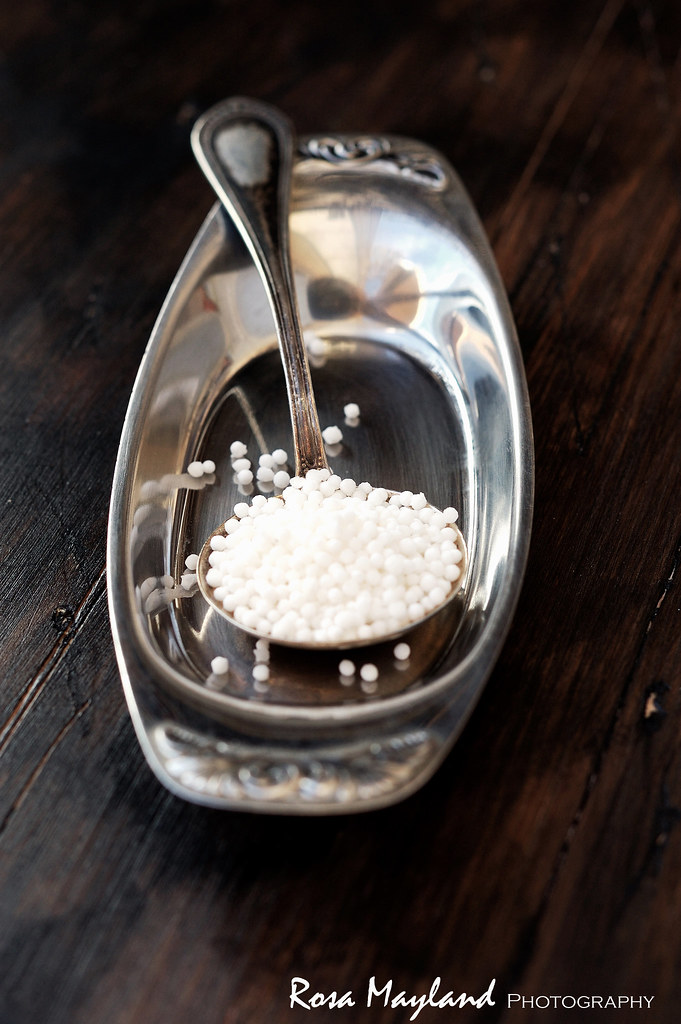
Last Saturday, after visiting my favorite Asian supermarkets (Asia Store & Thu Hang in Pâquis, Geneva - for addresses check out this link) and buying a shipload of food (noodles, condiments, sauces, spices, tofu, pastries, etc...), I decided to revisit a childhood classic and prepare a healthy dessert with the tapioca pearls I purchased there and some leftover Tarocco oranges I had in my fruit basket. The result was incredibly pleasing and even P. loved my "Tapioca And Orange Curd Puddings" despite his aversion to this cassava speciality and its weirdly chewy texture.

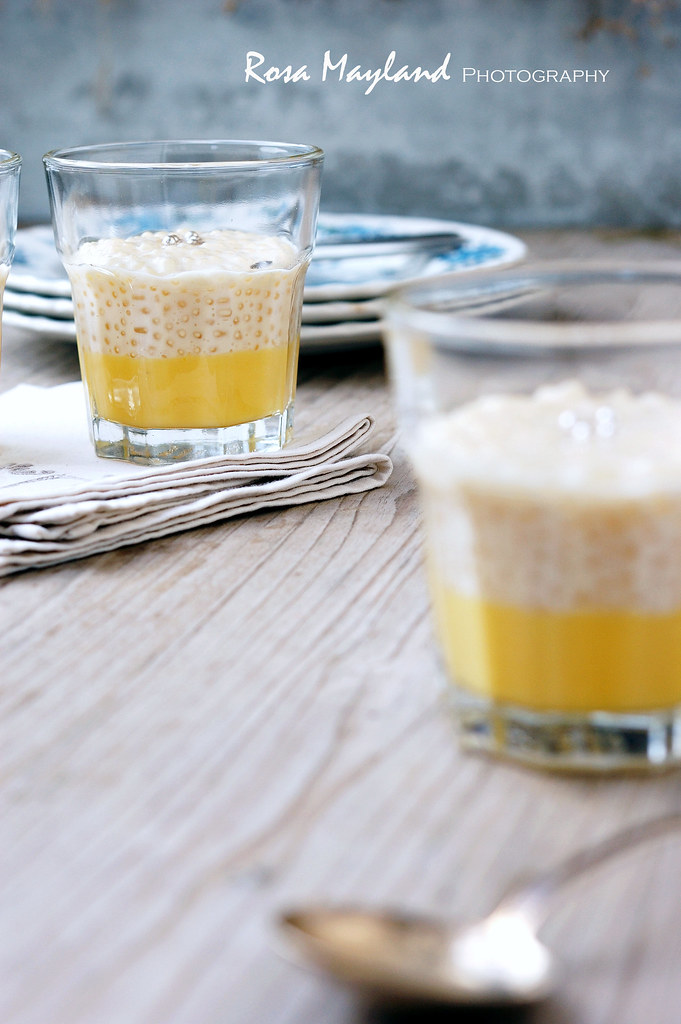
Those elegant Maroccan flavored verrines are delightfully refreshing, voluptuously creamy, exquisitely fragrant, zestfully citrusy and magnificently balanced with the slight sharpness of the orange curd. An exceptionally good, refined and gluten-free treat which will rejoice tapiocaphiles and tapiocaphobics alike!
 
Tapioca Verrine 4 2 bis
Honeyed Tapioca And Orange Curd Puddings
Recipe by Rosa Mayland, March 2013.

Makes 6 verrines.

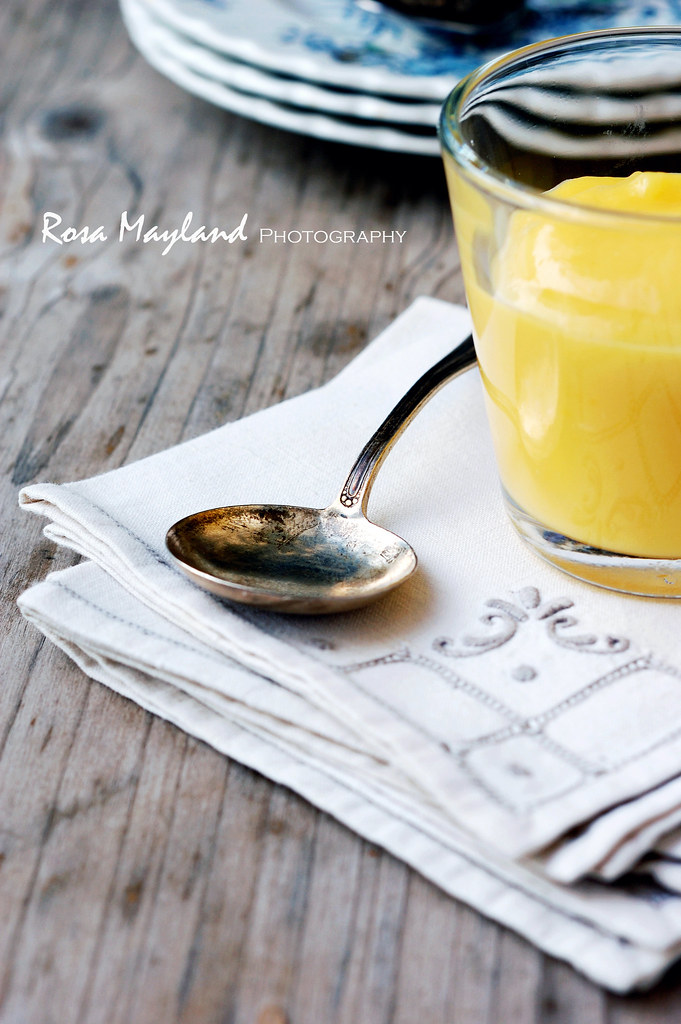
Ingredients For The "Orange Curd":
220ml Freshly squeezed orange juice (Tarocco)
1 Tbs Lemon juice
110g Castor sugar
2 Eggs
1 Tbs Cornflour
2 Tbs Unsalted butter
Ingredients For The "Tapioca Pudding":
3/4 Cup (120g) Small pearl tapioca
1 3/4 Cups (420ml) Milk
1/2 Cup (120ml) Water
1/3 Cup (115g) Light runny honey
1 Tsp Orange blossom water (optional) or pure vanilla extract

Method For The "Orange Curd":
1. In a medium pan, combine all the ingredients together.
2. Put over medium heat and stir constantly until the mixture thickens (custard-like consistency).
3. Remove from the heat and whisk in the butter.
4. Pour equal quantities of the curd into the verrines and let cool while you prepare the tapioca.


Method For The "Tapioca Pudding":
5. In a large saucepan, combine the tapioca, milk, honey and orange blossom water (or vanilla extract) over medium high heat.
6. Bring to a boil, then reduce the heat to low.
7. Let the mixture cook until the tapioca looks translucent and the pearls are chewy in texture, about 20-30 minutes.
8. Let cool to room temperature, stirring occasionally and divide in between the verrines with the orange curd. Refrigerate the puddings.
9. Just before serving, top with chopped nuts or decorative sugar.

Remarks:
You can also make orange curd with Moro or Navel oranges or just replace the orange curd by any other curd of your choice (lemon, rhubarb, strawberry, raspberry, etc...).
If you want your tapioca puddings to be a little richer, then replace the water by single or double cream.

Serving suggestions:
Serve as dessert or as afternoon treat with some jasmine tea.

Tapioca Verrine 3 7 bis
Puddings De Tapioca Au Miel Et À l'Orange Curd
Recette par Rosa Mayland, Mars 2013.
 

Pour 6 verrines.

Ingrédients Pour "l'Orange Curd":

220ml de Jus d'orange (Tarocco) fraîchement pressé

1 CS de Jus de citron
110g Sucre cristallisé
2 Oeufs
1 CS de Maïzena
2 CS de Beurre non-salé

Ingrédients Pour Le "Pudding De Tapioca":
120g (3/4 tasse) de Tapioca (perles du Japon)
420ml de Lait
120ml d'Eau
115g de Miel clair liquide
1 CC d'Eau de fleur d'oranger (facultatif) ou d'extrait de vanille pure

Méthode
Pour "l'Orange Curd":
1. Dans une casserole moyenne, mélanger tous les ingrédients ensemble.
2. Faire chauffer à feu moyen et remuer constamment jusqu'à ce que le mélange épaississe (il doit avoir la consistance d'un custard).
3. Retirer du feu et incorporer le beurre.
4. Verser le curd (en quantités égales) dans le fond des verrines et laisser refroidir pendant que vous préparez le pudding.


Tapioca Verrine 7 9 bis
Méthode Pour Le "Pudding De Tapioca":
5. Dans une grande casserole, mélanger ensemble le tapioca, le lait, le miel et l'eau de fleur d'oranger (ou la vanille), puis faire chauffer à feu moyennement élevé.
6. Porter à ébullition et réduire la température.
7. Faire cuire à feu doux jusqu'à ce que le tapioca soit translucide et que les perles soient tendre, pendant environ 20-30 minutes.
8. Laisser refroidir à la température ambiante, en remuant de temps en temps et verser dans les verrines (sur l'orange curd et en quantités égales). Réfrigérer les puddings.

9. Juste avant de servir, garnir de noix hachées ou de sucre décoratif.

Remarques:
Vous pouvez également fabriquer votre orange curd avec des oranges Moro ou Navel, ou bien tout simplement remplacer l'orange curd par le curd de votre choix (citron, rhubarbe, fraise, framboise, etc ..).
Si vous voulez que votre pudding au tapioca soit un peu plus riche, remplacez l'eau par de la crème légère ou double.

Idée de présentation:
Servir pour le dessert ou à l'heure du goûter avec du thé au jasmin.

Tapioca Verrine 5 11 bis

Friday, December 2, 2011

DELUXE TRADITIONAL ENGLISH TRIFLE - TRIFLE ANGLAIS TRADITIONNEL


I am very proud to have British blood (Viking too, as England was invaded by the Danes and under the Danelaw for more than a century) running through my veins and therefore I have a strong attraction for the culture of my ancestors, hence if you are no stranger to my writings you must already know that I am an ardent and passionate defender of the cuisine of my country of origin as I believe that English food is highly underrated and still gets an undeserved as well as unfair bad rap (read this article)...
"There is no such thing as bad food/cuisine, only lousy cooks using low-grade ingredients and crappy recipes!"
- Rosa Mayland, 2011

"She did not so much cook as assassinate food."
- Storm Jameson (1891-1986)
I am totally certain that people's negative vision and quasi-xenophobic stereotyping of this astounding island's unique specialities comes from the fact that they haven't yet tasted the real deal and have only eaten unfortunate dishes that were very badly prepared by untalented and clueless "cooks". When you come across disgusting chew, remember that you must never blame the cooking customs of a country, but rather the one who has created such abominable grub. Therefore, it is unjust to judge the gastronomy of a place when you haven't fed on the right fares.
 
Believe it or not, in the past, Great Britain was avant-gardish and its culinary legacy used to have a good reputation, but regretfully certain recent events in history have damaged it considerably. For all those of you who smirk when they hear that and doubt this affirmation, it has to be said that ancient hearty, humble, scrumptious and more recent colonially-tinted British food has, in its time, inspired the rest of the world for many years. Did you know that the Anglo-Saxons developed meat and savoury herb stewing techniques before the practice became common in the rest of Europe, that the Norman conquest introduced exotic spices during the Middle Ages and that the British Empire facilitated a knowledge of India's elaborate kitchen traditions of pungent, penetrating spices and herbs? I'm pretty sure not. Well, that is a detail all haters and foulmouthed criticizers must be conscious of before they start bringing Brit cooking down in flames and spreading false propaganda.

"There is much deliciousness in the British Isles; you just have to find it..."
- Fergus Hendersen

In days of yore, the peninsula was influenced by foreign invaders like the Vikings (from Scandinavia, but especially from Danemark), the Romans (from Italy) and even the Franco-Normans (from France) who all brought with them a melting pot of ingredients and foods to the English table, and imported new cooking methods and ideas.


Thanks to the French asilants, medieval English cookery abunded with recipes containing exotic seasonings such as saffron, mace, nutmeg, pepper, ginger and sugar. Many traditional recipes are still made nowadays and this heritage can be found in many contemporary treats such as "Christmas Pudding", "Christmas Cake", "Hot Cross Buns", "Mince Pies", etc... Then, with the colonization of far-away regions of the globe by the Empire tea was imported from India and British citizens started getting obssessed by curries, condiments and spicy sauces which are now an integral part of the rich and impressive food culture of England. In addition, immigrant workers have massively contributed to expanding this land's culinary horizon. Open-mindedness, assimilation and intergration has always been part of this nation's characteristics and that is why the term "fusion" is not alien to its folks.


Unfortunately, much harm was inflicted on English gastronomy throughout the Industrial Revolution, WWI, WWII and poor economic eras (1970's especially).
During the 18th and 19th century, nobody had time to spend time in the kitchen and Britain was in the forefront of canned foods as well as other mechanical preservation methods. From 1914 until early into the 1950’s, little food was left for private consumption (rationing of meat, sugar, butter and eggs). As a result, the decline of quality produces and meals became flagrant. Sadly, it is then that Great Britain acquired its status as gastronomic joke worldwide.

"British food has not traditionally been regarded as one of the world's great cuisines, and yet Stilton cheese, Scottish raspberries, Goosnargh duck and Welsh lamb are internationally renowned and celebrated. And then there are all those dishes and recipes that inspire passionately loyaltly among the initiated: Whitby lemon buns and banoffi pie, for example; pan haggerty and Hendersen's relish. All are as integral of the country's landscape as green fields, rolling hills and rocky costaline."
- Andrew Webb, "Food Britannia"
Although England's period of culinary disgrace lasted long, the joke is finally starting to get forgotten. One can now witness an extraordinary comeback in popularity of British food and the world cannot stop speaking about the archipelago's magnificent regional produces, fine dishes, awesome chefs and renowned restaurants/gastropubs. This change of situation brings me happiness because I wish that more folks out there will be able to get initiated to the proper stuff and discover as well as appreciate what I have been treasuring all my life. Light has definitely to be made on this important part of England's patrimony. My dream is that others learn to enjoy and respect it as much as I do...

You've got to understand that I have been literally brought up on the finest English specialities (made by expert hands too) and everything that ever graced my plate has been a real feast for my taste buds and a total enchantment. My grandparents, their friends and my mother have never deceived me when it comes to being terrific home chefs and introducing me to Britain's best recipes. This is the reason why I cannot accept that certain mean and uneducated individuals continue to spread false rumors about a gastronomy they don't grasp/understand at all and have not experienced correctly (just because it is your opinion and you don't like certain dishes, doesn't mean that they are horrible or make a generality)!

So, today, I wish to share with you my personal recipe for "Trifle" as this  old-fashioned delight deserves all your attention, especially if it is put together with a lot of loving care and without speeding up steps or forgetting that quality must always rule in the kitchen.


This sweet course is very popular at the moment and it is not rare to see excellent recipes for it in overseas magazines or on international blogs. Most of the time I find them interesting and mouthwatering, but I must admit that I often feel a little frustrated as most of them are too simplistic, a pale copy and lazy interpretation of the original. Besides, it is still not rare to watch a TV programm ("Come Dine with Me" on Channel 4) and see somebody shamelessly offering their chokingly disgusting and terrifyingly industrial 1970 version of that classic (low-grade store-bought cake, custard from a can or a packet, additive-laden jelly, Spanish greenhouse-grown strawberries and whipped cream from a tube). A true disgrace!


For those who have not the slightest idea regarding what a "Trifle is, then here's a short explaination. The origin of the name can be traced back to 1596 and it refers to a sweet course - very similar to a "Fool" - made with thick cream flavored with sugar, ginger and rosewater. It is only sixty years later that milk was added and the custard was poured over alcohol-soaked leftover bread. From then on, it hasn't stopped evolving in order to become the pudding we are all accustomed to seeing these days. And contrarily to common belief, the inclusion of gelatin is not a recent variation. In reality, the earliest known recipe to include jelly dates from 1747.


Despite being quite a straight-forward interpretation of the original recipe, my "Deluxe Traditional English Trifle" is nonetheless a personal creation and is quirkier and more versatile than the typical layered pud served by your granny. Mine has no trace of that repulsively wobbly mass (I adore homemade jelly, but find it not to be a must in "Trifle" since it adds nothing much to it and generally is not liked by most munchers), abominable factory-made custard or
of any fertilizer-boosted fruits, the pound cake has been baked by myself (you could also use "Ladyfingers" or "Sponge Cake"), it is spiked with Port rather than Sherry, can be adapted to all seasons and contains some extra lemon juice as well as zest for more freshness, sharpness and piquantness. And finally, but not lastly, each of its components are homemade from scratch, so it is a top-notch delicacy. It is so refreshing, fruity, smooth, regressive, exquisite and addictive that I have converted my 100% Swiss boyfriend into a trifle-aholic like me...
Trifle 8 warmer CHOSEN bis
~ Deluxe Traditional English Trifle ~
Recipe by Rosa Mayland, November 2011.

Ingredients For The "Cakes":

85g (3oz) Unsalted butter, at room temperature
85g (3oz) Castor sugar
2 Eggs (~ 63g)
1 Tsp Pure vanilla extract
125g (4.5oz) All-purpose flour
1 Tsp Baking powder
1/4 Fine sea salt
3 Tbs Whole milk 
Ingredients For The "Pastry Cream":
2 1/4 Cups (540ml) Whole milk
1/3 Tsp Fine sea salt
4 Tbs Cornstarch
1/2 Cup (110g) Castor sugar
2 Big eggs (~ 70g)
1 1/2 Tsp Pure vanilla extract
4 Tbs Unsalted butter, cut in small cubes
Ingredients For "Assembling The Trifle":
2 1/4 - 1/2 Cups (810 - 900g) Fruit compote (see comments)
2 Lemond (organic)
1 Tbs Light brown sugar
Red Port, to taste
1 Cup (250ml) Double cream (35%), whipped
1/2 Cup (90g) Matchstick almonds, toasted

Trifle 1 3 bis

Method For The "Cakes":
1. Preheat the oven to 180° C (350° F), then grease two 3x6 inches rectangular cake tins and
line the bases with baking paper.
2. Mix together the sifted flour, baking powder and salt. Set aside.
3. Cream the butter and sugar together in a bowl until pale, light and fluffy.
4. Add the eggs, one at a time, beating the mixture well between each addition and a tablespoon of the flour with the last egg to prevent the mixture from curdling and separating. Then, mix in the vanilla extract.
5. Incorporate the flour mixture by gently folding it in the egg mixture and add enough milk to obtain a batter that falls reluctantly from the spoon.
6. Spoon the mixture into the prepared tins, level the top and bake for 30-35 minutes or until golden and a skewer inserted in the centre of each cake comes out clean.
7. Let cool in the pan for ten minutes before turning out on to a wire rack and leaving to cool completely.
Method For The "Pastry Cream":
1. Put the milk and salt in a pan, bring to a light boil.
2. In a large mixing bowl, whisk together the sugar, cornstarch, eggs and vanilla extract until smooth, fluffy and light in color.
3. While constantly whisking, slowly pour the milk into the egg mixture.
4. Return the whole to the saucepan.
5. Over medium heat and while whisking non-stop, cook until you get a thick consistency (just bring to a slight boil).
6. Remove from heat and pour into a bowl. Let cool for 10 minutes and then incorporate the butter, a little at a time, until the pastry cream is smooth and shiny .
7. Cover the surface with clingplastic, directly touching the cream. Let cool completely before placing in the refrigerator.

Trifle 3 1 bis

Method For "Assembling The Trifle":
1. Cut the cake into slices (0.5 - 0.8mm/0.2 - 0.3 inches) and whisk the pastry cream until smooth again. Set aside.
2. Zest both lemons and juice them, then mix the zest as well as juice together with the brown sugar. Set aside.
3. Put 1/3 of the cake in the bottom of the bowl. Pour 1/3 of the lemon juice mixture on to it and do the same with the Port.
4. Spread 1/3 of the compote over the cake, then spread 1/3 of the pastry cream over it.
5. Repeat steps 3 and 4 two more times and then top with the whipped cream.
6. Put into the fridge to chill.
7. Before serving, sprinkle with the toasted almonds.

Comments:
Of course, I am quite aware that the fruit sauce I used is not in season anymore, but be reassured, mine came from the stock I have in my freezer. It can easily be replaced by the puree of your choice (cranberry, apple, pear, orange, chestnut, etc…).
The cake can be made up to two days in advance and kept tightly wrapped in clingfilm or frozen for up to 3 months.
The pastry cream as well as the compote can also be made ahead and kept in the fridge for up to 5 days.
I recommend that you chill the trifle for at least 4 hours (overnight is even better) before serving as then the flavors can fully develop.
Keep the trifle in the refrigerator for up to 2 days.

Serving suggestions:
Serve for dessert with a good cup of strong coffee, a glass of liquor or sweet wine.

~~~~~~~~~~~~~~~~~~~~~~

Trifle 11 reworked copy cooler bis

~ Trifle Anglais Traditionnel Revisité ~
Recette Par Rosa Mayland Novembre 2011.

Ingrédients Pour Le "Gâteau":
85g de Beurre non-salé, à température ambiante
85g de Sucre cristallisé
1 CC d'Extrait de vanille pure
2 Oeufs (~ 63g)
125g de Farine
1 CC de Poudre à pâte/lever
1/4 de Sel de mer fin
3 CS de Lait entier
Ingrédients Pour La "Crème pâtissière":
540ml de Lait entier
1/3 CC de Sel de mer fin
4 CS de Maïzena (fécule de maïs)
110g de Sucre cristallisé
2 Gros oeufs (~ 70g)
1 1/2 CC d'Extrait de vanille pure
60g de Beurre non-salé, coupé en petits cubes
Ingrédients Pour "Assembler le Trifle":
810-900g de Compote de fruits (voir commentaires)
2 Citrons (bio)
1 CS de Sucre brun clair
Porto rouge, selon au goût
250ml de crème double, fouettée
90g d'Amandes allumettes, torréfiées

Trifle 2 4 bis

Méthode Pour le «gâteau»:
1. Préchauffer le four à 180 ° C (350 ° F), puis beurrer 2 moules à cake rectangulaires de 8x15cm et recouvrir les fonds de papier sulfurisé.
2. Mélanger ensemble la farine tamisée, la poudre à pâte et le sel. Réserver.
3. Dans un bol moyen, battre le beurre et le sucre en pommade (le mélange doit être pâle et léger).
4. Ajouter les oeufs, un à un, en les incorporant complétement après chaque ajout. Ajouter une cuillère à soupe de farine avec le dernier œuf afin d'éviter que le mélange se sépare, puis incorporer l'estrait de vanille.
5. Incorporer la farine en pliant délicatement et ajouter assez de lait afin d'obtenir une pâte qui tombe de la cuillère (mais qui n'est pas liquide - telle une pâte à gâteau ordinaire).
6. Répartir la pâte également dans les moules, lisser et cuire cuire pendant 30-35 minutes ou jusqu'à ce que les gâteaux soient dorés et que la lame d'un couteau insérée en leur centre en ressorte propre.
7. Laisser refroidir dans les moules pendant dix minutes avant de démouler. Laisser refroidir sur un grille.
Méthode pour la "Crème pâtissière":
1. Mettre le lait et le sel dans une casserole, porter à ébullition (tout juste).
2. Dans un grand bol, battre ensemble le sucre, la fécule, les oeufs et la vanille jusqu'à ce le mélange soit pâle et mousseux.
3. Tout en fouettant constamment, verser lentement le lait dans le mélange (tempérage).
4. Verser l'ensemble dans la casserole.
5. À feu moyen et en fouettant en continu, faire cuire jusqu'à obtention une consistance épaisse, lisse et crémeuse.
6. Après ébullition, retirer du feu et versez dans un bol. Laisser refroidir pendant 10 minutes puis incorporer le beurre, un peu à la fois, jusqu'à ce que la crème pâtissière soit lisse et brillante.
7. Couvrir la surface avec du film plastique (toucher directement la crème pâtissière). Laisser refroidir complètement avant de placer dans le réfrigérateur.
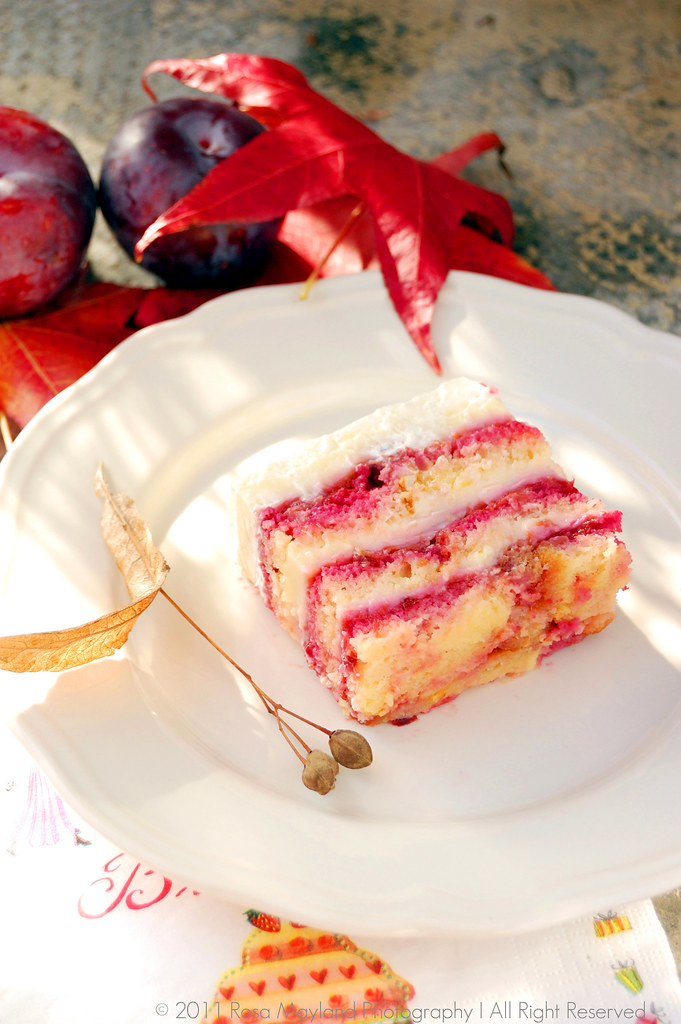
Trifle 10 warmer bis

Méthode Pour "Assembler Le Trifle":
1. Couper les gâteaux en tranches de 0.6-0.8mm et fouetter la crème pâtissière jusqu'à obtention d'une consistance lisse. Mettre de côté.
2. Prélever le zeste des deux citrons et les presser, puis mélanger le zeste et le jus avec le sucre brun. Mettre de côté.
3. Mettre 1/3 des tranches dans le fond du bol. Mouiller avec 1/3 du jus de citron et de faire la même chose avec le porto.
4. Étaler 1/3 de la compote sur les tranches de cake, puis étaler 1/3 de la crème pâtissière sur cette dernière.
5. Répétez les étapes 3 et 4 encore deux fois, puis décorer le dessus du trifle avec la crème fouettée.
6. Mettre au réfrigérateur.
7. Avant de servir, saupoudrer avec les amandes.

Commentaires:

Les prunes ne sont plus de saison (j'avais préparé cette recette lorsqu'ils était encore de saison), mais vous pouvez remplacer cette compote par la compote de votre choix (pommes, poires, cranberries, orange, châtaignes, etc...).
Les gâteaux peuvent être faits 2 jours à l'avance et enveloppés dans un film plastique ou congelés (maximum 3 mois).
La crème pâtissière ainsi que la compote peuvent également être préparées à l'avance et conservées au réfrigérateur pendant 5 jours maximum.
Je vous recommande de réfrigérer le trifle pendant au moins 4 heures (c'est encore meilleur après une nuit au réfrigérateur) avant de servir car de cette manière les saveurs peuvent se développer complètement.
Conserver pas plus de 2 jours au frigo.

Idées de présentation:
Servir pour le dessert avec une bonne tasse de café, un verre de liqueur ou de vin liquoureux.

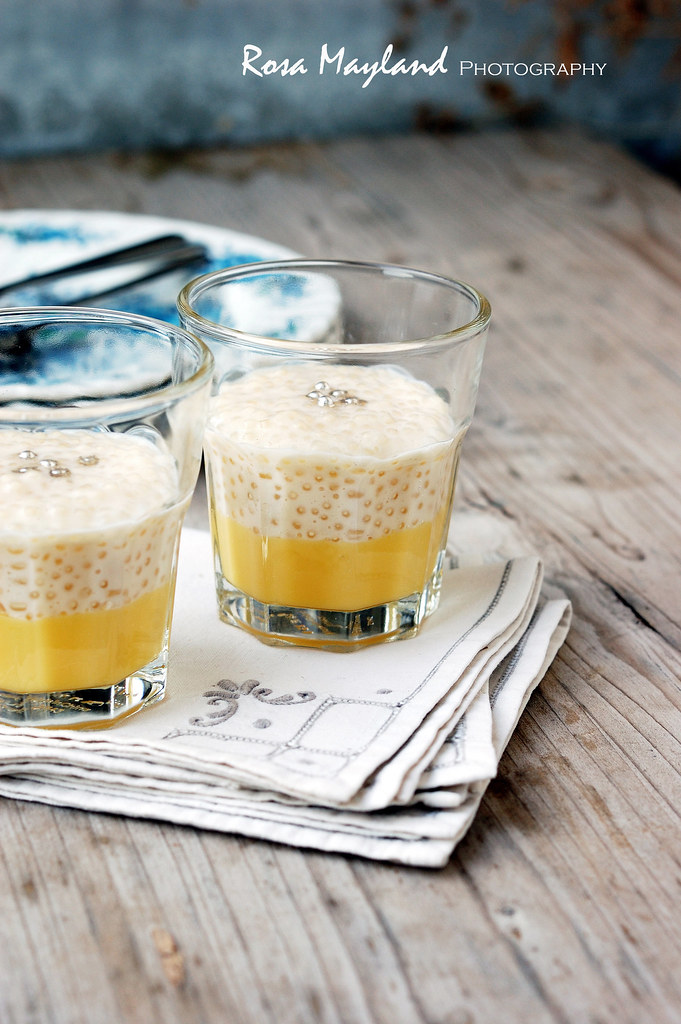
Trifle 5 2 bis

Friday, November 11, 2011

EPLEPAI, A NORWEGIAN APPLE CAKE - GÂTEAU NORVÉGIEN AUX POMMES

Apple Cake 8 bis
As much as I love my blog, adore my followers and  appreciate communicating my enthusiasm for all things culinary with the world, I have to admit that it is always very difficult to get back on track after having been on holiday and away from my virtual "baby" (yes, that's how I call it). Blogging offers a great deal of fun, but is also a full-time "job" if you are a dedicated and serious perfectionist like me.

There are some moments when I wish I would be less enslaved to Rosa's Yummy Yums, feel less under pressure and less "obligated" to make my faithful readership happy by offering regular updates on a weekly basis. Stress is negative and can really be destructive as it tends to kill the enjoyment this divertissement is supposed to bring and transforms it into a chore and a heavy responsability. It is exactly what you want to avoid and it is then that you have to unplug yourself before you wreck yourself and hate your hobby. In that case, a break is highly recommended

Having gone through a rough and emotionally draining phase lately, I had to interrupt my rat race routine with a lovely staycation. During two blissful weeks, I enjoyed relaxing my body, intellect and soul. Finally, I could breathe, sleep, stop looking at the clock, be as silly and snail-like as I wanted, yet I somehow missed putting my thoughts down on paper and sharing my vision of things as well as my latest gastronomical discoveries with you (addiction it is called - LOL).

Apple Cake 7 1 bis

On the one hand it might be an energy-consumming activity to feed such a site, but on the other hand, the pleasure and joy it gives to the person behind the keyboard is immeasurable and compensates for the endless exhausting and strainful photography sessions as well as every unnerving hour spent wracking my brains in order to find clever words, original ideas and dishes of interest that I can display here.

The positive news is that eventhough my batteries have not been entirely reloaded during the course of this small interlude, I am nonetheless back on the saddle once more and ready to kick some ass again! Hopefully you have savored that momentarily calm period during my absence. Aaahhh, what a relief! Finally free of my writing deliriums, photographic experiments, cunning points of view and my sinful as well as everlastingly tempting food.

Well, as I didn't want to leave you totally unoccupied while I was not visibly present (don't worry, just like a stalker or undercover agent, I followed each of your tweets, post and facebook movements as I'm an online junkie - LOL), two of my wonderful colleague bloggers (Tanvi and Peter) entertained you thanks to their delightful guest posts delivered with much warmth, charm, verve and talent.

But let me tell you, despite the fact that you might have the impression I have spent my vacation doing absolutely nothing and being lazy like a maggot, in no way have I been procrastinating or innactive. All on the contrary. I didn't publish any recent articles, that's true, but nevertheless, in my corner, I was calmly preparing my return and future features just like a tactician getting ready for war.

Apple Cake 1 4 bis
Apart from taking loads of fall pictures and doing lots of thinking as well as some reasearching, I worked on my new design, hence I have the immense pleasure of introducing you guys to Rosa's Yummy Yums' elegant, distinguished, fresh and chic layout (tweeting, facebooking, stumbling, etc... enabled, how class is that?). My blog really needed a facelift as it was starting to look quite outdated, aged and crusty, so I hope you'll appreciate this makeover (there's still more to do, but let's take one step at a time, shall we)...

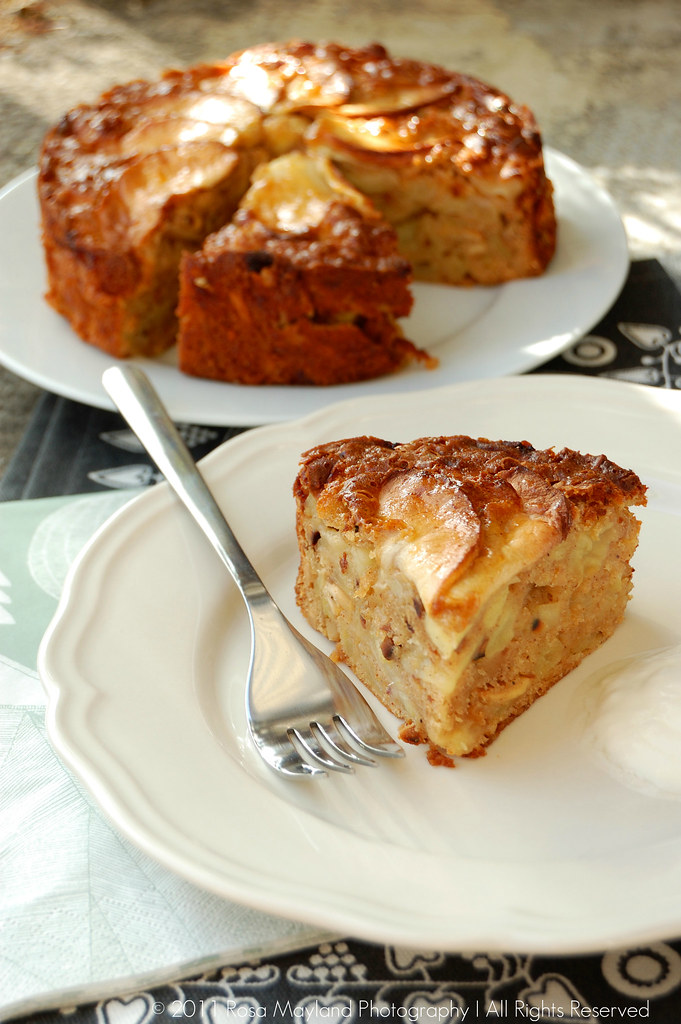
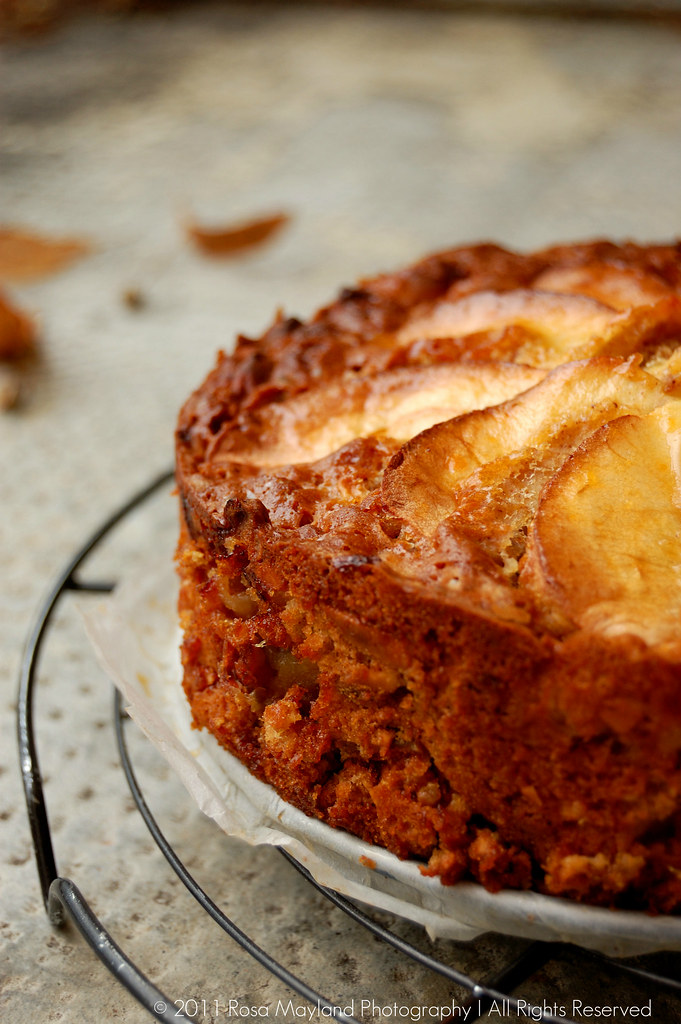
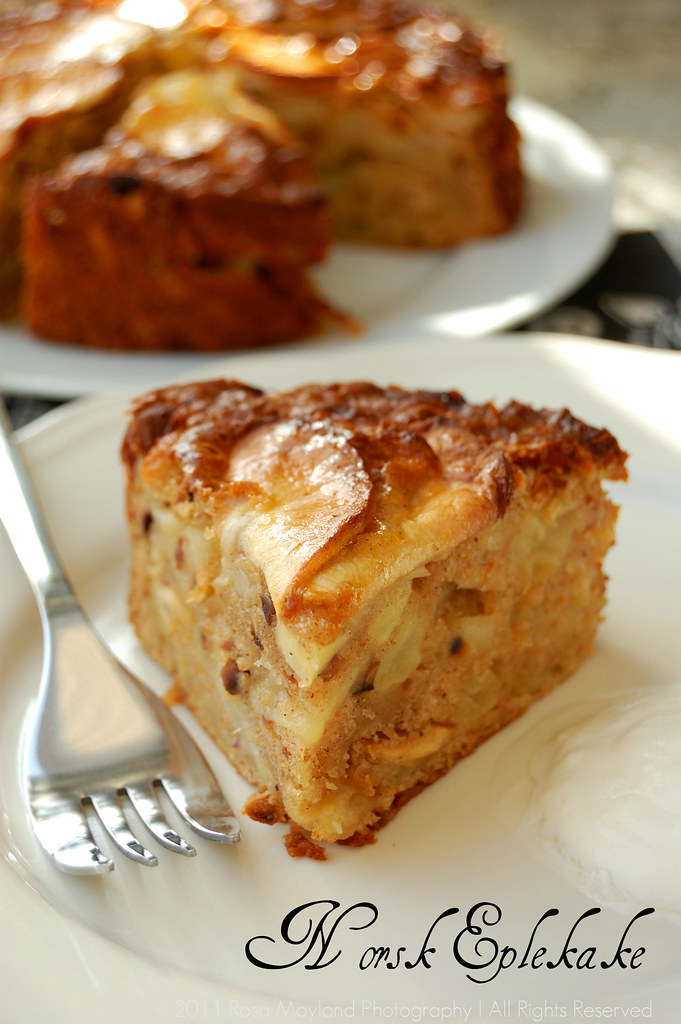
Today, I have decided to come back with an Autumn/Winter Norwegian apple delicacy that fits perfectly the season: "Eplepai". The name translates into "Apple Pie" in English, yet this speciality is rather a soft wettish cake than a shortcrust pastry-based dessert. 

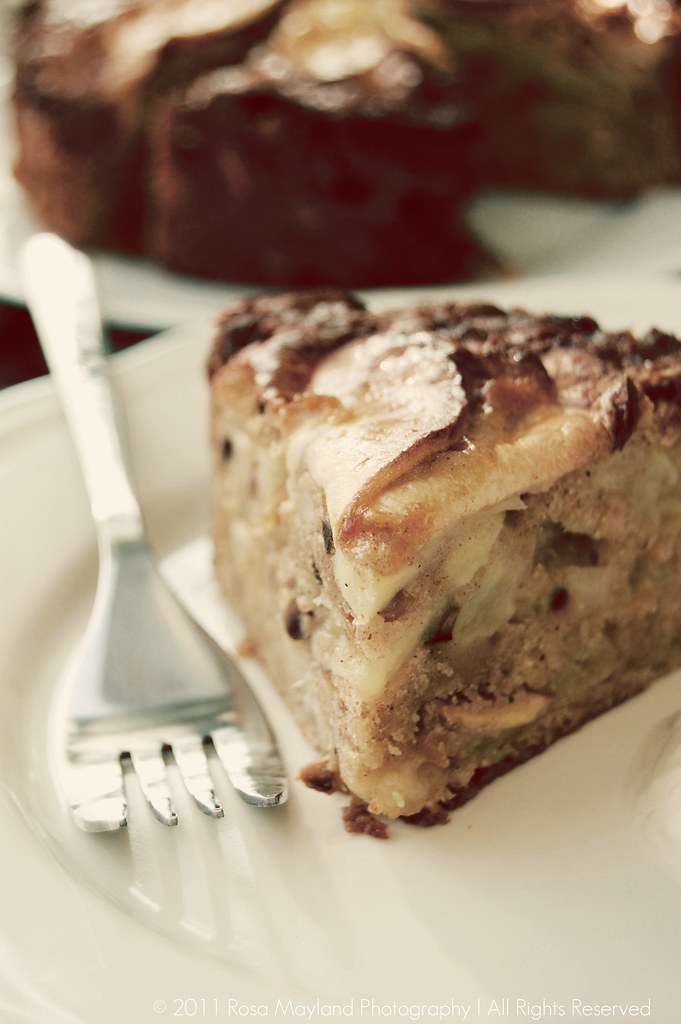
This Scandinavian goodie is ridiculously simple and fast to put together, nonetheless it is far from being characterless, boring or bland gustatively speaking. The warm spices pair admirably with the sweet tartness of the fruits and the toasted almonds add a gorgeously nutty note to the whole. A luscious and morish treat that is sticky, extra moist, super smooth in texture, mighty gratifying and somehow reminds me of pudding. Heavenly!

I have freely adapted the recipe from Beatrice Ojakangas' marvelous and highly recommended bestseller "The Great Scandinavian Baking Book". I operated a few small changes to it as I believed it could be slightly improved (not that it really needed any enhancement, though). My version uses ground cardamom, vanilla extract and roasted almond sticks. An addition which doesn't alter the über-nordisk and preciously old-fashioned flavors of that succulent torte.

Apple Cake 9 bis
~ Norwegian Apple Cake ~
Recipe adapted from
Beatrice Ojakangas' "The Great Scandinavian Baking Book".

Ingredients:
1 Egg (63g)
2 Tbs Milk
3/4 Cup (158g) Castor sugar
1 Tsp Pure vanilla extract
1 Tsp Baking powder
1/3 Tsp Fine sea salt
1 Tsp Ground cinnamon
1/3 Tsp Ground cardamom
1 Cup + 2 Tbs (158g) All-purpose flour
1/2 Chopped almonds/or almond sticks (50g), toasted
3 Medium-sized tart apples

Directions:
1. Preheat the oven to 180° C (350° F), line a 18cm (7-inch) springform cake pan with baking paper and then butter it.
2. Peal, core, and dice the apples.

Apple Cake 4 3 bis
3. Stir all the ingredients together (the mixture will be similar to that of muffins).
4. Spread into the pan.
5. Bake for 50-60 minutes, or until browned and a toothpick inserted in the center comes out clean.
6. After 1 minutes, run delicately a knife along the side of cake to loosen, then remove from the side of springform pan.
7. Place a cooling rack upside down over the cake. Turn rack and cake over. Remove the bottom as well as the baking paper of the springform pan. Place back on the rack.
8. Cool completely before serving.

Comments:
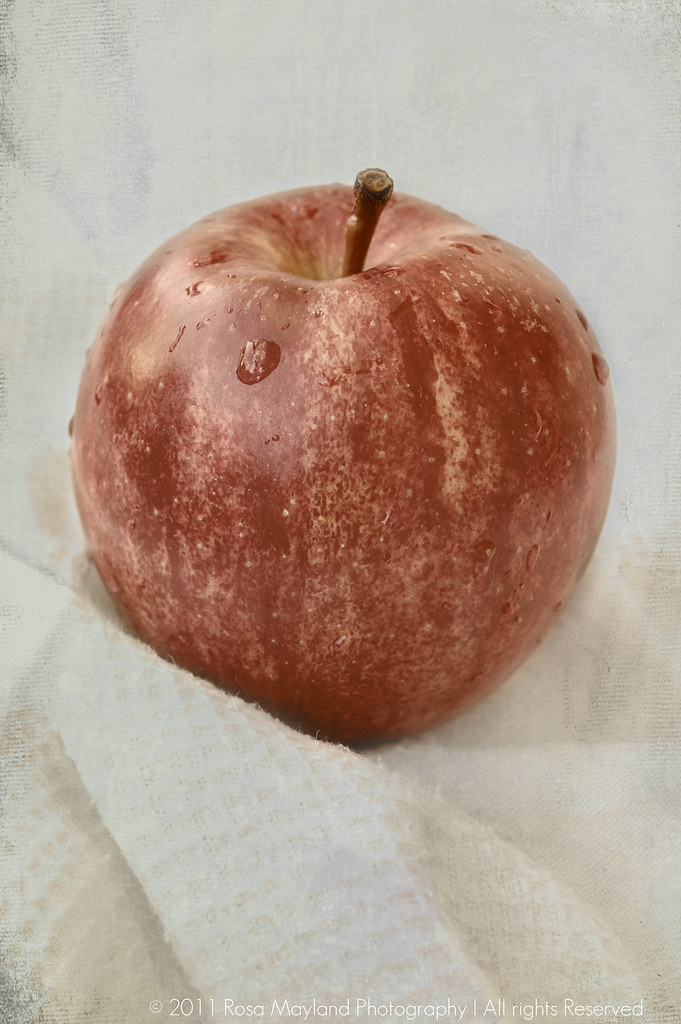
I used Belle de Boskoop apples (my favorite eating and baking apple) for this cake, but Bramley, Reine Des Reinettes, Braeburn, Granny Smith, Gravenstein apples, etc... are also ok.

Serving suggestions:
Cut into wedges and serve with either sweetened whipped cream, sweetened thick yogurt or ice cream.

~~~~~~~~~~~~~~~~~~~~~

Apple Cake 13 bis~ Gâteau Norvégien Aux Pommes ~
Recette adaptée du livre "The Great Scandinavian Baking Book" de Béatrice Ojakangas.

Ingrédients:
1 Oeuf (63g)
2 CS de Lait
158g
de Sucre cristallisé
1 CC d'Extrait de
vanille pure
1 CC de Poudre à lever/pâte
1/3 de CC de Sel de mer fin
1 CC de Cannelle en poudre
1/3 CC de Cardamome en poudre
158g de Farine
50g
d'Amandes hachées, torréfiées
3
Pommes (moyennes) acidulées

Méthode:

1. Préchauffer le four à 180 ° C (350 ° F), recouvrir le fond d'un moule à charnière de 18cm avec du papier sulfurisé et le beurrer.
2. Peler les pommes, les nettoyer et les couper en dés.


Apple Cake 5 1 bis

3. Mélanger tous les ingrédients ensemble (le mélange sera épais, mais tout de même légèrement coulant, comme une pâte à muffin).
4. Étaler la pâte dans le moule.

5. Cuire au four pendant 50-60 minutes ou jusqu'à ce que le cake soit doré et qu'un cure-dent inséré au centre en ressorte propre.
6. Dix minutes après avoir sorti le cake du four, passer un couteau le long des côtés du gâteau, puis déserrer et retirer le moule à charnière.
7. Enlever le fond du moule ainsi que le papier sulfurisé.
8. Laisser refroidir complètement avant de servir.

Commentaires:
J'ai utilisé des pommes Boskoop (mes pommes à manger et à cuire préférées) pour ce gâteau, mais les pommes reine des reinettes, braeburn, granny smith, gravenstein, etc .. feront également l'affaire.

Idées de présentation:
Couper en tranches et servir soit avec la crème chantilly, du yaourt grecque sucré ou de la glace.


Apple Cake 11 2 bis

Friday, September 23, 2011

SPICY DAMSON PLUM ROLY-POLY

Plum Roly-Poly 2 bis bis bis bis 2 bis
"Summer fades; the first cold, Northern air
Sweeps, like hatred, through still days -
The August heat now gone elsewhere,
To Southern, bird-filled coasts and bays;
Amid constricting vales of cloud,
A pale and liquid Autumn sun
That once beat down on an empty plain
And may again. And may again."
- Trever Howard, Autum
Recently, I have been in a very nostalgic and morose state of mind. No matter how much I love autumn and look forward to cooler weather, seasonal mood swings always tend to affect me strongly every year when the summer ends. I guess it is something natural/biologic which each of us experience to a certain degree. This time though, blahs hit me a little harder than usual and I guess this is partly beacause last week, on the 13th of September, my English grandmother would have celebrated her 85th birthday, that is if she had not passed away last March...

Usually, on that occasion I reached for the telephone, lifted up the receiver, composed her number, wished her a wonderful day and had a pleasant chat with her. Instead, there was no one to call and my day was rather eerie. A strange sensation of emptiness filled me. It is terrible how the deceased leave a void in our lives and hearts. An entire chapter of our existence gets closed forever and it is impossible to press the rewind button. By disappearing our loved ones take many information, memories and secrets to the grave.

" Loss is nothing else but change, and change is Nature's delight."
- Marc Aurelius
As we grow older, we learn to face the harsh reality of life. We are forced to see our heart get shattered in thousand pieces, make extremely difficult decisions, stand for ourselves, accept the fact that our dreams might never come true, start being more cynical and stop fantacizing too much, otherwise the sad and distressing events that we have to face as adults would just annihilate us if we were not a little prepared to suffer or get deceived. This is why we'd better be resilient and accept things as they are.

Well, eventhough I have embraced the fact that not everything in our existence if fair, acceptable or wanted, my first biggest regret as a grownup
is to not have been able to
go to visit granny for the last 13 years, to really have had the opportunity to get to know her better and get to pierce her carapace, to share some quality time together as equals and to show her the woman I have become (the last time we met, I was still living at home and had just stepped out of my adolescence).

Lack of bonding, money issues, weak kinship and limited communication made it very difficult for me to travel all the way to Derbyshire. My grandmother always asked me when I was going to come over to England, yet when I explained her that I was jobless and didn't have one dime in order to buy a plane ticket, I never got a response or reaction from her. Not one single answer, just silence. Eloquent silence that was worth a thousand words...

Anyway, even if I doubt she loved me as much as I loved her or cared for me as much as I cared for her, I nonetheless was extremely fond of my granny and revered her extraordinary culinary talents. Yet, never would I be capable of nourishing any form of resentment towards her as
I am quite aware that people who were born at the beginning of the last century were brought up in an austere fashion and are not accustomed to exteriorizing their sentiments as well as emotions. It was quite taboo then, hence they are just sentimentally handicapped. This is what leads me to believe that somewhere deep inside of her, she had a well-hidden soft spot for me. So, to make peace with the past and to come to terms with my afflictions, I forgive her for having been imperfect relationship-wise and for not having given me the love I craved/needed.

Red fruits 1 2 bis
Having been missing my second country, Great Britain, and Nana a lot lately, I decided to bake a "Jam Roly-Poly" to soothe my aching soul. During our stay in this land of rich history, ancient cities, captivating legends, green landscapes, ethereal atmospheres and homey food, my grandma rarely failed to regale us with this humble and comforting speciality. It is the reason why I invariably associate this treat with this beautiful country and this branch of my family.

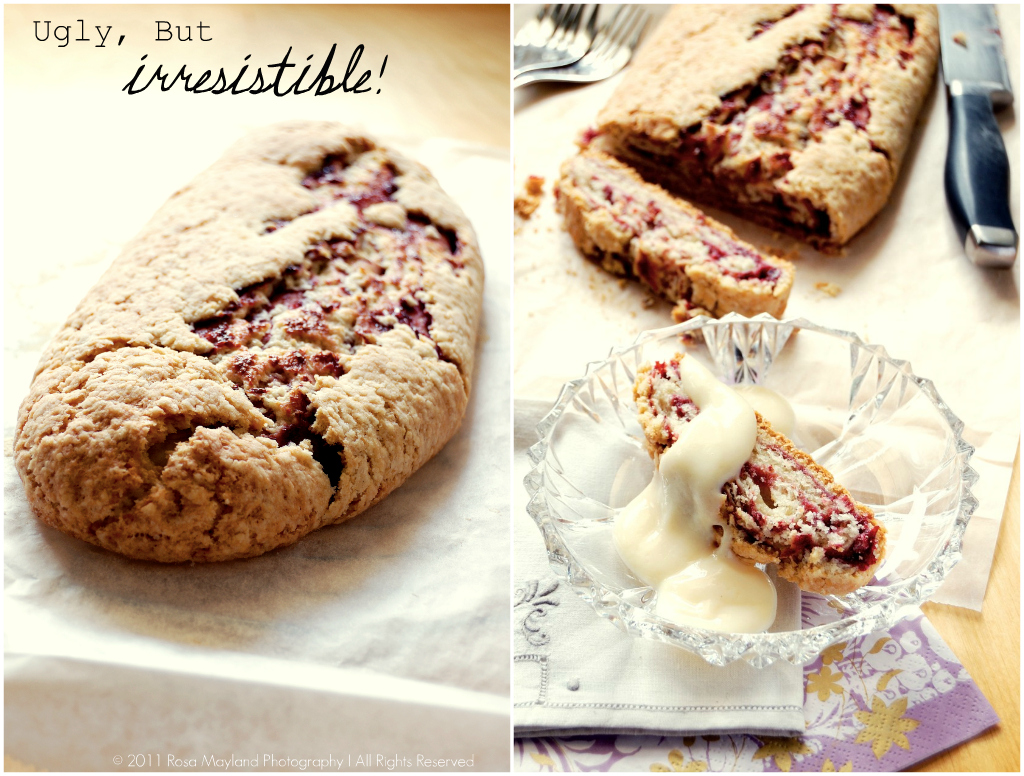
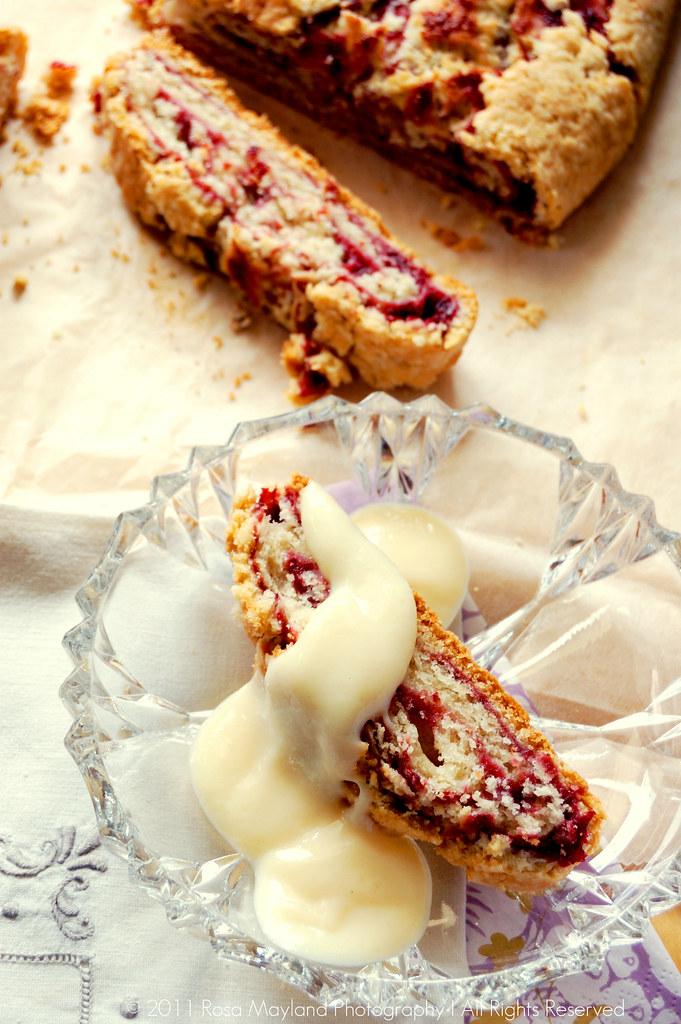
"Jam Roly-Poly" (also less glamorously called "Dead Man's Arm", "Dead Man's Leg" or "Shirt Sleeve Pudding") is a traditional British pudding which was invented in the 1800's and which is composed of suet pastry and jam (generally raspberry or strawberry jam). It is a kind of rustic, flattish and ugly version of "Swiss Roll". Originally, it was steamed, but nowadays it is mostly baked.

Suet pastry is one of the most English of all pastries. As a matter of fact, it is used in a large variety of dishes such as puddings, dumplings and pies. As it is made with the rendered fat of either lamb, beef or pork, suet-based doughs are definitely not suitable for vegetarians. Since this sort of fat imparts an incomparably amazing and "meaty" flavor to baked goods, it is unfortunately quite difficult to find many animal-free substitutes for it. Coconut butter is the only one I can think of...

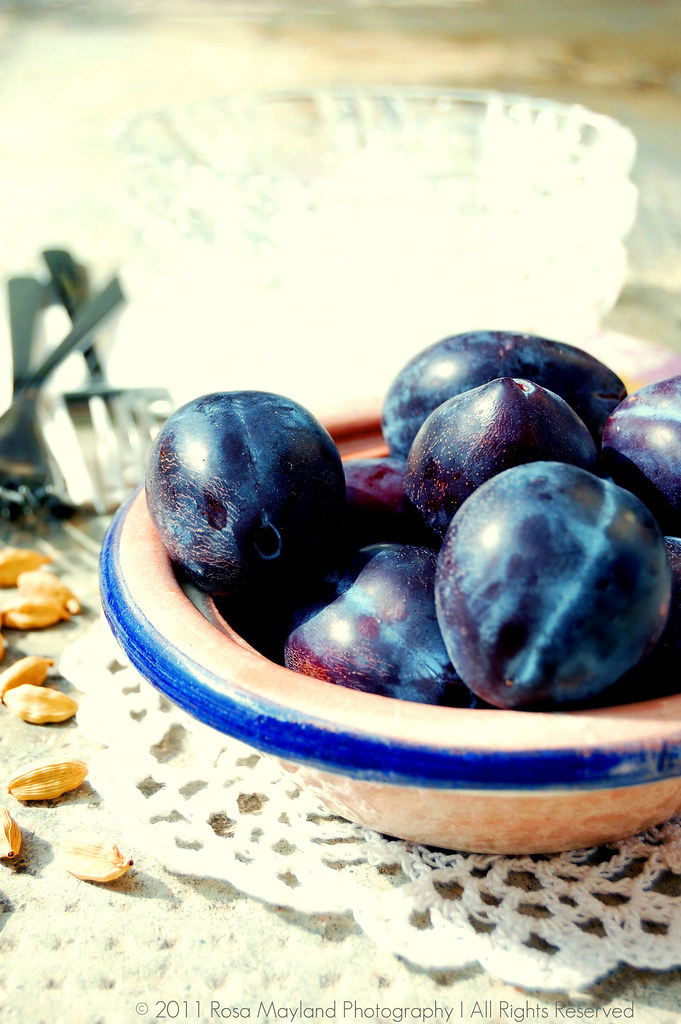
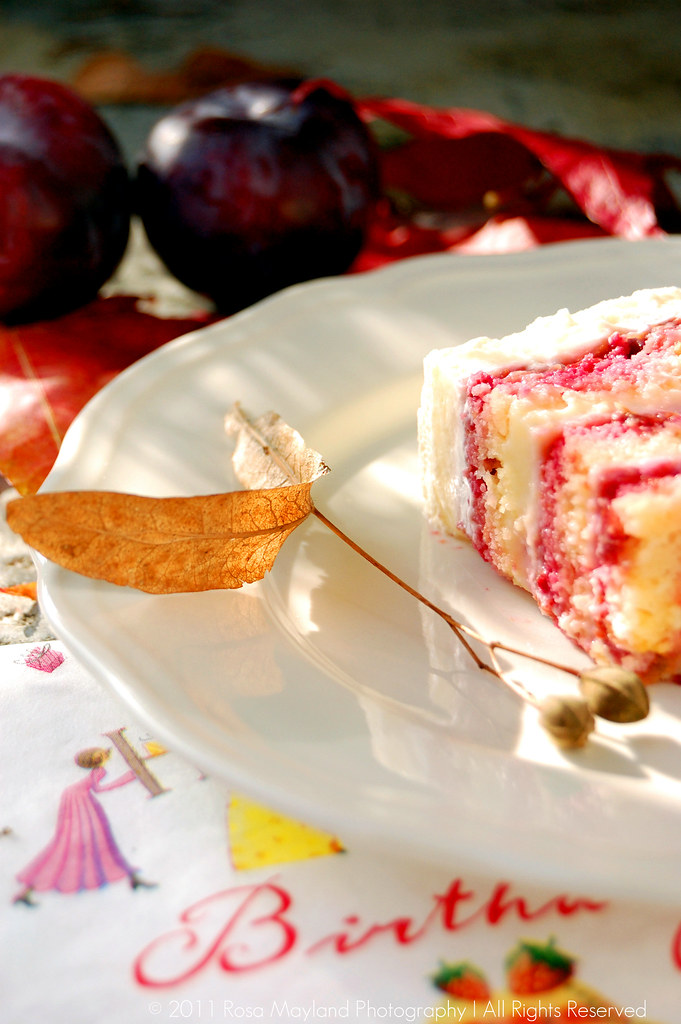
So, instead of making a straight-forward "Jam Roly-Poly" I opted for preparing a spicy version of that good old-fashioned pud. To the pastry, I incorporated cardamom powder and I replaced the usual cloying raspberry/strawberry jam (I love those berries, but dislike them when they are transformed into jam), by damson plum (or Italian plum) compote (less sweet and boring) that I flavored with orange peel. Those additions give some dimension and modernity to this dessert, thus bringing it forth into the 21st century.

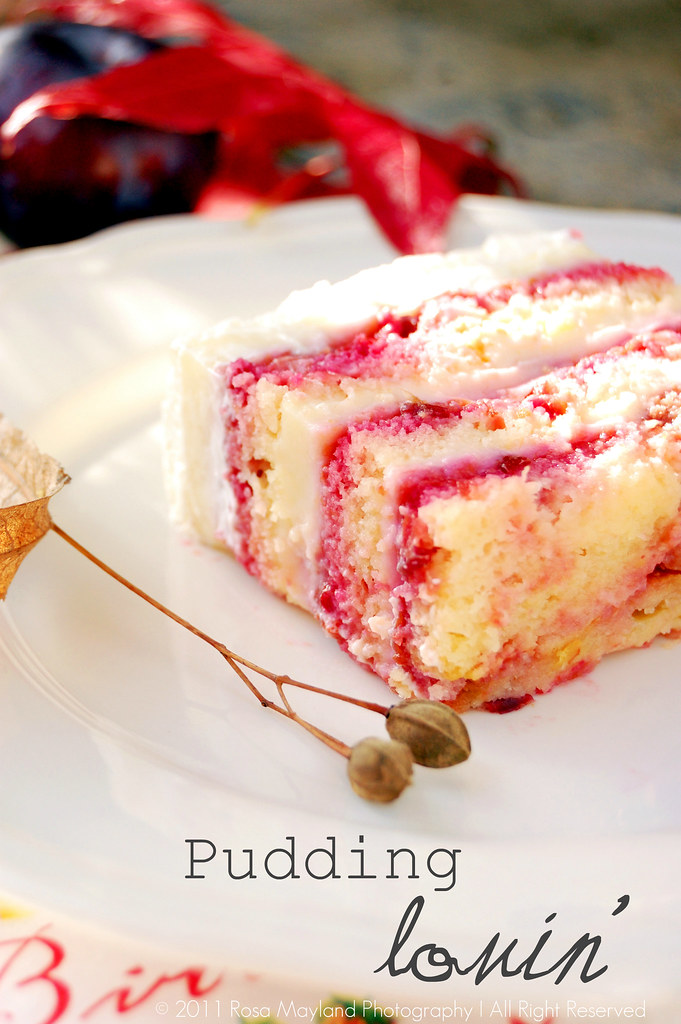
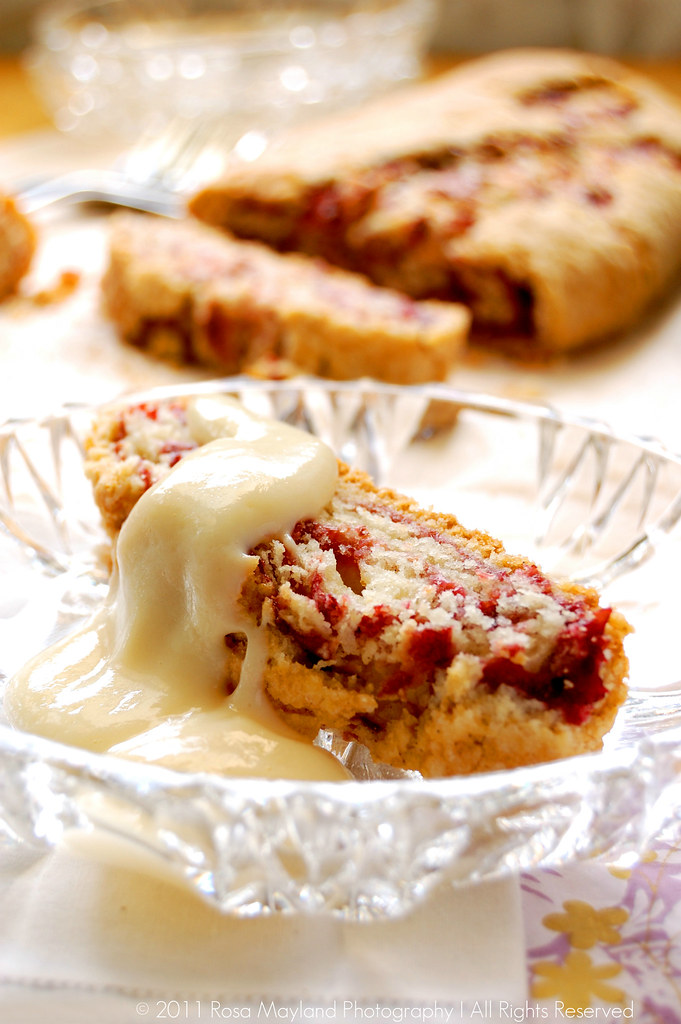
My "Spicy Damson Plum Roly-Poly" might not be the prettiest or most photogenic (I had problems shooting it and nearly lost my temper trying to make it look presentable - I am definitely not a prop artist) of puddings, but it doesn't really matter as what counts is its taste which is simply certainly not devoid of oomph. The pastry is crisp and flaky on the outside and smooth, fluffy as well as slightly moist on the inside. The compote adds an extra welcome wetness to the goodie and the spices confer a divinely heady fragrance to the whole.

Plum Roly-Poly Collage
~ Spicy Damson Plum Roly-Poly ~
Recipe by Rosa Mayland, September 2011.

Serves 4.

Ingredients:
250g Flour, plus extra for dusting
1 1/2 Tsp Baking powder
60g Castor sugar
A pinch sea salt
1/2 Tsp Ground cardamom
115g Suet (Pork)
, very cold
120ml Full fat milk

6 Tbs (90g) Damson compote (or jam)
6g Orange zest
Custard sauce, to serve (recipe here)

Directions:
1. Preheat the oven to 180° C (350° F).
2. Cover a baking pan with baking paper.
3. In a medium bowl, mix the flour together with the baking powder, sugar, salt and cardamom.
4. Add the suet and cut it into the flour mixture.
5. Then, bind with the milk in order to obtain a soft, but not sticky pastry.
Gather together into a ball, but don't overwork otherwise it will get tough.

Mairie Veyrier 1 8 bis
6. On a lightly floured work surface, roll the dough into a rectangle about 23cm x 32cm.
7. Spread with the damson compote, making sure you leave a 2cm border all around the edge and sprinkle with the orange zest.
8. Moisten the borders with either cold water or milk.
9. Roll into a tightish cylinder or sausage shape, starting with one short end (23cm).
10. Pinch the ends to seal in the jam.
11. Lay the roll in the centre of the baking paper, making sure the seal is underneath.

12. Bake for 45-50 minutes, or until the roly-poly is golden brown.
13. Let it rest for about 5 minutes before serving.

Comments:
If you don't want to use pork suet, then you can either replace it by coconut butter (vegetarian), cold beef or duck fat (kosher/halal).
By letting the roly-poly rest for 5 minutes, you ensure the jam to not come oozing out of the roll when you cut it.


Serving suggestions:
Eat warm with a dollop of warm custard sauce.

~~~~~~~~~~~~~~~~~~~~~~

Plum Roly-Poly 4 1 bis
~ Roly-Poly Epicé A La Compote De Quetsches ~
Recette par Rosa Mayland, Septembre 2011.

Pour 4 personnes.

Ingrédients:
250g de Farine. plus un peu pour saupoudrer le plan de travail
1 1/2 CC de Poudre à lever
60g de Sucre cristallisé
1 Pincée de Sel de mer fin
1/2 de CC de Cardamome en poudre
115g de Saindoux
, très froid
120ml de Lait entier

6 CS (90g) de Compote de quetsches (ou de confiture)
6g de Zeste d'orange
Crème anglaise/custard, pour servir (recette ici)

Méthode:
1. Préchauffer le four à 180° C.
2. Recouvrir une plaque de cuisson avec du papier sulfurisé.
3. Dans un bol moyen, mélanger la farine avec la poudre à lever, le sucre, le sel et la c
ardamome.
4. Ajouter le saindoux. F
rotter la farine et le beurre entre les doigts afin d'obtenir un mélange qui ait la texture sabloneuse.
5. Incorporer le lait afin d'obtenir une pâte souple, mais pas collante. Ne pas trop pétrir autrement votre pâte sera dure. Former une boule.

Plum Roly-Poly 1 1 bis tagged
6. Sur une surface enfarinée, rouler la pâte en un rectangle de 23cm x 32cm.
7. Etaler la compote de quetsches en laissant 2cm de pâte non couverte sur tout le pourtour et saupouder avec le zeste d'orange.
8. Humidifier les bords non-recouverts avec de l'eau ou du lait.
9. Rouler la pâte (en commençant par l'un des côtés étroits - 23cm) afin d'obtenir un
rouleau assez serré (pas trop tout de même).
10. Pincer les bouts afin de les refermer.
11. Poser le roulé au centre de votre plaque en faisant attention à ce que le joint soit en-dessous.
12. Cuire pendant 45-50 minutes, jusqu'à ce que le roly-poly soit légèrement doré.
1
3. Laisser refroidir pendant 5 minutes avant de servir.

Remarques:
Le saindoux peut-être remplacé par du beurre de noix de coco (version végétarienne), de la graisse de boeuf ou canard (froide/dure - version kosher ou halal)
Si vous laissez le roly-poly reposer pendant 5 minutes, la compote ne coulera pas hors du roulé lorsque vous le couperez.


Idées de présentation:
Servir chaud avec de la crème anglaise.

Garden Tree 1 1 bis