Showing posts with label Pastry Cream. Show all posts

Friday, March 16, 2012

CHERRY DELIGHTS - DÉLICES A LA CERISE

Cherry Shots 4 3 bis
He appears your friend, but
the Saint hides many Satans
He's contemptuous, you know
of your Godgiven stupidities
He calls you in question with
affected modesty and create
of you an object of derision [...]
- Except taken from the song "Master In Disguise" by Arcturus (Nor)
The weather is a devil in disguise which always manages to surprise us and never fails to be temperamental as well as unpredictable just like a tyrinnical diva. Generally, it's either all or nothing. One day you think that you are living in frostbitten Siberia and the next you'd get tricked into believing that you are residing in the sunny Mediterranean.

A few weeks ago, Europe was still being brushed by a coldwave that froze everything to the core. One had the impression that the North Pole had shifted to our latitudes. Then it was followed by a short interval of chilly, but decent late winter climate which gave way to extremely mild conditions, comparable to that of the end of April. Within a fortnight, the temperatures jumped up dramatically and we experienced an increase of about 30° C (86° f - from minus 14° C to 18° C). Incredible!

Now, it really feels like spring. The air has a distinctive metallic and marine odor similar to that you smell when boats are sitting in the summer heat, daylight lasts longer, primroses and snowdrops are starting to blossom in a parasitic manner, green shoots are appearing between the dead leaves, buds are getting fat and ready to explode, woodpeckers drill trees madly, in the morning and evening black birds sing loud enough to wake up the whole neighborhood, noisy and agitated flocks of crows circle menacingly overhead, cats fight like old rags and people are suddenly more optimistic than ever.
Springtime is the land awakening.
The March winds are the morning yawn.
- Lewis Grizzard

Spring is sooner recognized by plants than by men.
- Chinese Proverb

It was one of those March days when the sun shines hot and the wind blows cold:  when it is summer in the light, and winter in the shade.
- Charles Dickens
When you go out, you are greeted by a symphony of chirps and the warm rays of the sunshine on your pale and shy skin. Every place is bustling with activity. Joggers are doing their rounds, terrace cafés are alarmingly cacaphonous, the streets are bustling with dashing passer-bys and animals are busy getting ready for the birthing season.

Those drastic changes can be quite mind-boggling and tiring as your brain and body are having a hard time adapting to this abrupt transition. After having dressed up like the Michelin man for the last 4 months and eaten your good share of comfort foods without being upset about the calories you ingested, you are now having difficulties knowing what to put on as you are not ready to shed off your thick layer of reassuring clothes in order to reveal your dismally flabby belly, untoned legs and pudgy arms (please be reassured, I am exagerating for the sake of entertainment) .

What a shock! The disastrous vision of your unfit self is not a pleasant thing to aknowledge and suddenly, with sheer terror you realise how much you allowed yourself to become a little too lazy and careless.

So, even if you don't care about all this propaganda about being skinny and believe that healthy women should have curves in the right places, you nonetheless start panicking and feeling desperate and guilty as you wish you had not sat so much in front of your favorite series, hibernated like a big fat grizzly bear or gobbled all those gorgeously soul-uplifting calories during the entire duration of the winter.

Why did you enjoy so many rich meals and not exercise more? You ask yourself the same question over and over, and you can't stop blaming yourself for having given in to laxity. However you are not somebody who endless laments herself over her, thus you decide to take action and begin elaborating plans in order to regain control over your slack lifestyle...

 
Cherry Shots Village Entry 1 6 bis
Going through such phases is quite normal as it is in our nature to need to cocoon and raise our spirits with soothing grub when the climate is unfriendly. If we overdieted and did not take a moment to breathe as well as to slow down once in a while, we'd end up being malnourished, depressed and totally drained of our energy as we'd act against what our organism dictates us to do. We all have to accept that there are periods during which we have no other choice than to follow our instincts and listen to what our physical system tells us.
Take care of your body. It's the only place you have to live.
- Jim Rohn
The body too has its rights; and it will have them: they cannot be trampled on without peril. The body ought to be the soul's best friend.
Many good men however have neglected to make it such: so it has become a fiend and has plagued them.
- Augustus William Hare and Julius Charles Hare, Guesses at Truth, by Two Brothers, 1827
Of course, whatever you do, you must never forget that any excess is dangerous and that you should privilege harmony over debauchery or overdiscipline. For that reason, I try to not dramatize the fact that my trousers are ever so slightly tighter, because I know that I haven't done anything terribly wrong and that I will soon be able to lose the extra grams I have gained lately. Nothing tragic here.

Spring is synonymous of rebirth, awakening as well as lightness and thankfully, it forces us to wake up and alter our behavior. That cosmic metamorphosis influences us greatly and consequently we go through some kind of natural reprogramming before the summer arrives. With the arrival of February, we begin to crave food that is less fat and heavy and we look forward to going for walks and getting closer to nature again. 

Even if I didn't properly let myself go, the cold season had its toll on me and now that April is at our doorstep, I feel boosted with a new energy and reconnected with my mortal frame. At the moment, I yearn for fresh, refined, flour-free and fruity desserts.

Being a passionate cook/baker, I am graced with a flourishing imagination, hence I am rarely short of resourcefulness and constantly come up with terrific ideas that I successfully turn into reality (flops happen, but they are outnumbered by favorable outcomes).

The verrine recipe I am presenting today, was invented on the occasion of a friend's visit. As I know that she is not against reasonable indulging and is not enclined to swallow tons of  artery-clogging victuals, I decided to offer her a heavenly sweet treat that would not sit on her stomach after our banquetting on "Apple & Celeriac Soup" and  "Guinness Shepherd's Pie".

Recently, pastry cream and griottes in syrup have been quite often on the menu, so I thought that it would be wonderul to concoct a sweet pudding which would combine both and would emphasize the delights of cherries. This lead me to associating the flavors of sour cherries with that of mahleb.

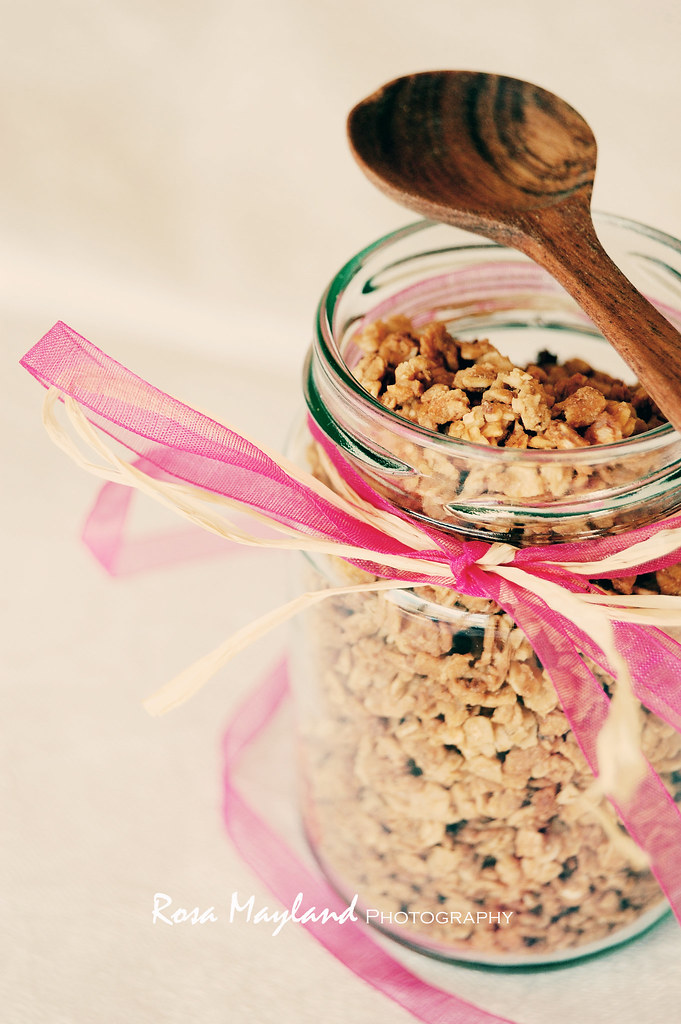
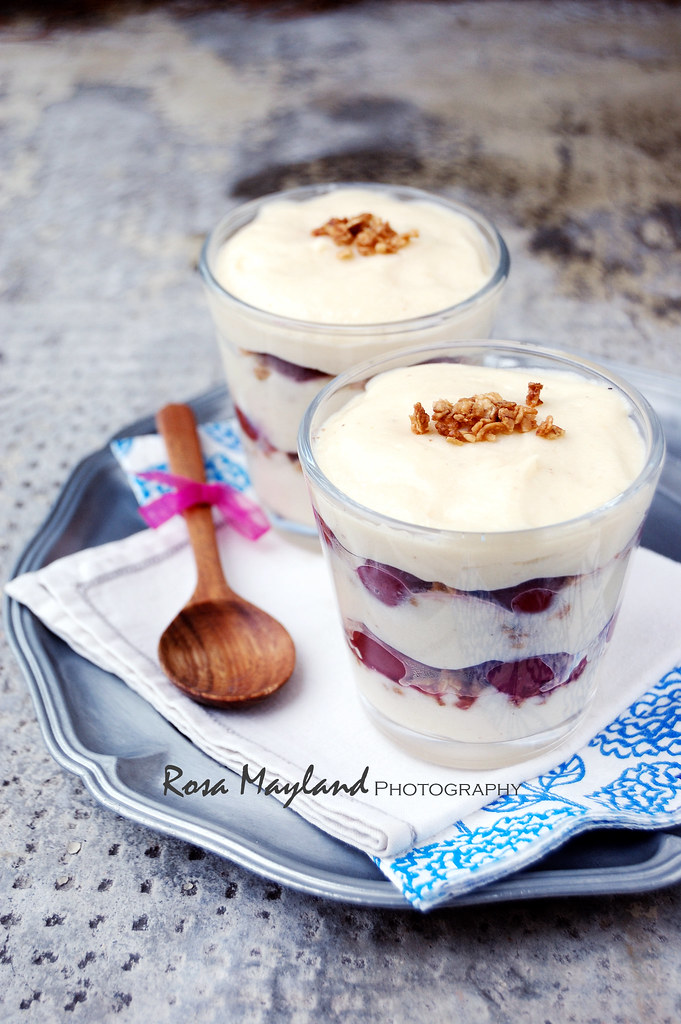
To accompany my fruits, I made a straight-forward crème pâtissière and incorporated a few teaspoons of this Middle-Eastern aromatic spice into it, then once the preparation was cold I folded in some whipped egg white in order to obtain a fluffy and delicate mousse consistency. To add a bit of crunch to the whole thing, I prepared a healthy granola with oats, honey, tahini and a spit of butter. Once everything was ready, I arranged those three components in alternating layers and presented them in pretty glasses.

As you can imagine, my "Cherry Delights" were a total winner and disappeared very fast. Seeing Corinne and P. gobble them greedily brought a smile on my face. There is no better reward than catching a glimpse of the people who you are close to you having a blast while savoring something you have lovingly made for them!

Cherry Shots 1 3 bis
~ Cherry Delights ~
Recipe by Rosa Mayland, March 2012

For 6 people/makes 6 verrines.

Ingredients For The "Granola":
3/4 Cup (90g) Quick cooking oats
3 Tbs Runny honey
1 Tbs Tahini
1 Tbs Unsalted butter
Ingredients For The "Pastry Cream Mousse":
2 1/4 Cups (540ml) Whole milk

2 Tsp Mahleb
1/3 Tsp Fine sea salt
4 Tbs Cornstarch
1/2 Cup + 1 Tbs (125g) Castor sugar
2 Eggs (~ 63g)
1 Egg yolk
1 Tsp Pure vanilla extract
4 Tbs Unsalted butter, cut into small cubes
1 Egg white
2 Tbs Powder sugar, sifted
Ingredients For "Assembling":
250g Stoned sour cherries/griottes (preserved in syrup), drained

Method For The "Granola":
1. Preheat the oven to 180° C.
2. In a pan, melt the butter, add the honey and tahini.
3. Add this mixture to the oats and combine well, making sure that the oats are coated with the liquid.
4. Spread on a tray covered with baking paper.
5. Bake for about 20-25 minutes, stirring every 5 minutes, until golden brown.
6. Let cool completely before using.

Method For The "Pastry Cream":
7. Put the milk, mahleb and salt in a pan, bring to a light boil.
8. In a large mixing bowl, whisk together the sugar, cornstarch,  2 eggs, 1 yolk and vanilla extract until smooth, fluffy and light/pale in color.
9. While constantly whisking, slowly pour the milk into the egg mixture.
10. Return the whole to the saucepan.
11. Over medium heat and while whisking non-stop, cook until you get a thick consistency (just bring to a slight boil).
12. Remove from heat and pour into a bowl. Let cool for 10 minutes and then incorporate the butter, a little at a time, until the pastry cream is smooth and shiny .
13. Cover the surface with clingplastic, directly touching the cream. Let cool completely.

14. Once the pastry cream is at room temperature, whisk it in order to make it smooth again.
15. Beat  the egg white until soft peaks form.
16. Add the  powdered sugar and continue beating until stiff peaks appear.
17. Incorporate delicately the egg whites to the pastry cream.
Method For "Assembling The Verrines":
18. Start filling the bottom of the glasses with about 2-3 Tbs pastry cream mousse, add about 1 1/2 Tbs granola and then the cherries (6-7).
19. Repeat the process once more and finish with an extra layer of pastry cream mousse.
20. Place in the fridge until ready to serve.
21. Just before serving, sprinkle with some of the leftover granola.

Comments:
If you don't have any mahleb, then add a little more vanilla extract to the pastry cream or a few drops almond extract.
You can replace the tahini by the same quantity of butter.

You can also make this dessert with fresh cherries (I recommend the darker variety).
Please note that I weighed the cherries once drained.

Serving suggestions:
Serve as dessert with some bubbly wine (Champagne, Clairette De Die or  Prosecco) or some quality Sauterne, Vin Santo, Gewürtzraminer, Amaretto or Maraschino.
Cherry Shots 3 3 bis
~ Délices A La Cerise ~
Recette par Rosa Mayland, mars 2012.

Pour 6 personnes/verrines.


Ingrédients Pour Le "Granola":  
90g de Flocons d'avoine
3 CS de Miel liquide
1 CS de Tahini
1 CS de Beurre non-salé
Ingrédients Pour La "Mousse De Crème Pâtissière":

540ml de Lait entier

2 CC de Mahlep
1/3 CC de Sel de mer fin
4 CS de Maïzena (fécule de maïs)
125g de Sucre cristallisé
2 Gros oeufs (~ 63g)
1 Jaune d'oeuf
1 CC d'Extrait de vanille pure
60g de Beurre non-salé, coupé en petits cubes

1 Blanc d'oeuf
2 CS de Sucre en poudre, tamisé
Ingrédients Pour Le "Montage":
250g de Griottes dénoyautées au sirop, égouttées

Méthode Pour Le "Granola":

1. Préchauffer le four à 180 ° C.
2. Dans une casserole, faire fondre le beurre, ajouter le miel et le tahini.
3. Ajouter ce mélange à l'avoine et bien mélanger. Faire en sorte que les flocons d'avoine soient recouverts par le liquide.
4. Étendre sur une plaque recouverte de papier sulfurisé.
5. Cuire au four pendant environ 20-25 minutes, en remuant toutes les 5 minutes.
6. Laisser refroidir complètement avant d'utiliser.


Cherry Shots Path 1 5 bis
Méthode Pour La "Mousse De Crème Pâtissière":
7. Mettre le lait, le mahlep et le sel dans une casserole, porter à ébullition (tout juste).
8. Dans un grand bol, battre ensemble le sucre, la fécule, les 2 oeufs, le jaune d'oeuf et la vanille jusqu'à ce le mélange soit pâle et mousseux.
9. Tout en fouettant constamment, verser lentement le lait dans le mélange (tempérage).
10. Verser l'ensemble dans la casserole.

11. À feu moyen et en fouettant en continu, faire cuire jusqu'à obtention une consistance épaisse, lisse et crémeuse.
12. Après ébullition, retirer du feu et versez dans un bol. Laisser refroidir pendant 10 minutes puis incorporer le beurre, un peu à la fois, jusqu'à ce que la crème pâtissière soit lisse et brillante.
13. Couvrir la surface avec du film plastique (toucher directement la crème pâtissière). Laisser refroidir complètement avant d'utiliser.

14. Une fois la crème pâtissière est à température ambiante, la fouetter afin de le rendre lisse.
15. Battre le blanc d'oeuf jusqu'à ce qu'il forme des pics mous.
16. Ajouter le sucre en poudre et continuer de battre jusqu'à formation de pics rigides.
17. Incorporer délicatement les blancs d'oeufs à la crème pâtissière.
Méthode Pour "Assemblage Les Verrines":
18. Commencer à remplir le fond des verres avec environ 2-3 cuillères à soupe de mousse de  crème pâtissière, ajouter environ 1 1/2 cuillères à soupe de granola, puis les cerises (6-7).
19. Répétez l'opération encore une fois et finir avec une couche supplémentaire de mousse de crème pâtissière.
20. Réserver les verrines au frigo jusqu'au moment de servir.
21. Juste avant de servir, saupoudrer avec le granola restant.
 

Commentaires:
Si vous n'avez pas de mahlep, vous pouvez incoporer un petit peu plus d'extrait de vanille ou quelques gouttes d'extrait d'amande
dans le lait pour la crème pâtissière.
Vous pouvez aussi remplacer le tahini par la même quantité de beurre.
Ce dessert peut aussi être préparé avec des cerises fraîches (je recommande d'utiliser des cerises foncées).
Faites bien attention d'utiliser 250g de griottes égouttés - na pas peser les cerises dans leur jus.

Suggestions d'accompagnement:

Servir en guise de dessert avec un verre de vin mousseux (Champagne, Clairette de Die ou Prosecco) ou de Sauterne, Vin Santo, Gewurtzraminer, d'Amaretto ou de Maraschino.


Cherry Shots 2 3 bis

Friday, December 2, 2011

DELUXE TRADITIONAL ENGLISH TRIFLE - TRIFLE ANGLAIS TRADITIONNEL


I am very proud to have British blood (Viking too, as England was invaded by the Danes and under the Danelaw for more than a century) running through my veins and therefore I have a strong attraction for the culture of my ancestors, hence if you are no stranger to my writings you must already know that I am an ardent and passionate defender of the cuisine of my country of origin as I believe that English food is highly underrated and still gets an undeserved as well as unfair bad rap (read this article)...
"There is no such thing as bad food/cuisine, only lousy cooks using low-grade ingredients and crappy recipes!"
- Rosa Mayland, 2011

"She did not so much cook as assassinate food."
- Storm Jameson (1891-1986)
I am totally certain that people's negative vision and quasi-xenophobic stereotyping of this astounding island's unique specialities comes from the fact that they haven't yet tasted the real deal and have only eaten unfortunate dishes that were very badly prepared by untalented and clueless "cooks". When you come across disgusting chew, remember that you must never blame the cooking customs of a country, but rather the one who has created such abominable grub. Therefore, it is unjust to judge the gastronomy of a place when you haven't fed on the right fares.
 
Believe it or not, in the past, Great Britain was avant-gardish and its culinary legacy used to have a good reputation, but regretfully certain recent events in history have damaged it considerably. For all those of you who smirk when they hear that and doubt this affirmation, it has to be said that ancient hearty, humble, scrumptious and more recent colonially-tinted British food has, in its time, inspired the rest of the world for many years. Did you know that the Anglo-Saxons developed meat and savoury herb stewing techniques before the practice became common in the rest of Europe, that the Norman conquest introduced exotic spices during the Middle Ages and that the British Empire facilitated a knowledge of India's elaborate kitchen traditions of pungent, penetrating spices and herbs? I'm pretty sure not. Well, that is a detail all haters and foulmouthed criticizers must be conscious of before they start bringing Brit cooking down in flames and spreading false propaganda.

"There is much deliciousness in the British Isles; you just have to find it..."
- Fergus Hendersen

In days of yore, the peninsula was influenced by foreign invaders like the Vikings (from Scandinavia, but especially from Danemark), the Romans (from Italy) and even the Franco-Normans (from France) who all brought with them a melting pot of ingredients and foods to the English table, and imported new cooking methods and ideas.


Thanks to the French asilants, medieval English cookery abunded with recipes containing exotic seasonings such as saffron, mace, nutmeg, pepper, ginger and sugar. Many traditional recipes are still made nowadays and this heritage can be found in many contemporary treats such as "Christmas Pudding", "Christmas Cake", "Hot Cross Buns", "Mince Pies", etc... Then, with the colonization of far-away regions of the globe by the Empire tea was imported from India and British citizens started getting obssessed by curries, condiments and spicy sauces which are now an integral part of the rich and impressive food culture of England. In addition, immigrant workers have massively contributed to expanding this land's culinary horizon. Open-mindedness, assimilation and intergration has always been part of this nation's characteristics and that is why the term "fusion" is not alien to its folks.


Unfortunately, much harm was inflicted on English gastronomy throughout the Industrial Revolution, WWI, WWII and poor economic eras (1970's especially).
During the 18th and 19th century, nobody had time to spend time in the kitchen and Britain was in the forefront of canned foods as well as other mechanical preservation methods. From 1914 until early into the 1950’s, little food was left for private consumption (rationing of meat, sugar, butter and eggs). As a result, the decline of quality produces and meals became flagrant. Sadly, it is then that Great Britain acquired its status as gastronomic joke worldwide.

"British food has not traditionally been regarded as one of the world's great cuisines, and yet Stilton cheese, Scottish raspberries, Goosnargh duck and Welsh lamb are internationally renowned and celebrated. And then there are all those dishes and recipes that inspire passionately loyaltly among the initiated: Whitby lemon buns and banoffi pie, for example; pan haggerty and Hendersen's relish. All are as integral of the country's landscape as green fields, rolling hills and rocky costaline."
- Andrew Webb, "Food Britannia"
Although England's period of culinary disgrace lasted long, the joke is finally starting to get forgotten. One can now witness an extraordinary comeback in popularity of British food and the world cannot stop speaking about the archipelago's magnificent regional produces, fine dishes, awesome chefs and renowned restaurants/gastropubs. This change of situation brings me happiness because I wish that more folks out there will be able to get initiated to the proper stuff and discover as well as appreciate what I have been treasuring all my life. Light has definitely to be made on this important part of England's patrimony. My dream is that others learn to enjoy and respect it as much as I do...

You've got to understand that I have been literally brought up on the finest English specialities (made by expert hands too) and everything that ever graced my plate has been a real feast for my taste buds and a total enchantment. My grandparents, their friends and my mother have never deceived me when it comes to being terrific home chefs and introducing me to Britain's best recipes. This is the reason why I cannot accept that certain mean and uneducated individuals continue to spread false rumors about a gastronomy they don't grasp/understand at all and have not experienced correctly (just because it is your opinion and you don't like certain dishes, doesn't mean that they are horrible or make a generality)!

So, today, I wish to share with you my personal recipe for "Trifle" as this  old-fashioned delight deserves all your attention, especially if it is put together with a lot of loving care and without speeding up steps or forgetting that quality must always rule in the kitchen.


This sweet course is very popular at the moment and it is not rare to see excellent recipes for it in overseas magazines or on international blogs. Most of the time I find them interesting and mouthwatering, but I must admit that I often feel a little frustrated as most of them are too simplistic, a pale copy and lazy interpretation of the original. Besides, it is still not rare to watch a TV programm ("Come Dine with Me" on Channel 4) and see somebody shamelessly offering their chokingly disgusting and terrifyingly industrial 1970 version of that classic (low-grade store-bought cake, custard from a can or a packet, additive-laden jelly, Spanish greenhouse-grown strawberries and whipped cream from a tube). A true disgrace!


For those who have not the slightest idea regarding what a "Trifle is, then here's a short explaination. The origin of the name can be traced back to 1596 and it refers to a sweet course - very similar to a "Fool" - made with thick cream flavored with sugar, ginger and rosewater. It is only sixty years later that milk was added and the custard was poured over alcohol-soaked leftover bread. From then on, it hasn't stopped evolving in order to become the pudding we are all accustomed to seeing these days. And contrarily to common belief, the inclusion of gelatin is not a recent variation. In reality, the earliest known recipe to include jelly dates from 1747.


Despite being quite a straight-forward interpretation of the original recipe, my "Deluxe Traditional English Trifle" is nonetheless a personal creation and is quirkier and more versatile than the typical layered pud served by your granny. Mine has no trace of that repulsively wobbly mass (I adore homemade jelly, but find it not to be a must in "Trifle" since it adds nothing much to it and generally is not liked by most munchers), abominable factory-made custard or
of any fertilizer-boosted fruits, the pound cake has been baked by myself (you could also use "Ladyfingers" or "Sponge Cake"), it is spiked with Port rather than Sherry, can be adapted to all seasons and contains some extra lemon juice as well as zest for more freshness, sharpness and piquantness. And finally, but not lastly, each of its components are homemade from scratch, so it is a top-notch delicacy. It is so refreshing, fruity, smooth, regressive, exquisite and addictive that I have converted my 100% Swiss boyfriend into a trifle-aholic like me...

Trifle 8 warmer CHOSEN bis
~ Deluxe Traditional English Trifle ~
Recipe by Rosa Mayland, November 2011.

Ingredients For The "Cakes":

85g (3oz) Unsalted butter, at room temperature
85g (3oz) Castor sugar
2 Eggs (~ 63g)
1 Tsp Pure vanilla extract
125g (4.5oz) All-purpose flour
1 Tsp Baking powder
1/4 Fine sea salt
3 Tbs Whole milk 
Ingredients For The "Pastry Cream":
2 1/4 Cups (540ml) Whole milk
1/3 Tsp Fine sea salt
4 Tbs Cornstarch
1/2 Cup (110g) Castor sugar
2 Big eggs (~ 70g)
1 1/2 Tsp Pure vanilla extract
4 Tbs Unsalted butter, cut in small cubes
Ingredients For "Assembling The Trifle":
2 1/4 - 1/2 Cups (810 - 900g) Fruit compote (see comments)
2 Lemond (organic)
1 Tbs Light brown sugar
Red Port, to taste
1 Cup (250ml) Double cream (35%), whipped
1/2 Cup (90g) Matchstick almonds, toasted

Trifle 1 3 bis

Method For The "Cakes":
1. Preheat the oven to 180° C (350° F), then grease two 3x6 inches rectangular cake tins and
line the bases with baking paper.
2. Mix together the sifted flour, baking powder and salt. Set aside.
3. Cream the butter and sugar together in a bowl until pale, light and fluffy.
4. Add the eggs, one at a time, beating the mixture well between each addition and a tablespoon of the flour with the last egg to prevent the mixture from curdling and separating. Then, mix in the vanilla extract.
5. Incorporate the flour mixture by gently folding it in the egg mixture and add enough milk to obtain a batter that falls reluctantly from the spoon.
6. Spoon the mixture into the prepared tins, level the top and bake for 30-35 minutes or until golden and a skewer inserted in the centre of each cake comes out clean.
7. Let cool in the pan for ten minutes before turning out on to a wire rack and leaving to cool completely.
Method For The "Pastry Cream":
1. Put the milk and salt in a pan, bring to a light boil.
2. In a large mixing bowl, whisk together the sugar, cornstarch, eggs and vanilla extract until smooth, fluffy and light in color.
3. While constantly whisking, slowly pour the milk into the egg mixture.
4. Return the whole to the saucepan.
5. Over medium heat and while whisking non-stop, cook until you get a thick consistency (just bring to a slight boil).
6. Remove from heat and pour into a bowl. Let cool for 10 minutes and then incorporate the butter, a little at a time, until the pastry cream is smooth and shiny .
7. Cover the surface with clingplastic, directly touching the cream. Let cool completely before placing in the refrigerator.

Trifle 3 1 bis

Method For "Assembling The Trifle":
1. Cut the cake into slices (0.5 - 0.8mm/0.2 - 0.3 inches) and whisk the pastry cream until smooth again. Set aside.
2. Zest both lemons and juice them, then mix the zest as well as juice together with the brown sugar. Set aside.
3. Put 1/3 of the cake in the bottom of the bowl. Pour 1/3 of the lemon juice mixture on to it and do the same with the Port.
4. Spread 1/3 of the compote over the cake, then spread 1/3 of the pastry cream over it.
5. Repeat steps 3 and 4 two more times and then top with the whipped cream.
6. Put into the fridge to chill.
7. Before serving, sprinkle with the toasted almonds.

Comments:
Of course, I am quite aware that the fruit sauce I used is not in season anymore, but be reassured, mine came from the stock I have in my freezer. It can easily be replaced by the puree of your choice (cranberry, apple, pear, orange, chestnut, etc…).
The cake can be made up to two days in advance and kept tightly wrapped in clingfilm or frozen for up to 3 months.
The pastry cream as well as the compote can also be made ahead and kept in the fridge for up to 5 days.
I recommend that you chill the trifle for at least 4 hours (overnight is even better) before serving as then the flavors can fully develop.
Keep the trifle in the refrigerator for up to 2 days.

Serving suggestions:
Serve for dessert with a good cup of strong coffee, a glass of liquor or sweet wine.

~~~~~~~~~~~~~~~~~~~~~~

Trifle 11 reworked copy cooler bis

~ Trifle Anglais Traditionnel Revisité ~
Recette Par Rosa Mayland Novembre 2011.

Ingrédients Pour Le "Gâteau":
85g de Beurre non-salé, à température ambiante
85g de Sucre cristallisé
1 CC d'Extrait de vanille pure
2 Oeufs (~ 63g)
125g de Farine
1 CC de Poudre à pâte/lever
1/4 de Sel de mer fin
3 CS de Lait entier
Ingrédients Pour La "Crème pâtissière":
540ml de Lait entier
1/3 CC de Sel de mer fin
4 CS de Maïzena (fécule de maïs)
110g de Sucre cristallisé
2 Gros oeufs (~ 70g)
1 1/2 CC d'Extrait de vanille pure
60g de Beurre non-salé, coupé en petits cubes
Ingrédients Pour "Assembler le Trifle":
810-900g de Compote de fruits (voir commentaires)
2 Citrons (bio)
1 CS de Sucre brun clair
Porto rouge, selon au goût
250ml de crème double, fouettée
90g d'Amandes allumettes, torréfiées

Trifle 2 4 bis

Méthode Pour le «gâteau»:
1. Préchauffer le four à 180 ° C (350 ° F), puis beurrer 2 moules à cake rectangulaires de 8x15cm et recouvrir les fonds de papier sulfurisé.
2. Mélanger ensemble la farine tamisée, la poudre à pâte et le sel. Réserver.
3. Dans un bol moyen, battre le beurre et le sucre en pommade (le mélange doit être pâle et léger).
4. Ajouter les oeufs, un à un, en les incorporant complétement après chaque ajout. Ajouter une cuillère à soupe de farine avec le dernier œuf afin d'éviter que le mélange se sépare, puis incorporer l'estrait de vanille.
5. Incorporer la farine en pliant délicatement et ajouter assez de lait afin d'obtenir une pâte qui tombe de la cuillère (mais qui n'est pas liquide - telle une pâte à gâteau ordinaire).
6. Répartir la pâte également dans les moules, lisser et cuire cuire pendant 30-35 minutes ou jusqu'à ce que les gâteaux soient dorés et que la lame d'un couteau insérée en leur centre en ressorte propre.
7. Laisser refroidir dans les moules pendant dix minutes avant de démouler. Laisser refroidir sur un grille.
Méthode pour la "Crème pâtissière":
1. Mettre le lait et le sel dans une casserole, porter à ébullition (tout juste).
2. Dans un grand bol, battre ensemble le sucre, la fécule, les oeufs et la vanille jusqu'à ce le mélange soit pâle et mousseux.
3. Tout en fouettant constamment, verser lentement le lait dans le mélange (tempérage).
4. Verser l'ensemble dans la casserole.
5. À feu moyen et en fouettant en continu, faire cuire jusqu'à obtention une consistance épaisse, lisse et crémeuse.
6. Après ébullition, retirer du feu et versez dans un bol. Laisser refroidir pendant 10 minutes puis incorporer le beurre, un peu à la fois, jusqu'à ce que la crème pâtissière soit lisse et brillante.
7. Couvrir la surface avec du film plastique (toucher directement la crème pâtissière). Laisser refroidir complètement avant de placer dans le réfrigérateur.

Trifle 10 warmer bis

Méthode Pour "Assembler Le Trifle":
1. Couper les gâteaux en tranches de 0.6-0.8mm et fouetter la crème pâtissière jusqu'à obtention d'une consistance lisse. Mettre de côté.
2. Prélever le zeste des deux citrons et les presser, puis mélanger le zeste et le jus avec le sucre brun. Mettre de côté.
3. Mettre 1/3 des tranches dans le fond du bol. Mouiller avec 1/3 du jus de citron et de faire la même chose avec le porto.
4. Étaler 1/3 de la compote sur les tranches de cake, puis étaler 1/3 de la crème pâtissière sur cette dernière.
5. Répétez les étapes 3 et 4 encore deux fois, puis décorer le dessus du trifle avec la crème fouettée.
6. Mettre au réfrigérateur.
7. Avant de servir, saupoudrer avec les amandes.

Commentaires:

Les prunes ne sont plus de saison (j'avais préparé cette recette lorsqu'ils était encore de saison), mais vous pouvez remplacer cette compote par la compote de votre choix (pommes, poires, cranberries, orange, châtaignes, etc...).
Les gâteaux peuvent être faits 2 jours à l'avance et enveloppés dans un film plastique ou congelés (maximum 3 mois).
La crème pâtissière ainsi que la compote peuvent également être préparées à l'avance et conservées au réfrigérateur pendant 5 jours maximum.
Je vous recommande de réfrigérer le trifle pendant au moins 4 heures (c'est encore meilleur après une nuit au réfrigérateur) avant de servir car de cette manière les saveurs peuvent se développer complètement.
Conserver pas plus de 2 jours au frigo.

Idées de présentation:
Servir pour le dessert avec une bonne tasse de café, un verre de liqueur ou de vin liquoureux.

Trifle 5 2 bis

Thursday, May 27, 2010

CROQUEMBOUCHE - THE DARING BAKERS


When seeing the date on my calender, I had to curse. I could not believe that in less than a day it would be the 27th of May and that all members of the Daring Bakers' would be blogging about their latest creation, yet I still had not started making this month's challenge. Once again, I did not manage to start baking in advance for the event and had to run at the last minute in order to be able to blog about it on time. I cannot believe that the 27th has already arrived...

The May 2010 Daring Bakers’ challenge wa
s hosted by Cat of "Little Miss Cupcake". Cat challenged everyone to make a "Piece Montée", or "Croquembouche", based on recipes from Peter Kump’s Baking School in Manhattan and Nick Malgieri.

Well, to tell you the truth, for this very challenge I was not the least stressed by the work that was awaiting nor apprehensive about the idea of putting together a "Pièce Montée" because making choux pastry (remember my DB post about "Chocolate Éclairs"), pastry cream or caramel was nothing new to me. Most Daring Bakers members have already made one or the other during the course of the last months.

I thought to myself "Finely, this recipe is not going to cause any trouble". Well, as incredible as it might seem
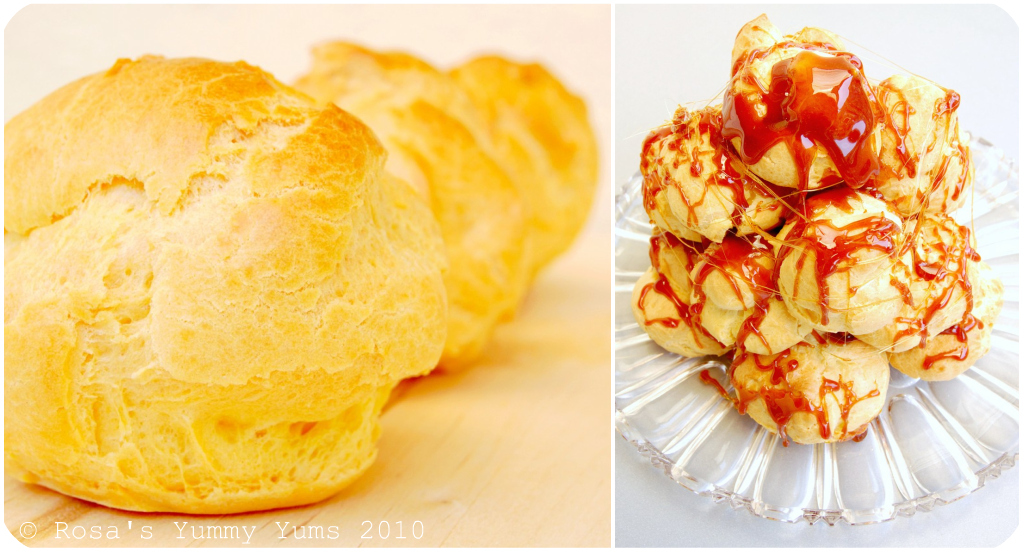
, I did come across a very annoying problem while making my cream puff shells. My first batch was a total flop. The cream puff shells looked so sad and were flat like omelets. this made me slightly panick and question my capacities as a baker. it was one of those moments when you lose all self-confidence and blame yourself for the bad results. I mean, boy were they fugly and totally unusable!

After doing a little research, I realized that if they had this saggy shape it was due to the
fact that the pastry was far too wet. So, for my second attempt at making cream puff shells I decided to use smaller eggs (53g instead of 63g), thus incorporating less liquid to the choux pastry. My second batch was just perfect. The cream puff shells came out all puffy and looked very pretty. Phew!

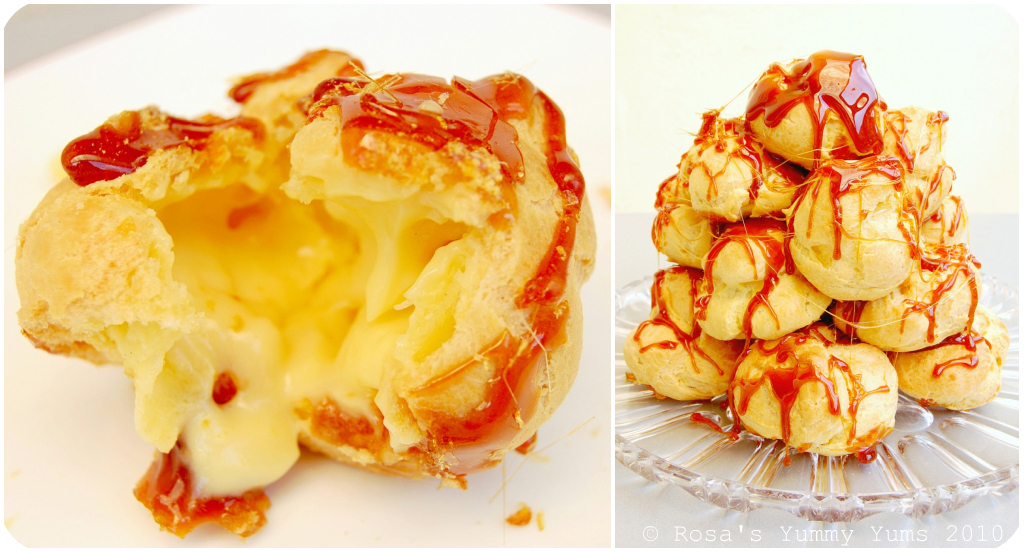
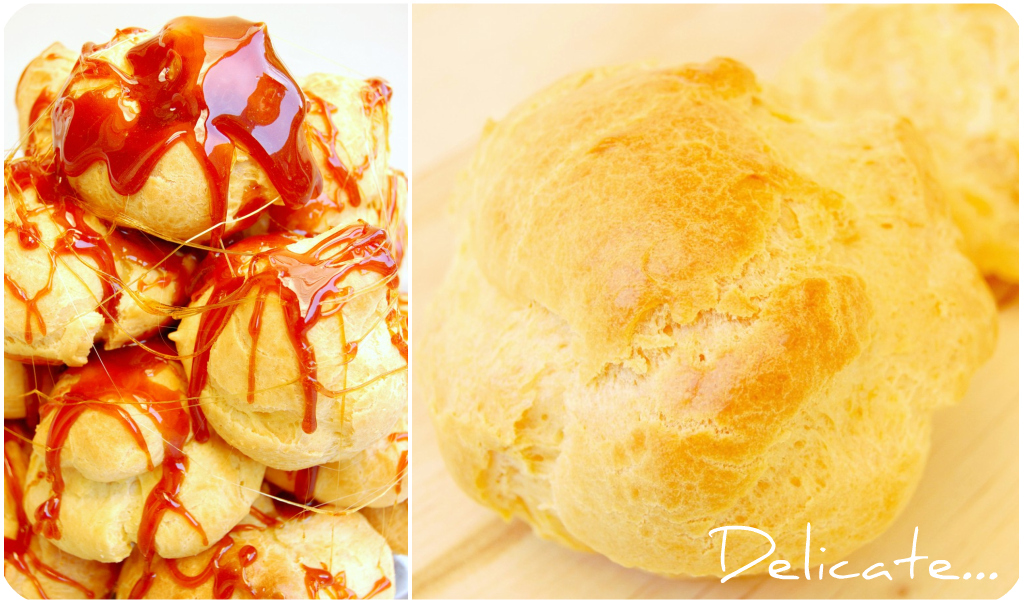
The cream puffs shells rose beautifully, were crispy on the outside and soft on the inside. They tasted of butter and reminded me of popovers. As I wanted to give a summery flavor to my cream puffs, I chose to make lemon pastry cream. Needless to say that the pastry cream was delightfully fresh and irresistibly silky smooth. In order to stick the cream puffs together, I opted for the caramel glaze wich added a layer of oomph to the whole dessert and gave a dramatic look to the pièce montée.

I wish to thanks Cat for having chosen that awesome treat and for giving me the opportunity to prove to myself that I have the skills to put together such a festive dessert. I will certainly make this goodie very soon again!
~Pièce Montée or Croquembouche ~

Equipment required:
• Several baking sheets
• Parchment paper
• A whisk
• A pastry brush (for the egg wash)
• A pastry bag and tip (a plain tip or no tip is best for piping the puff pastry; you can use a plain or star tip to fill the puff pastry with the cream)
• A flat surface such as a baking sheet or cake board/stand on which to assemble your piece montée
• Some of the items you may want to use to decorate your piece montée include ribbons, Jordan almonds, fresh flowers, sugar cookie cut-outs, chocolates, etc.

~~~~~~~~~~~~~~~~~~~~~~

LEMON CRÈME PÂTISSIÈRE

Ingredients:
1 Cup (225ml) Whole milk
2 Tbsp Cornstarch
6 Tbsp (100g) Sugar
1 Large egg
2 Large egg yolks
2 Tbsp (30G) Unsalted butter
1 Tsp Natural vanilla extract
3/4 Tsp Pure lemon extract

Method:
1. Dissolve cornstarch in 1/4 cup of milk. Combine the remaining milk with the sugar in a saucepan; bring to boil; remove from heat.
2. Beat the whole egg, then the yolks into the cornstarch mixture.
3. Pour 1/3 of boiling milk into the egg mixture, whisking constantly so that the eggs do not begin to cook.
4. Return the remaining milk to boil. Pour in the hot egg mixture in a stream, continuing whisking. Continue whisking (this is important – you do not want the eggs to solidify/cook) until the cream thickens and comes to a boil.
5. Remove from heat and beat in the butter and vanilla. Pour cream into a stainless steel/ceramic bowl. Press plastic wrap firmly against the surface.
6. Chill immediately and until ready to use.

For Chocolate Pastry Cream:
Bring 1/4 cup (about 50 cl.) milk to a boil in a small pan; remove from heat and add in 3 ounces (about 80 g.) semisweet chocolate, finely chopped, and mix until smooth. Whisk into pastry cream when you add the butter and vanilla.
For Coffee Pastry Cream:
Dissolve 1 ½ teaspoons instant espresso powder in 1 ½ teaspoons boiling water. Whisk into pastry cream with butter and vanilla.

~~~~~~~~~~~~~~~~~~~~~~

PÂTE A CHOUX

Yields about 28.

Ingredients:
3/4 Cup (175ml) Water
6 Tbsp (85g) Unsalted butter
1/4 Tsp Sea salt
1 Tbsp Sugar
1 Cup (125g) All-purpose flour
4 Large eggs (~53g)
1 Egg & A pinch of salt (for egg wash)

Method:
1. Pre-heat oven to 220◦C (425° F). Line two baking sheets with parchment paper.
2. Combine water, butter, salt and sugar in a saucepan over medium heat. Bring to a boil and stir occasionally.
3. At boil, remove from heat and sift in the flour, stirring to combine completely.
4. Return to heat and cook, stirring constantly until the batter dries slightly and begins to pull away from the sides of the pan.
5. Transfer to a bowl and stir with a wooden spoon 1 minute to cool slightly.
6. Add 1 egg (The batter will appear loose and shiny). As you stir, the batter will become dry-looking like lightly buttered mashed potatoes. It is at this point that you will add in the next egg. Repeat until you have incorporated all the eggs.
7. Transfer batter to a pastry bag fitted with a large open tip (I piped directly from the bag opening without a tip). Pipe choux about 1 inch-part in the baking sheets (Choux should be about 1 inch high about 1 inch wide). Using a clean finger dipped in hot water, gently press down on any tips that have formed on the top of choux when piping. You want them to retain their ball shape, but be smoothly curved on top.
8. Brush tops with egg wash (1 egg lightly beaten with pinch of salt).
9. Bake the choux at 220◦C (425° F) until well-puffed and turning lightly golden in color, about 10 minutes.
10. Lower the temperature to 180◦ C (350° F) and continue baking until well-colored and dry, about 20 minutes more.
11. Remove to a rack and cool.

Remarks:

They can be stored in a airtight box overnight.

~~~~~~~~~~~~~~~~~~~~~~


FILLING THE CHOUX

Method:
1. When you are ready to assemble your piece montée, using a plain pastry tip, pierce the bottom of each choux. Fill the choux with pastry cream using either the same tip or a star tip, and place on a paper-lined sheet (Choux can be refrigerated briefly at this point while you make your glaze).

~~~~~~~~~~~~~~~~~~~~~~~

HARD CARAMEL GLAZE

Ingredients:

1 Cup (225g) Sugar
1/2 Tsp Lemon juice

Method:

1. Combine sugar and lemon juice in a saucepan with a metal kitchen spoon stirring until the sugar resembles wet sand.
2. Place on medium heat; heat without stirring until sugar starts to melt around the sides of the pan and the center begins to smoke.
3. Begin to stir sugar. Continue heating, stirring occasionally until the sugar is a clear, amber color.
4. Remove from heat immediately; place bottom of pan in ice water to stop the cooking. Use immediately.

~~~~~~~~~~~~~~~~~~~~~~~~


ASSEMBLING THE PIÈCE MONTÉE

You may want to lay out your unfilled, unglazed choux in a practice design to get a feel for how to assemble the final dessert.
For example, if making a conical shape, trace a circle (no bigger than 8 inches) on a piece of parchmen
t to use as a pattern. Then take some of the larger choux and assemble them in the circle for the bottom layer.
Pr
actice seeing which pieces fit together best.

Method:
1. Once you are ready to assemble your piece montée, dip the top of each choux in your glaze (careful it may be still hot!), and start assembling on your cake board/plate/sheet.
2. Continue dipping and adding choux in levels using the glaze to hold them together as you build up. (You may want to use toothpicks to hold them in place).
3. When you have finished the design of your piece montée, you may drizzle with remaining glaze or use ribbons, sugar cookie cut-outs, almonds, flowers, etc. to decorate.

~~~~~~~~~~~~~~~~~~~~~~~

Etant donné la longueur du texte original, je n'ai malheureusement pas pu faire une traduction française de ce billet et je m'en excuse auprès de tous mes amis lecteurs et blogueurs francophones!

C'est pourquoi je vous suggère de vous rendre sur le blog mentionné ci-dessous. Vous y trouverez cette recette en version française.

Chez Isa de "Les Gourmandises d'Isa" (Canada)
Chez Vibi de "La Casserole Carrée" (Canada)

Saturday, February 27, 2010

TIRAMISÙ - THE DARING BAKERS

Is it me or time is really passing so fast? It seems that since I last blogged about the January Daring Bakers' challenge I barely have been able to sit down and think about the following one. Nowadays, I never get to finish completing my challenges before the very last minute (last day mostly)...

Anyhow, it is with great joy that I write about the February 2010 Daring Bakers’ challenge which is hosted by Aparna of "My Diverse Kitchen" and Deeba of "Passionate About Baking". They chose "Tiramisù" as the challenge for the month. Their challenge recipe is based on recipes from The Washington Post, "Cordon Bleu At Home" and Baking Obsession.

As I am a big "Tiramisù" fan and I love testing different recipes, Aparna and Deeba's choice could not have made me more happy. My excitment was also multiplied by the prospect of trying my hand for the very first time at baking "Ladyfingers" and making my own "Mascarpone Cheese". Awesome!

"Tiramisù" is one of the most popular desserts/cakes hailing from Italy. It is composed of light, crispy and sweet Génoise cake-like biscuits called "Ladyfingers" (or "Savoiardi") which are dipped in espresso or strong coffee or rum, a whipped mixture made with egg yolks, mascarpone cheese, sugar and is sprinkled with cocoa. This kind of pudding is somehow comparable to the French "Charlotte" or the English "
Trifle".

The origins of "Tiramisù" are not very clear as there is no documented mention of the dessert before 1983. Some think that it is a recent invention. Apparently, "Tiramisù" was created in 1971 in Treviso by Giuseppe Di Clemente. Several sources claim that "Tiramisù" was invented in Treviso at Le Beccherie restaurant by the god-daughter and apprentice of confectioner Roberto Linguanotto, Francesca Valori, whose maiden name was Tiramisu. It is believed that Linguanotto named the dish in honour of Francesca's culinary skill. Then, other sources report the creation of the cake to have originated in the city of Siena in honour of Cosimo III on the occasion of his visit to the city. Alternatively, accounts by Carminantonio Iannaccone as researched and written about by The Washington Post and Baltimore Magazine establish the creation of "Tiramisù" by him on December 24, 1969, in Via Sottotreviso while he was head chef at Treviso, near Venice.


To be perfectly honest with you, I don't really give a damn who invented this dessert or when it was created as the one thing that comes to my/our minds when thinking about it is it's incomparable deliciousness that is so soul-uplifting and mind-boggling. No wonder the phrase "tirami su" literally means "pick me up" or "pull me up" in Italian...

Making this recipe was not difficult in itself. The diverse componenets (ladyfingers, mascarpone cheese, pastry cream, zabaglione, whipped cream) were not very complicate to realize and, for the exception of "Ladyfingers" and "Mascarpone Cheese", I already knew how to make the other elements composing this dessert. My main problem resided in finding the right dish to contain that "pudding" since all of my dishes were not deep enough. Somehow, I managed to find a dish that was not as shallow as all the others...

Although the "Tiramisù" was extremely unphotogenic (very difficult to unmold cleanly, thus looking somewhat like a "dog's dinner" and only wanted to lean dangerously on one side like the Tower of Pisa), it was nonetheless a real success once it hit our palates.

The taste of that dessert is just divine and it's texture is heavenly. All the aromas blend perfectly together in order to create a sweet symphony of flavors that'll blow your brains out. That "Tiramisù" dissolves without chewing and is so silky, smooth, creamy, fluffy, spongy in texture. Orgasmically luscious!


Many thanks to Aparna & Deeba for making me discover a different version of that Italian speciality and for intriducing me to the art of homemade "Mascarpone Cheese" and "Ladyfingers".


~ TIRAMISÙ ~

Mascarpone Cheese - Vera’s Recipe (Baking Obsession) for Homemade Mascarpone Cheese Savoiardi/ Ladyfinger BiscuitsRecipe from Cordon Bleu At Home
Tiramisu – Carminantonio's Tiramisu recipe from The Washington Post, July 11 2007

Makes one 20 x 20cm (8 x 8 inch) Tiramisù or 6 servings.

PREPARATION TIME:

Tiramisu is made up of several components which can be made separately and ahead of time and put together the day before serving.
Making tiramisu from scratch requires about 2 to 3 days (including refrigeration) from when you start making the mascarpone to the time the tiramisu is served.
So this challenge requires some prior planning. Please read the instructions as you need to begin making the mascarpone at least a day in advance. The zabaglione & pastry cream also need 4 hours to an overnight for chilling, as does the main dessert.The flavours mature after an overnight rest, and the dessert can be kept refrigerated for 2-3 days.

Once assembled, the tiramisu can be frozen till you need to serve it, in case you are not serving it immediately.

~~~~~~~~~~~~~~~~~~~~~~~

TIRAMISÙ

This recipe makes 6 servings.

Ingredients for the "Zabaglione":
2 Large egg yolks
3 Tbs Sugar/50gms

1/4 Cup/60ml Marsala wine (or port or coffee)

1/4 Tsp/1.25ml Pure vanilla extract

1/2 Tsp Finely grated organic lemon zest
Ingredients for the "Vanilla Pastry Cream":

1 Cup/235ml Chilled heavy cream (I used 25%)
1/4 Cup/55gms Sugar

1/2 Tsp/2.5ml Pure vanilla extract
Ingredients to assemble the "Tiramisù":
2 Cups/470ml Brewed espresso, warmed

1 teaspoon/5ml rum extract (optional/I used 1 3/4 Cups espresso and 1/4 Cup Whiskey)
1/2 Cup/110gms Sugar
1/3 Cup/75gms Mascarpone cheese
3
6 Savoiardi/ ladyfinger biscuits (you may use less)
2 Tbs/30gms Unsweetened cocoa powder


Method for the "Zabaglione":
1. Heat water in a double boiler (If you don’t have a double boiler, place a pot with about an inch of water in it on the stove. Place a heat-proof bow
l in the pot making sure the bottom does not touch the water).
2. In a large mixing bowl (or stainless steel mixing bowl), mix together the egg yolks, sugar, the Marsala (or espresso/ coffee), vanilla extract and lemon zest. Whisk together until the yolks are fully blended and the mixture looks smooth.
3. Transfer the mixture to the top of a double boiler or place your bowl over the pan/ pot with simmering water. Cook the egg mixture over low heat, stirring constantly, for about 8 minutes or until it resembles thick custard (It may bubble a
bit as it reaches that consistency).
4. Let cool to room temperature and transfer the zabaglione to a bowl. Cover and refrigerate at least 4 hours or overnight, until thoroughly chilled.


Method for the "Vanilla Pastry Cream":

1. Mix together the sugar, flour, lemon zest and vanilla extract in a medium heavy-bottomed saucepan. To this add the egg yolk and half the milk. Whisk until smooth.
2. Now place the saucepan over low heat and cook, stirring constantly to prevent the mixture from curdling. Add the remaining milk a little at a time, still stirring constantly (After about 12 minutes the mixture will be thick, free of lumps and beginning to bubble. If you have a few lumps, don’t worry. You can push the cream through a fine-mesh strainer).
3. Transfer the pastry cream to a bowl and cool to room temperature. Co
ver with plastic film and refrigerate at least 4 hours or overnight, until thoroughly chilled.
Method for the "Whipped Cream":

1. Combine the cream, sugar and vanilla extract in a mixing bowl.
2. Beat with an electric hand mixer or immersion blender until the mixture holds stiff peaks. Set aside.
Method to "Assemble The Tiramisù":
1. Have ready a rectangular serving dish (about 8" by 8" should do) or one of your choice.
2. Mix together the warm espresso, rum extract and sugar in a shallow dish, whisking to mix well. Set aside to cool.

3. In a large bowl, beat the mascarpone cheese with a spoon to break down the lumps and make it smooth (This will make it easier to fold).
4. Add the prepared and chilled zabaglione and pastry cream, blending until just combined.

5. Gently fold in the whipped cream. Set this cream mixture aside.
6. Now to start assembling the tiramisu. Workings quickly, dip 12 of the ladyfingers in the sweetened espresso, about 1 se
cond per side. They should be moist but not soggy.
7. Immediately transfer each ladyfinger to the platter, placing them side by side in a single row (You may break a lady finger into two, if necessary, to ensure the base of your dish is completely covered).
8. Spoon one-third of the cream mixture on top of the ladyfingers, then use a rubber spatula or spreading knife to cover the top evenly, all the way to the edges.

9. Repeat to create 2 more layers, using 12 ladyfingers and the cream mixture for each layer. 10. Clean any spilled cream mixture; cover carefully with plastic wrap and refrigerate the tiramisu overnight.
11. To serve, carefully remove the plastic wrap and sprinkle the tiramisu with cocoa powder using a fine-mesh strainer or decorate as you please.

12. Cut into individual portions and serve.

~~~~~~~~~~~~~~~~~~~~~~

MASCARPONE CHEESE

This recipe makes 12oz/ 340gm of mascarpone cheese.

Ingredients:

474ml (approx. 500ml)/2 Cups Whipping (36 %) pasteurized (not ultra-pasteurized), preferably organic cream (between 25% to 36% cream will do)
1 Tbs Fresh lemon (organic) juice


Method:

1. Bring 1 inch of water to a boil in a wide skillet. Reduce the heat to medium-low so the water is barely simmering.
2. Pour the cream into a medium heat-resistant bowl, then place the bowl into the skillet. Heat the cream, stirring often, to 190 F/87° C (If you do not have a thermometer, wait until small bubbles keep trying to push up to the surface). It will take about 15 minutes of delicate heating.
3. Add the lemon juice and continue heating the mixture, stirring gently, until the cream curdles (Do not expect the same action as you see during ricotta cheese making. All that the whipping cream will do is become thicker, like a well-done crème anglaise. It will cover a back of your wooden spoon thickly. You will see just a few clear whey streaks when you stir).
4. Remove the bowl from the water and let cool for about 20 minutes.
5. Meanwhile, line a sieve with four layers of dampened cheesecloth and set it over a bowl. Transfer the mixture into the lined sieve (Do not squeeze the cheese in the cheesecloth or press on its surface. Be patient, it will firm up after refrigeration time).
6. Once cooled completely, cover with plastic wrap and refrigerate (in the sieve) overnight or up to 24 hours.

Notes:
The first time I made mascarpone I had all doubts if it’d been cooked enough, because of its custard-like texture. Have no fear, it will firm up beautifully in the fridge, and will yet remain lusciously creamy.
Keep refrigerated and use within 3 to 4 days.

~~~~~~~~~~~~~~~~~~~~~~

LADYFINGERS/ SAVOIARDI BISCUITS

This recipe makes approximately 24 big ladyfingers or 45 small (2 1/2" to 3" long) ladyfingers.

Ingredients:
3 Eggs, separated
6 Tbs/75gms Granulated sugar

3/4 Cup/95gms Cake flour, sifted (or 3/4 cup all purpose flour + 2 tbsp corn starch)

6 Tbs/50gms Confectioner's sugar

Method:
1. Preheat your oven to 350° F (175° C) degrees, then lightly brush 2 baking sheets with oil or softened butter and line with parchment paper.
2. Beat the egg whites using a hand held electric mixer until stiff peaks form.
3. Gradually add granulate sugar and continue beating until the egg whites become stiff again, glossy and smooth.
4. In a small bowl, beat the egg yolks lightly with a fork and fold them into the meringue, using a wooden spoon.
5. Sift the flour over this mixture and fold gently until just mixed (It is important to fold very gently and not overdo the folding. Otherwise the batter would deflate and lose volume resulting in ladyfingers which are flat and not spongy).
6. Fit a pastry bag with a plain tip (or just snip the end off; you could also use a Ziploc bag) and fill with the batter. Pipe the batter into 5"/12.5cm long and 3/4"/2cm wide strips leaving about 1"/2.5cm space in between the strips.
7. Sprinkle half the confectioner's sugar over the ladyfingers and wait for 5 minutes (The sugar will pearl or look wet and glisten). Now sprinkle the remaining sugar (This helps to give the ladyfingers their characteristic crispness).
8. Hold the parchment paper in place with your thumb and lift one side of the baking sheet and gently tap it on the work surface to remove excess sprinkled sugar.
9. Bake the ladyfingers for 10 minutes, then rotate the sheets and bake for another 5 minutes or so until the puff up, turn lightly golden brown and are still soft.
10. Allow t
hem to cool slightly on the sheets for about 5 minutes and then remove the ladyfingers from the baking sheet with a metal spatula while still hot, and cool on a rack.

Note:
Store them in an airtight container till required. They should keep for 2 to 3 weeks.

~~~~~~~~~~~~~~~~~~~~~~~

ADDITIONAL INFORMATION
Site Links:
Step by step pictures for making Tiramisù (including zabaglione & pastry cream).
Gluten Free Ladyfingers - 1000 gluten-free recipes by Carol Fenster (ladyfingers pg 436, Tiramisu pg 651).
Gluten free Ladyfingers & Tiramisù.
Diary Free Tiramisu - Levana Cooks Diary-Free by Lévana Kirschenbaum,
Menachem Adelman, Meir Pliskin (pg 86).
Video links for making "Tiramisu":
These are not for the recipe given for this challenge, but the procedure in the video would be a helpful guide.
Gordon Ramsay's video for dipping savioardi

~~~~~~~~~~~~~~~~~~~~~~

Etant donné la longueur du texte original, je n'ai malheureusement pas pu faire une traduction française de ce billet et je m'en excuse auprès de tous mes amis lecteurs et blogueurs francophones!

C'est pourquoi je vous suggère de vous rendre sur le blog mentionné ci-dessous. Vous y trouverez cette recette en version française.

Chez Isa de "Les Gourmandises d'Isa" (Canada)