Showing posts with label French Food. Show all posts

Tuesday, October 22, 2013

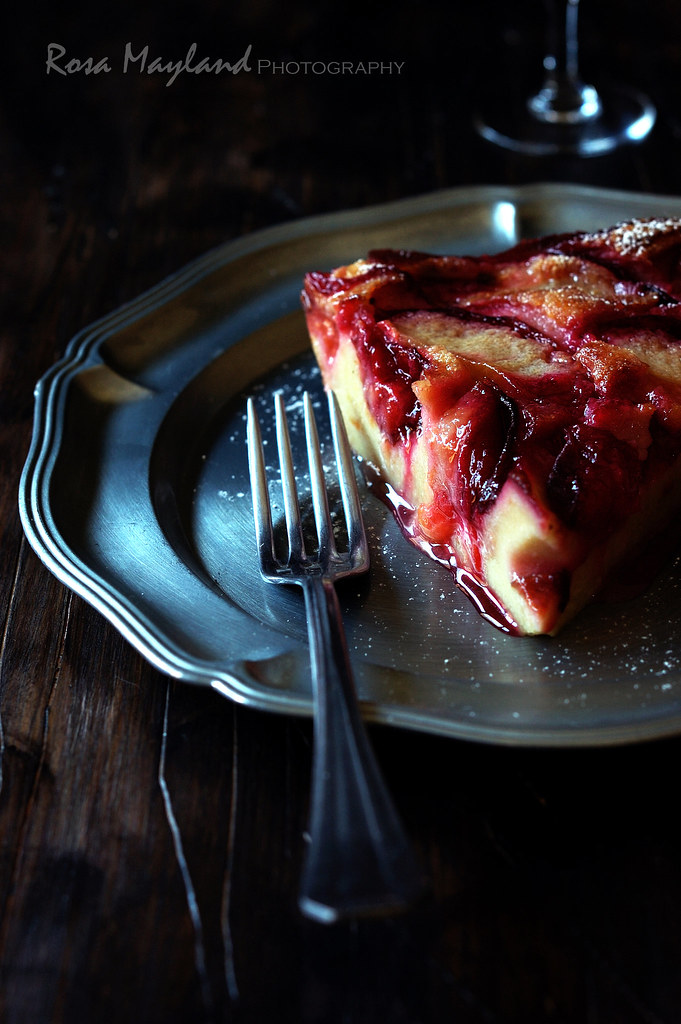
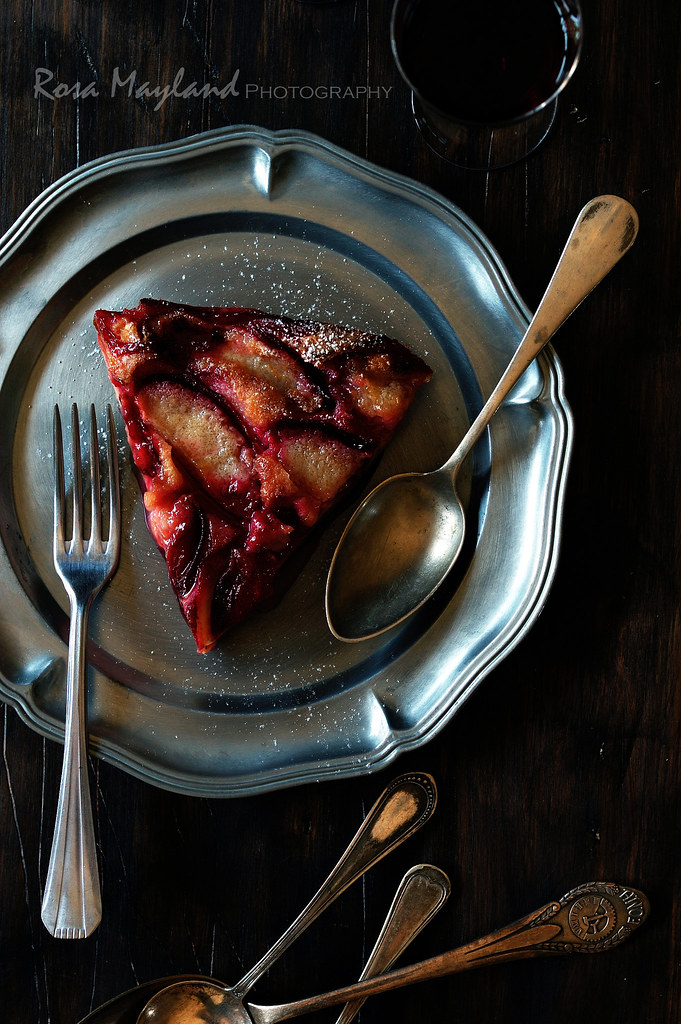
DAMSON PLUM FLAUGNARDE (CLAFOUTIS) - FLAUGNARDE AUX QUETSCHES

September days have the warmth of summer in their briefer hours, but in their lengthening evenings a prophetic breath of autumn. The cricket chirps in the noontide, making the most of what remains of his brief life. The bumblebee is busy among the clover blossoms of the aftermath, and their shrill and dreamy hum hold the outdoor world above the voices of the song birds, now silent or departed.
-   September Days b
y Rowland E. Robinson, Vermont.


September's baccalaureate
A combination is of crickets - crows - and retrospects
And a dissembling breeze
That hints without assuming -
An innuendo sear
That makes the heart put up its fun
And turn philosopher.

-   Emily Dickinson, September's Baccalaureate
August ended on a bright, balmy and estival note, but as we were entering September the weather decided to take an abrupt turn when summer silently sneaked out through the back door like some secret lover on a undercover mission. Without much fuss, it shyly bid us farewell and quietly tiptoed away; as if its joyful presence and warm embrace had not mattered to us, it eclipsed itself, never to be seen again.

Autumn, that artfully cheeky little opportunist of a trickster swiftly and discretely replaced our beloved summer and immediately made itself comfortable. Similarly to a fearsome king marking his territory, fall entered the scene dramatically and imperially. Fierce thunderbolts, tempestuous northern winds and torrents of water accompanied his boisterous arrival.
October, baptize me with leaves! Swaddle me in corduroy and nurse me with split pea soup. October, tuck tiny candy bars in my pockets and carve my smile into a thousand pumpkins. O autumn! O teakettle! O grace!
- Rainbow Rowell, Attachments


You expected to be sad in the fall. Part of you died each year when the leaves fell from the trees and their branches were bare against the wind and the cold, wintery light. But you knew there would always be the spring, as you knew the river would flow again after it was frozen. When the cold rains kept on and killed the spring, it was as though a young person died for no reason.
- Ernest Hemingway, A Moveable Feast
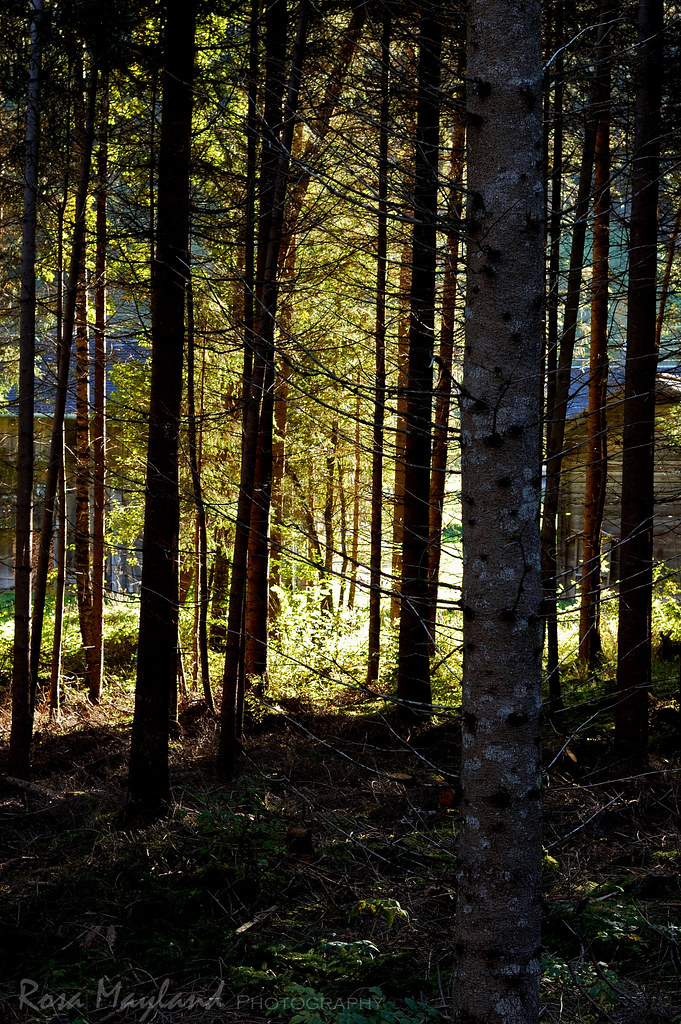
Lenk Trip 7 2 bis
The change was so unexpected and radical that it shocked us all. Now that capricious october has fully kicked in and Samhain is nearing, thick fog blankets obscure the sky till noon, the world is filled with chilly warmth (temperatures rarely reach 18°C/64° F in the afternoon), sun rays gracefully bathe the landscapes in a golden glow, light's decline is becoming more palpable every evening, melancholic quietness fills the air, snow returns to the mountains and suddenly, I find myself craving comforting casseroles as well as warm drinks and prefer to sit indoors rather than on my balcony (unless it is for a short coffee break - in order to aerate my head).

Despite being an unconditional admirer of the fiery season, it is with a heavy heart and a lot of nostalgy that I mourn the death of our late radiant and frivolous dandy. We had so much fun in each other's company, however our time together was far too short. Hence it is difficult to accept the fact that, after barely 8 weeks of continuous heat and sunshine, the grim and colder days are once more back and we'll have to wait another long 6 to 7 months before we can frolick in the grass and have a drink on a terrace - sans jacket, sweater or coat - again.
Earth is here so kind, that just tickle her with a hoe and she laughs with a harvest.
- Douglas Jerrold
Anyway, this time of the year is also my favorite as it is that of the harvest and for our biggest pleasure, many sensational fruits and vegetables reappear on the market stalls. It is a period of abundance and plentifulness during which our plates are well-garnished and dishes are colorful (earthly tones of orange, brown, red, purple, yellow and green invite themselves to the dinning table), hearty as well as flavorful.

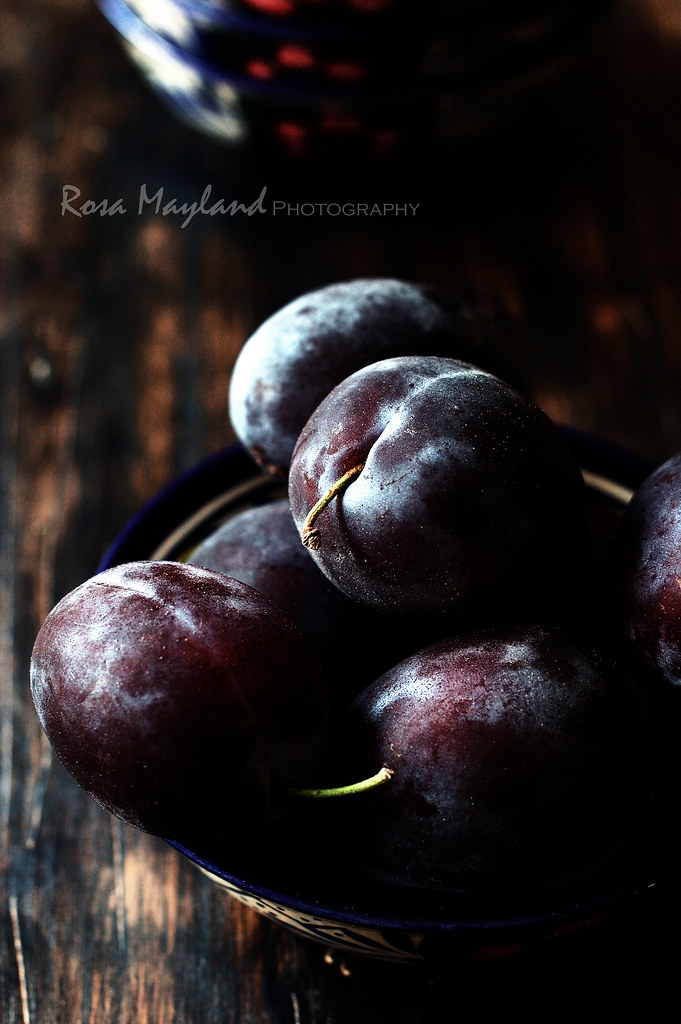
One of my most cherished perennial produces is unquestionably the Swiss plum. I am totally addicted to this violet fruit and can never get enough of its incomparable exquisiteness and versatility. Unfortunately, the "prunneau" picking period doesn't last very long, so I try my best to make the most out of this delicacy while it is still available. Clafoutis, cakes, foccacie, jams, trifles, compotes, puddings, muffins, crumbles, you name it, from late August to the end of October, there isn't one dessert I'll not make with quetsches!

Sadly for me, plum cropping is slowly coming to an end and the mighty apple will soon take its turn under the spotlight and become the star in my kitchen. So in order to appropriately say goodbye to damsons (my most treasured variety), I have decided to share with you a flaugnarde (also known as flagnarde, flognarde or flougnarde) recipe inspired by the talented Jamie Schler at "Life's A Feast".

I am a big fan of this lady's fabulous bakes and delightful prose, and whenever I visit her blog a strike of creativity hits me. This generally leads me to getting into a productive state and artistic frenzy. Thus, after admiring her incredibly enticing "Flognarde (Clafoutis) Aux Pommes", ideas started to flood my brain and I felt the urge to create my own funky version of this French classic (Jamie's interpretation of it is original too).

Commonly, this speciality always contains plain flour only and apart from vanilla, another flavor is rarely added to the preparation. Anyhow, I'm a transgresser of rules who doesn't enjoy culinary rigidity or lack of imagination and it is for that very reason that I took the liberty of adding coconut flour, orange rind puree and Grand-Marnier to the batter.

My "Damson Plum Flaugnarde" turned out wonderfully and since then, I have baked it at least once a week (it is our official movie night treat). Hopefully you'll adore it as much as we do...
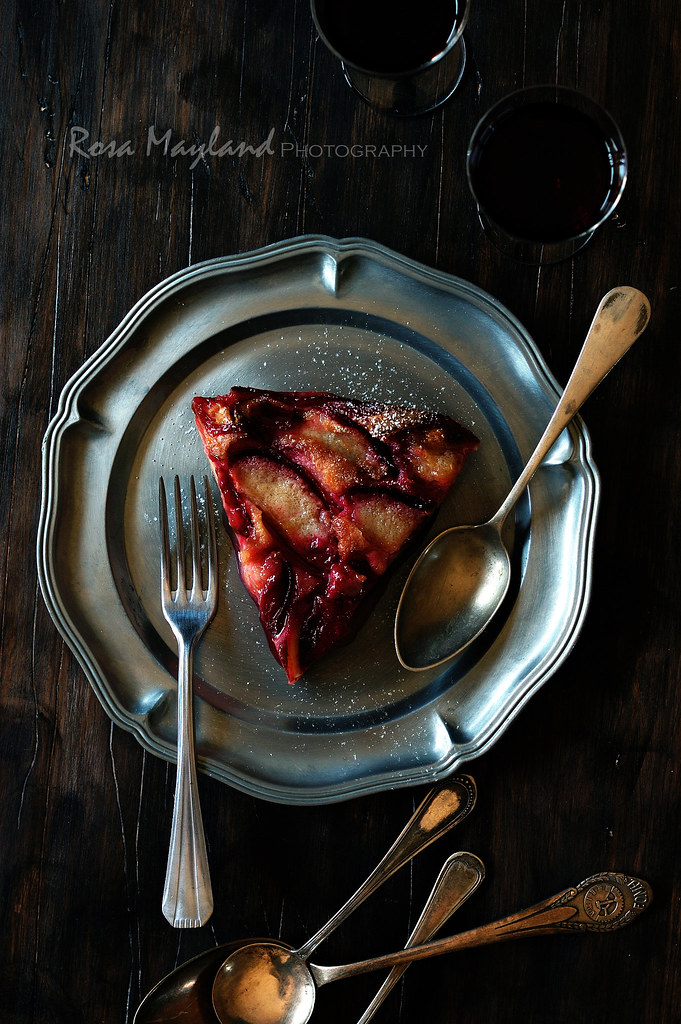
Damson Plum Flaugnarde
Recipe by Rosa Mayland.


Makes 1 flaugnarde - serves 4-6.

Ingredients:

1 1/2 Cups (360ml) of Milk
3 Big (~63g) Eggs
1/4 Cup + 1 Tbs (73g) Light brown sugar
1/4 Cup Castor Sugar (53g + some extra sugar for sprinkling)
1/2 Cup (64g) All-purpose flour
2 Tbs (30g) Coconut flour
1 Tsp Pure vanilla extract
1/3 Tsp Orange rind puree
2 Tbs Orange liquor (Cointreau or Grand-Marnier)
2 Tbs Oil (neutral)
8-10 Damson plums, stoned and halfed
Icing sugar, to decorate
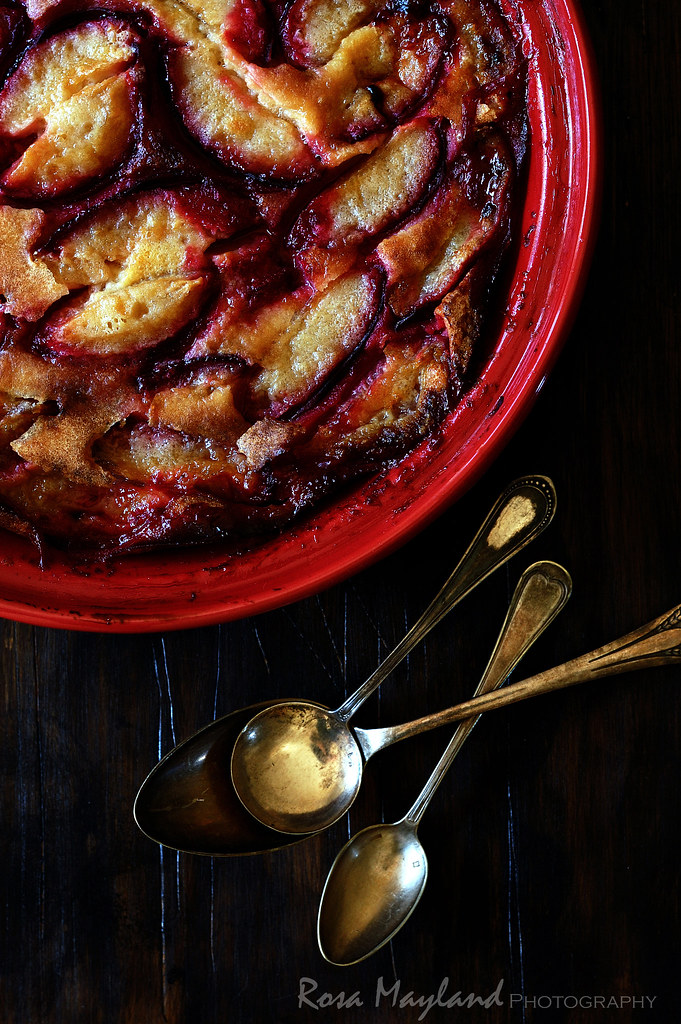
 Method:
1. Preheat the oven to 200° C (400° F).
2. Over medium heat, bring the milk to a light simmer, then set aside.
3. In a mixing bowl, whisk together the eggs and sugars until pale in color and foamy.
4. Add the flours, vanilla extract, orange rind puree, liquor and oil. Whisk until smooth.
5. Gradually whisk in the warm milk.
6. Pour the mixture into a buttered round 8-9" (20-22cm) pie dish.
7. Drop the plums into the batter and sprinkle with a little extra sugar.
8. Bake for 35-40 minutes until the flaugnarde is puffed and golden.
9. Sprinkle with icing sugar and serve.

Remarks:
The coconut flour can be replaced with the same amount of all-pupose flour and the brown sugar with the same quantity of castor sugar.
If you don't like orange rind or liquor, then you can use lemon zest and Limoncello instead.

Serving suggestions:
Eat warm or at room temperature and serve alone or with a scoop of ice cream (vanilla, pecan, walnut, caramel, etc...).

Flaugnarde Aux Quetsches
Recette par Rosa Mayland.


Pour 1 flaugnarde, 4-6 personnes.
 

Ingrédients:
360ml de Lait
3 Gros (~63g) Oeufs

73g de Sucre de canne fin
53g de Sucre fin cristallisé (+ un peu de sucre supplémentaire pour saupoudrer)

64g de Farine blanche
30g de Farine de noix de coco
1 CC d'Extrait de vanille pure
1/3 CC de Zeste d'orange en purée
2 CS de Liqueur d'orange (Cointreau ou Grand-Marnier)
2 CS d'Huile (neutre)
8-10 Quetsches/prunes, dénoyautées et coupées en deux

Sucre glace, pour décorer
Méthode:
1. Préchauffer le four à 200 ° C.
2. À feu moyen, porter le lait à frémissement léger, puis le mettre de côté.
3. Dans un bol, fouetter ensemble les oeufs et les sucres, jusqu'à ce que le mélange soit pâle et mousseux.
4. Ajoutez les farines, l'extrait de vanille, le zeste d'orange, la liqueur et l'huile. Fouetter afin d'obtenir un consistance lisse et homogène.
5. Incorporer graduellement le lait chaud, tout en continuant de bien fouetter l'appareil.
6. Verser le mélange dans un moule à pie beurré (20-22cm).
7. Déposez les quetsches/prunes dans la pâte et saupoudrez le dessus de la flaugnarde avec un peu de sucre.
8. Cuire au four pendant 35-40 minutes, jusqu'à ce que la flaugnarde soit gonflée et dorée.
9. Saupoudrer de sucre glace et servir.

Remarques:

La farine de noix de coco peut être remplacée par de la farine blanche et la cassonade par du sucre fin cristallisé.
Si vous n'aimez pas le zeste ou la liqueur d'orange, alors vous pouvez utiliser du zeste de citron et du Limoncello à la place.

Suggestion de présentation: 

Cette flaugnarde peut être mangée chaude ou à température ambiante et servie sans accompagnement ou avec une boule de glace (vanille, noix de pécan, noix, caramel, etc...).
Friday, April 8, 2011

CANNELÉS BORDELAIS - LAROUSSE CUISINE BOOK REVIEW

Cannelés Picnik collage 2 bis
Book Review - Critique De Livre

I don't know if it's the same for you, but sometimes there are specialities I dream of making, yet for no apparent reason I never get to test them as fast as I wish. For example I have been dreaming of tasting and baking "Cannelés Bordelais" since the day I started blogging in 2005. I have been drooling over that French cake for long and every time I saw a post on that subject I promised myself to make them, but somehow never got to it (until lately). Finding the correct mold already took me a couple of years (Switzerland isn't a great place for amateur bakers) and then I needed a few months to finally get cracking.
Well, I am known for being a big procrasitinator. I guess that is my problem... /// Je ne sais pas si vous êtes comme moi, mais beaucoup de fois je vois une spécialité que je désire tester et il me faut un certain temps avant de mettre la main à la pâte. Par example, ça fait un bon bout de temps (depuis que j'ai commencé à bloguer en 2005) que je salive à l'idée de faire des "Cannelés Bordelais" et que je me promets d'en préparer chaque fois que j'en vois sur vos blogs. Pourtant jusqu'à aujourd'hui je n'ai pas réussi à en confectionner. Il m'a déjà fallu plusieurs année pour dénicher le moule (en Suisse on est pas gâté lorsqu'il est question de matériel de cuisine), puis encore quelques mois avant de finalement me décider sauter le pas. Je suis une vraie procrastinatrice et je pense que c'est ça mon problème...

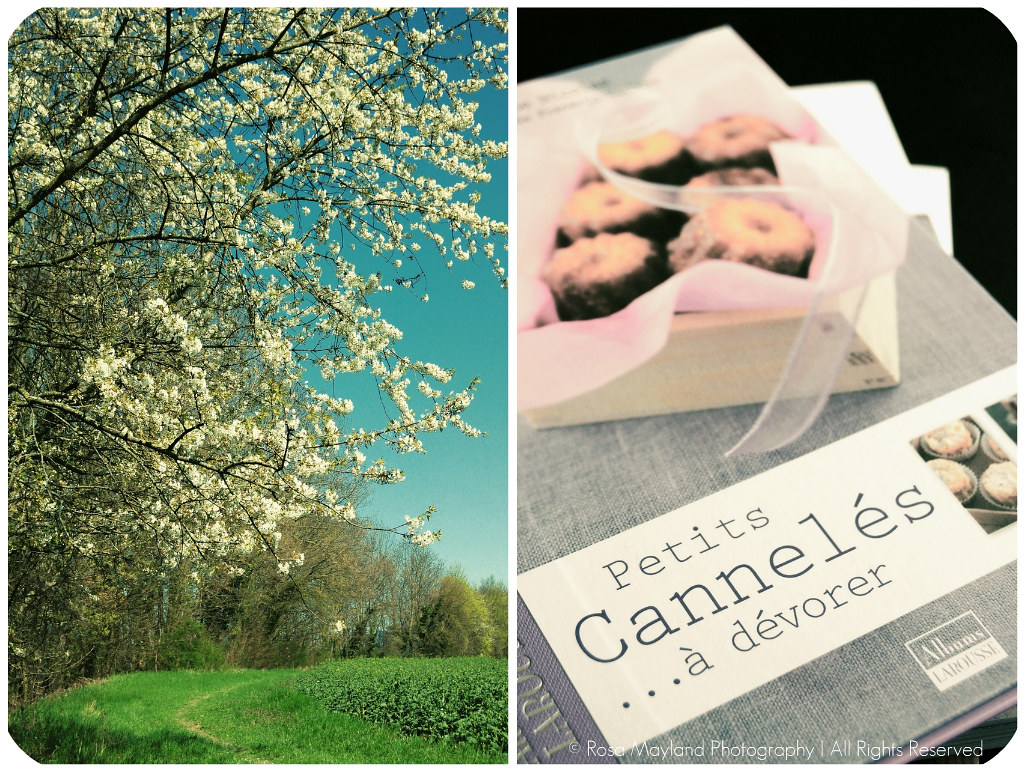
So, when the Editions Larousse kindly sent me their latest book "Petits Cannelés.... A Dévorer" I had no more excuse not to drag my sorry ass into the kitchen and whip up some cute cannelés. /// Alors quand Les Editions Larousse m'ont gentiment fait parvenir le livre"Petits Cannelés.... A Dévorer" (une de leurs récentes parutions), je n'avais plus d'excuse pour ne pas bouger mon popotin et m'activer à la création de cannelés.

Catherine Nicolas' dainty book contains gorgeous pictures and gives you the opportunity to prepare many different variations of that heavenly snack. Her 30 recipes for sweet, savory, classic and non-traditional cannelés (original recipe, kourabiedes-, cheesecake-, tapioca pudding-, pomme d'amour-, carrot cake-, chorizo polenta-, speck muffin-style cannelés, etc...) are very imaginative and pleasant. Whether you are a die-hard worshipper of the historic version or you are a more adventurous baker I'm pretty sure that you'll have fun creating those lovely petits fours which will meet a great success at your table when served for teatime, brunch or as an apperitive. /// Le mignon petit livre de Catherine Nicolas est merveilleusement illustré et nous donne la possibilité de réaliser multiples variations autour de ce délicieux gâteau. Les 30 recettes sucrées, salées, classiques et non-traditionnnelles qu'elle nous présente sont très imaginatives et séduisantes (cannelés d'amour, cannelés aux pruneaux, cannelés en pâte de fruits, cannelés en robe de chocolat, cannelés à la crème d'avocat, cannelés moelleux aux lardons, cannelés de chèvre aux courgettes). Que vous soyez un(e) grand(e) amateur(amatrice) du cannelé original ou que vous adorez la nouveauté je suis sûre que vous prendrez beaucoup de plaisir à créer ces petits fours qui seront les stars incontournables de tous vos cafés gourmands, brunches, goûters ou appéritifs.

For my part I decided to try her "Cannelés Bordelais" in order to put an end to my years of craving for that humble treat. Although this experiment proved me once again that my reasons for
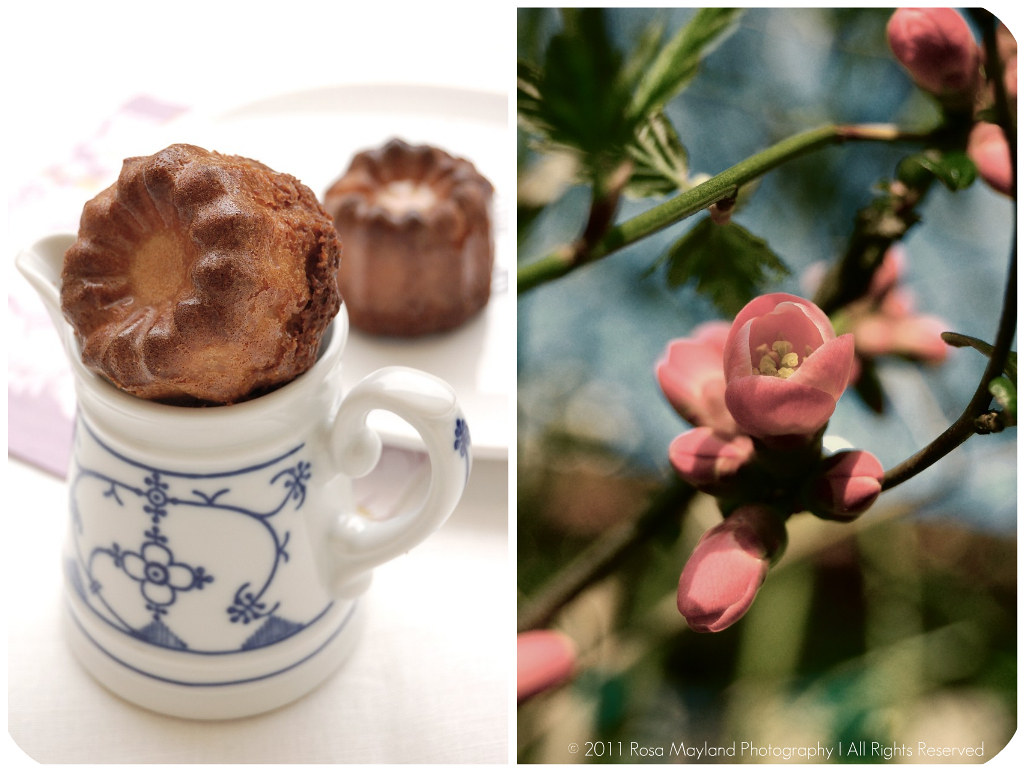
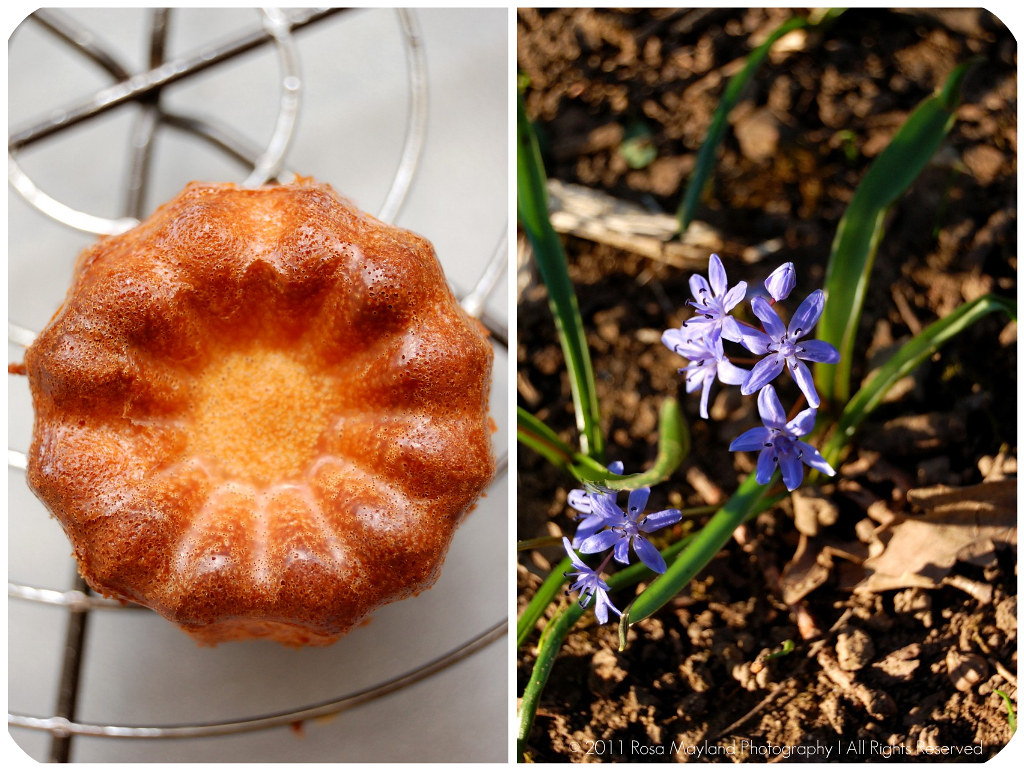
loathing those damn silicone pans (they stink, stick and my cakes always get squashed when I try to unmold them - the old-fashioned metal molds/pans work perfectly and never let me down) are grounded, I was nonetheless really happy with the end result. Even if my cannelés were quite fugly, they nonentheless tasted divine and had the most orgasmic of textures. /// Pour ma part, j'ai décidé d'essayer la recette pour les "Cannelés Bordelais" classiques afin de mettre fin à ces années passées à saliver devant les images de cette humble gourmandise. Bien que cette aventure m'ait encore une fois prouvé que ma haine contre les moules en silicone est fondée (ils puent, collent et mes gâteaux sont toujours écrasés lorsque je les éjecte du moule - les bons vieux moules métalliques ne me laissent jamais tomber), j'étais tout de même contente du résultat final. Mes cannelés étaient assez moches, mais cela ne les a pas empêché d'être divins et d'avoir une textures des plus orgasmiques.

~~~~~~~~~~~~~~~~~~~~~~

Cannelés Picnik collage 6 bis
According to the legend, this treat dates back to the 17th century and was invented by nuns of the convent of The Annonciades (today, nuns of the convent of Mercy) in Bordeaux. Back then cannelés were called "canelas" or "canelons", were long thin cakes wound around a stick ("canne" in french, hence the name) and fried in lard. Apparently they are very closely linked to the making of red wine. This beverage was filtered through whipped egg whites and as the personnel of the castle did not know what to do with the leftover egg yolks, they donated them the cloister.

This marvelous pastry has gone through ups and downs since the day it was invented. Its origin is still unclear and the word's ethymology is very enigmatic. The name "Can(n)elé" (pronounced "kah-nuh-leh" and meaning "fluted") is very recent. In 1970 it does not appear in the “Guide Gourmand de la France” by Gault and Millau and it is only when, in 1985, the brotherhood of the Canelé of Bordeaux sees the day of light that the name becomes a collective brand. Ten years later, this goodie is once again very popular and many manufactures are built (about 1400) in Aquitaine and Gironde. Today this wonder of the French culinary patrimony is so fashionable and beloved that it can be found in numerous bakeries in France and around the world (it can even be bought at Bordeaux's McDonalds -*ugh*).

When it comes to cannelés there are a lot of secrets surrounding them, but one thing is for sure, there is absolutely no mystery to why those unique confections meet such a success. It is absolutely impossible to doubt their deliciousness. They are just irrefutably fantastic and irresistible.

Made with a revamped crêpe batter, "
Cannelés Bordelais" are a bit like a cross
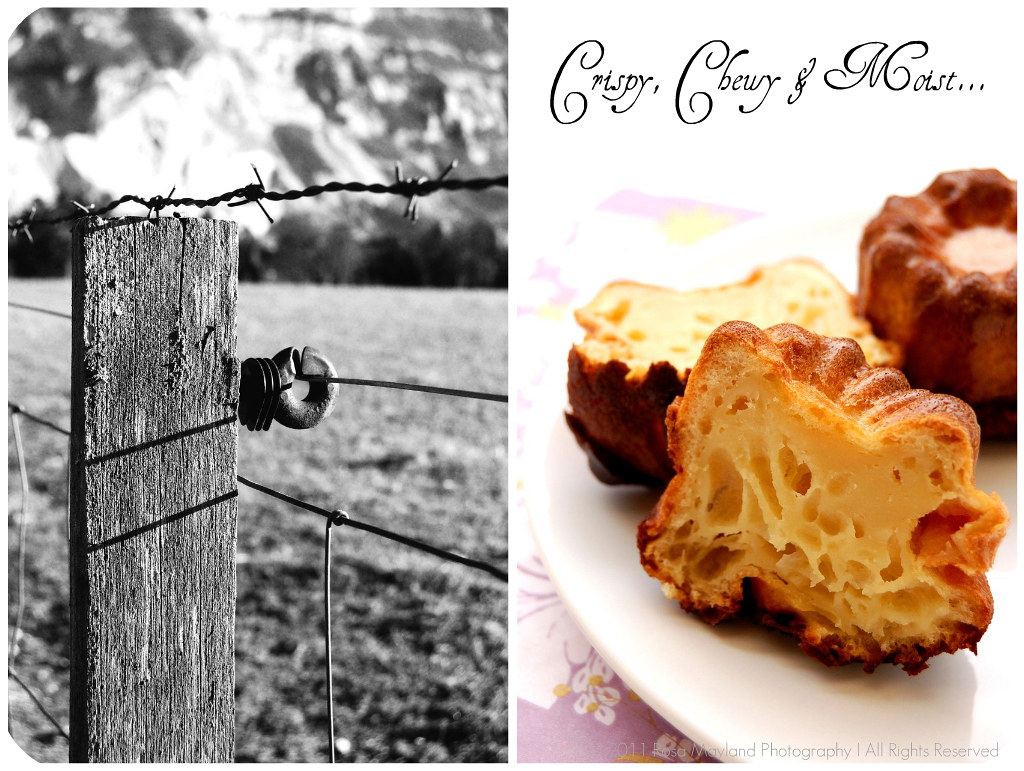
between a pancake, waffle, pudding, popovers and clafoutis. Their moist, spongy and custardy insides, crisp, crusty, chewy and caramelized outsides as well as amazing flavor redolent of vanilla and rum will enchant your tastebuds and conquer your heart. This delicacy is so exquisite that you'll be incapable of forgetting it and will bake them on a regular basis.

Oh, why did it take me so long to discover those wonderful babies? When I think that I have wasted so many years dawdling, it makes me rip my hair out in utter desperation. So, please do me a favor, don't be stupid like me and postpone the sampling of "Cannelés Bordelais" (or anything else for that effect). Run into your kitchen and make the immediately!

Cannelés Cherry Blossom 1.2 bis
~ Cannelés Bordelais ~
Recipe adapted from
"Petits Cannelés.... A Dévorer" by Catherine Nicolas.

Makes 12 mini cannelés or 7 medium cannelés.

Ingredients:
1 Pod vanilla or 1 1/2 Tsp Pure vanilla paste
200ml Full-fat milk
20g Unsalted butter, at room temperature
1 Big egg
90g Granulated sugar
1 Tbs Dark rum
45g All-purpose flour
1 Pinch Fine sea salt

Method:
1 . Put the milk in a small pan. Add the split and scraped vanilla pod (or the vanilla paste). Bring to the boil, remove from the heat and let rest for 10 minutes.
2 . In a medium bowl, cream the butter together with the sugar.
3 . Add the egg and mix well (use a whisk).
4. Incorporate the rum, then the flour and salt. Whisk well (there should be no lumps left).
5. Slowly pour the warm milk into the mixture while mixing gently.

6. Put the batter in the fridge (in a closed recipient) for 12 hours minumum.

Cannelés Picnik collage 4 bis
7. The next day, preheat the oven to 210° C (410 ° C).
8. Pour the batter into the cannelé compartments about 3/4 of the way.
9. Bake for about 1 hour (or 45 minutes if you are using the mini molds).
10 . Once you've removed the cannelés from the oven, proceed to unmoold. Let cool on a wire rack.


Remarks:
I recommend you to use a traditional metal cannelé pan (no silicone).
If you don't have a cannelé pan then you can use a popover pan.
Cannelés are ready when they are crusty and looking caramelized as well as dark on the outside.
Eat rapidly. They are best when eaten fresh and still a little warm.

Serving suggestions:
Serve for dessert with some whipped cream and a fruit salad or alone for breakfast or teatime.

~~~~~~~~~~~~~~~~~~~~~~

Cannelés Picnik collage 3 bis
~ Cannelés Bordelais ~
Recette adaptée de "Petits Cannelés.... A Dévorer" par Catherine Nicolas.

Pour 12 mini cannelés ou 7 cannelés moyen.

Ingrédients:
1 Gousse de vanille ou 1 1/2 CC de Pâte de vanille pure
200ml de Lait entier
20g de Beurre non-salé, ramolli
1 Gros oeuf
90g de Sucre cristallisé
1 CS de Rhum brun
45g de Farine blanche
1 Pincée de Sel de mer fin

Méthode:
1 . Mettre le lait dans une casserole. Y ajouter la gousse de vanille (fendue en deux et raclé - ou la pâte de vanille pure) et ses graines. Porter à ébullition, puis éteindre le feu et laissez infuser 10 minutes à couvert.
2 . Dans un bol moyen, mélanger ensemble le sucre et le beurre mou.
Les battre en pommade.
3 . Ajouter l'oeuf et bien mélanger à l'ai
de d'un fouet.
4. Incorporer le rhum, puis la farine et le sel. Bien mélanger (il ne faut plus qu'il y ait de grumeaux).
5. Verser le lait petit à petit tout en remuant doucement avec le fouet.

6. Mettre la préparation au frigo (dans un récipient fermé) pendant au moins 12 heures.

Cannelés Picnik collage 1 bis
7. Le lendemain, préchauffer le four à 210° C (410 ° C).
8. Remplir les moules à mini cannelés aux trois quarts.
9. Enfournez et faites cuire pendant 1 heure (45 minutes pour les petits) environ.
10 . Démouler les cannelés au sortir du four et faire refroidir sur un grille.
Servir tiède ou à température ambiante.

Remarques:
Je vous conseille de cuire ces cannelés dans des moules métalliques.
Les cannelés sont prêts quand leur croûte est bien caramélisée et sombre.
Cette spécialité est meilleure fraîche et juste sortie du four (mais refroidie un peu).

Idées de présentation:
Servir au dessert avec de la crème chantilly et une salade de fruits, ou pour le petit déjeûner ou à l'heure du thé (sans accompagnement).

Cannelés Picnik collage 5 bis

Saturday, April 3, 2010

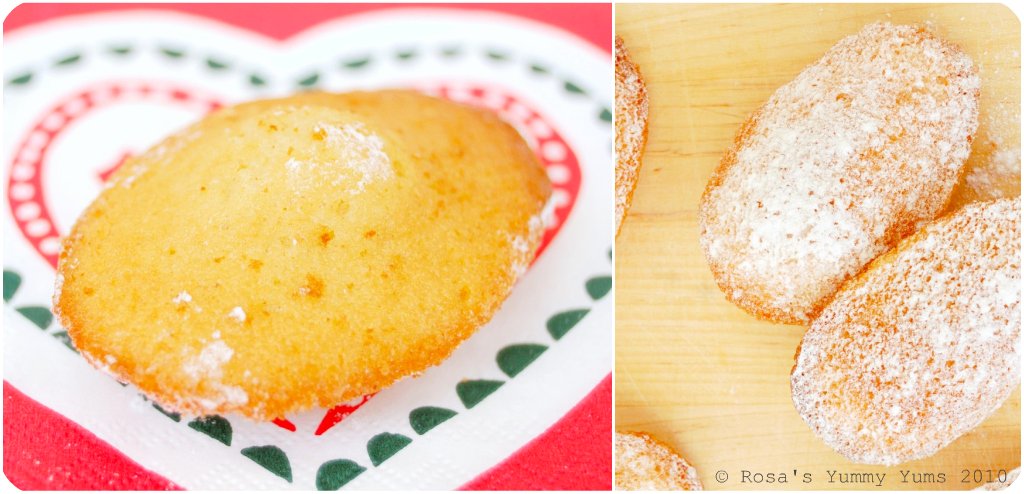
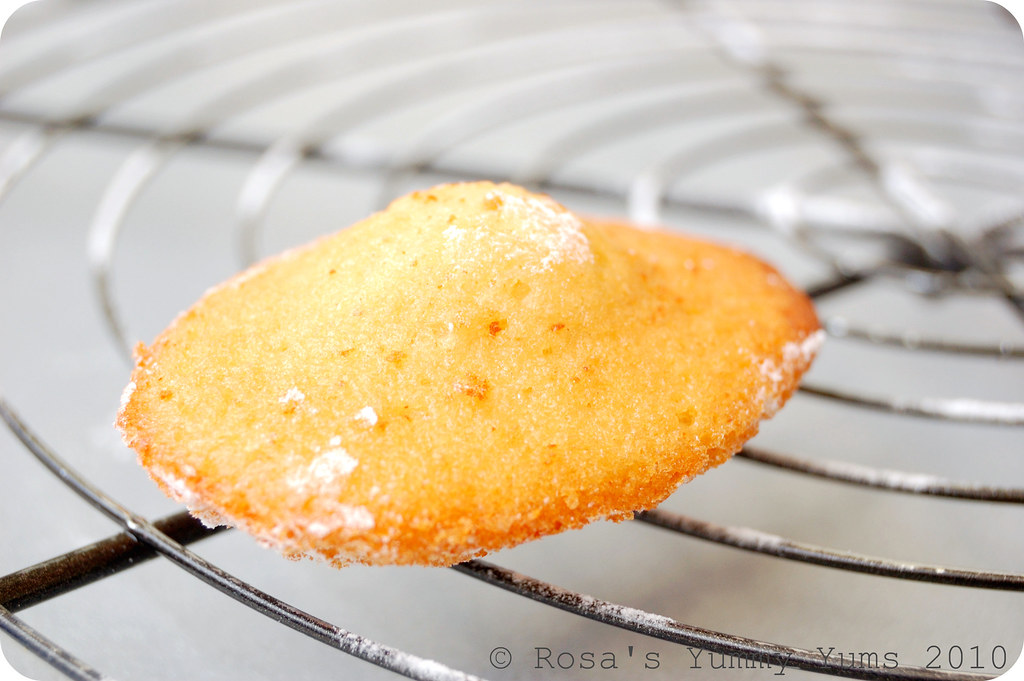
ROSE & HONEY MADELEINES


"She sent out for one of those short, plump little cakes called petites madeleines, which look as though they had been moulded in the fluted scallop of a pilgrim's shell. And soon, mechanically, weary after a dull day with the prospect of a depressing morrow, I raised to my lips a spoonful of the tea in which I had soaked a morsel of the cake. No sooner had
the warm liquid, and the crumbs with it, touched my palate than a shudder ran through my whole body, and I stopped, intent upon the extraordinary changes that were taking place…at once the vicissitudes of life had become indifferent to me, its disasters innocuous, its brevity illusory…"

- Except taken from Marcel Proust's "In Search Of Lost Time" -

~~~~~~~~~~~~~~~~~~~~~~~~~~~

Although I have never been a big fan of industrially produced Madeleines which are very popular here in Switzerland (especially with the kids when I was at primary school in the 80's), that French little cookie-sized cake has always made me fantasize...

There is definitely something magical to that lovely and elegant treat. Whether it has something to do with it's cute shell shape or it's size, Madeleines will not leave you indifferent. They definitely have an attractive aspect and a winning pedigree!


The origin of those tiny sponge cakes is not clear. Some think that they may have been named for a 19th century pastry cook, Madeleine Paulmier, but others believe that Madeleine Paulmier was a cook in the 18th century for Stanislaw Leszczynski, whose son-in-law, Louis XV of France, named them for her. In any case, Madeleines are most famous outside France for their association with Marcel Proust's novel "À La Recherche du Temps Perdu (In Search of Lost Time)", in which the narrator experiences an awakening upon tasting a madeleine dipped in tea...

Well, after having finaly bought a Madeleine pan, I thought that it was about time for me to stop dreaming about them and start experimenting with them. So, on Monday, I made the Génoise-style batter and waited for the next day to bravely get out my mould in order to bake my first batch of close to perfect Madeleines.

After some researching on the net, I decided to make Claudia Flemming's recipe which I freely adapted according to my cravings for spring-like flavors. Originally, her Madeleines are made with chestnut honey, but since I had none I used a normal type of runny honey. And as I wanted to add an extra dimension to them, I ground a few dried rosebuds that I added to the pastry.

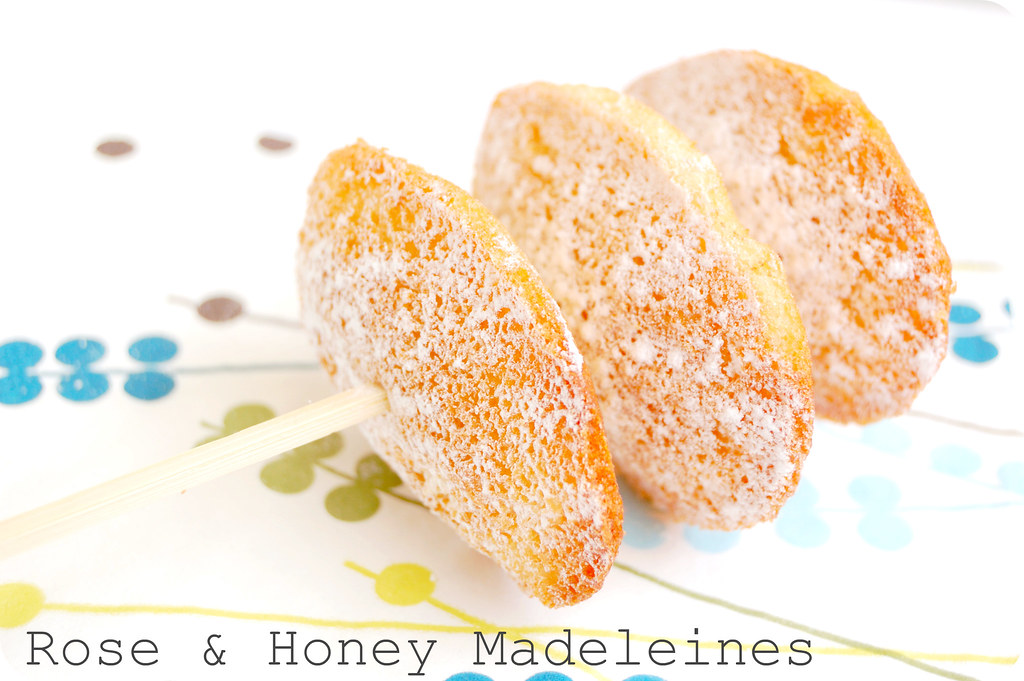
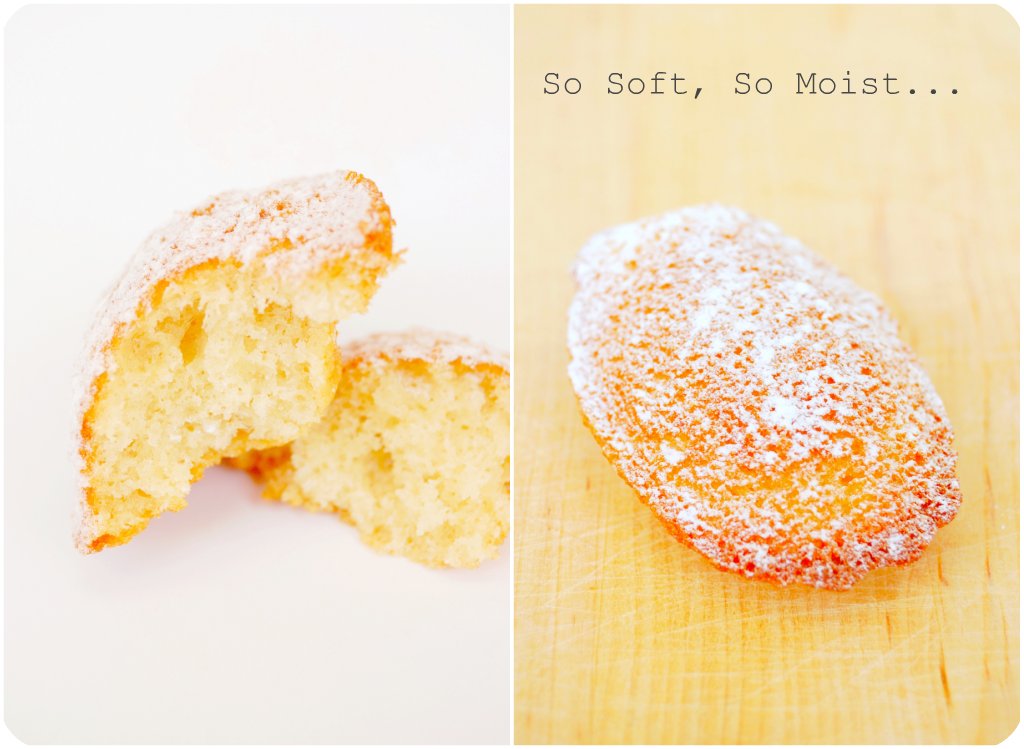
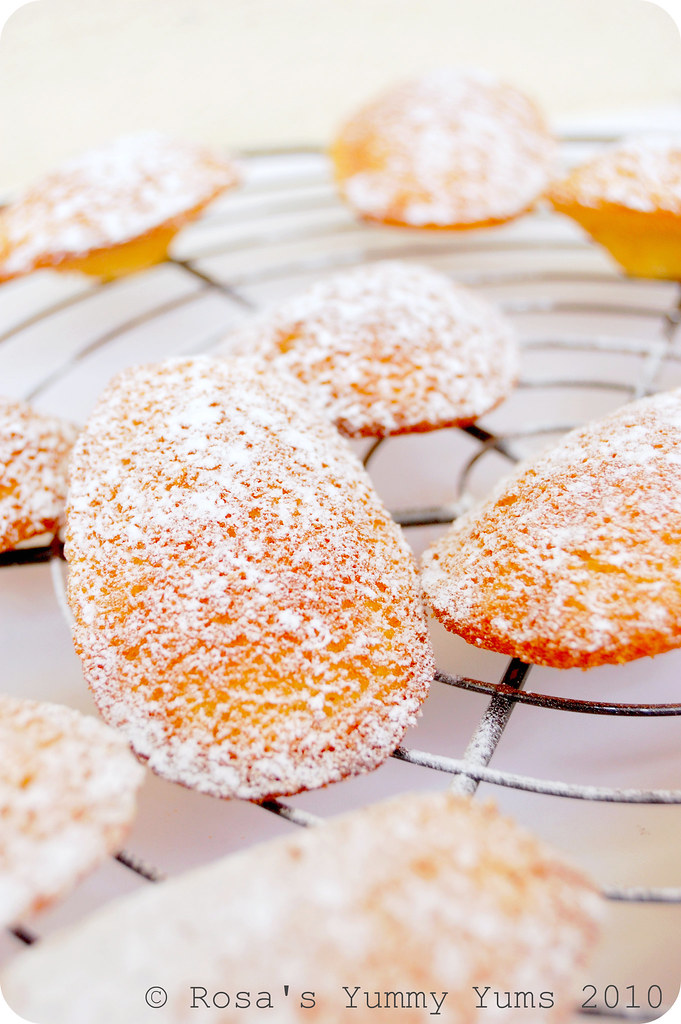
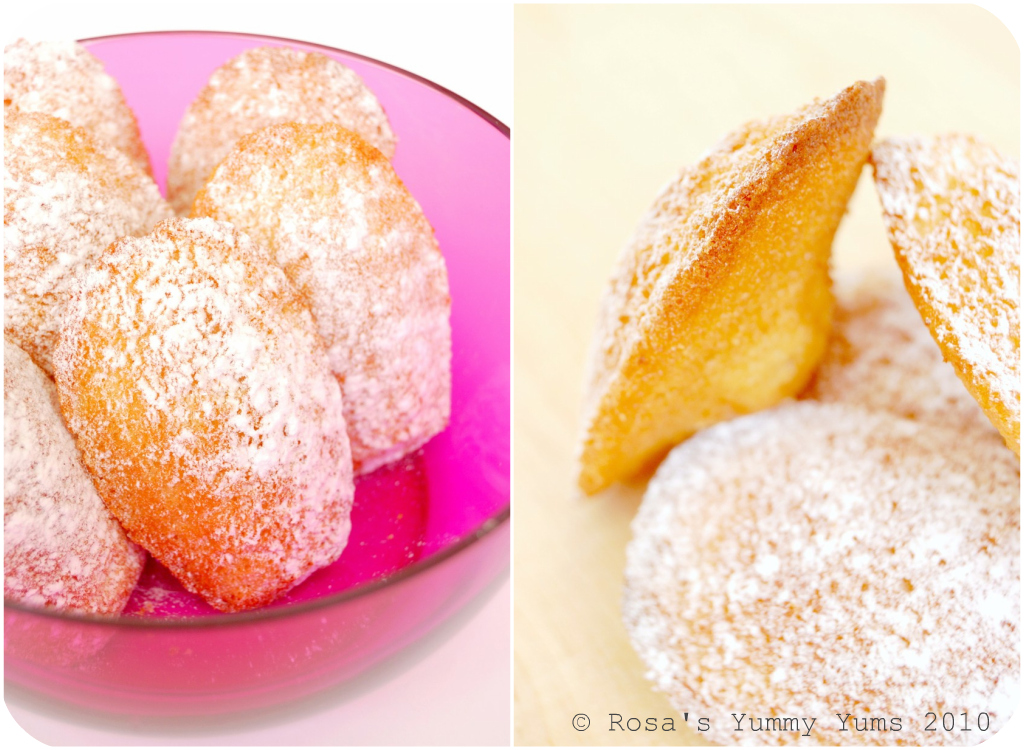
Those "Rose & Honey Madeleines" are very easy to make and taste so good. Texture-wise they are very moist, tender on the inside and slighty crispy on the outside. Taste-wise they have an extremely exhalirating and delicate flowery fragrance as well as a divinely sweet and pungent honey flavor. To die for and a perfect addition to your Easter table!

~ Rose & Honey Madeleines ~
Recipe taken from Claudia Fleming's "The Last Course" and adapted by Rosa @ Rosa's Yummy Yums 2010.

Yields 2 dozen madeleines.

Ingredients:

12 Tbsp (180g/1.5 sticks) Unsalted butter, plus additional softened butter for the moulds
4 Large eggs
1/2 Cup Granulated sugar

2 Tbsp Firmly packed dark brown sugar
1/4 Cup Runny honey (strong flavored)

1 Cup All purpose flour
1/2 Cup Cake flour
2 Tsp Baking powder

1/4 Tsp Sea salt
2 Dried rosebuds, ground

Confectioners' sugar for dusting
Method:
1. In a small skillet over medium heat, melt the butter. Continue to let the butter cook until some of the white milk solids fall to the bottom of the skillet and turn a rich hazelnut brown, about 5 minutes. Strain the browned butter through a fine sieve into a small bowl.
2. In the bowl of an electric mixer fitted with the whisk attachment, beat the eggs, both sugars, and honey until pale and foamy, 2-3 minutes.
3. Sift both flours, the baking powder, ground rosebuds and salt over the egg mixtu
re and use a rubber spatula to gently fold in. Fold in the browned butter. Cover the batter and refrigerate for at least 8 hours, or overnight.
4. Preheat the oven to 200° c (400° F). Liberally butter the madeleine molds. Spoon or pipe the batter evenly into the molds. Bake for 5-7 minutes, until golden brown.
5. Transfer the pans to a wire rack to cool for 5 minutes then unmold the cakes and let them cool completely on the rack. Dust with confectioners' sugar before serving.


Remarks:

I recommend that you butter the pans, then dust the
m with flour and put them in the freezer for a short while before you pipe the batter in the moulds.

Serving suggestions:
Eat those Madeleines whenever you feel like it and don't forget to accompany them with a good cup of tea.
~~~~~~~~~~~~~~~~~~~~~~

~ Madeleines Au Miel Et A La Rose ~
Recette tirée du livre "The Last Course"
de Claudia Fleming et adaptée par Rosa @ Rosa's Yummy Yums 2010.

Pour 2 douzaines de madeleines.

Ingrédients:

180g de Beurre non-salé, plus un peu de beurre ramolli pour beurrer les moules
4 Gros oeufs
105g de Sucre cristallisé
2 CS de Sucre brun clair
60g de Miel (au goût prononcé)
127.5g de Farine blanche

64g de Farine à gâteau
2 CC de Poudre à lever
1/4 CC de Sel de mer
2 Boutons de roses séchées, réduits en poudre
Sucre en poudre pour saupoudrer


Méthode:
1. Dans une petite poêle faire fondre le beurre
à température moyenne. Continuer à cuire le beurre pendant 5 minutes jusqu'à ce que le lactose se teinte (couleur noisette) et tombe au fond de la poêle. Filtrer le beurre et réserver.
2. Dans le bol d'un robot, battre (avec le fouet pendant 2-3 minutes) les oeufs, les sucres et le miel jusqu'à obtention d'une mousse
pâle.
3. Tamiser les farines avec la poudre à lever, la poudre de boutons de roses et le sel et ajouter à la mi
xture aux oeufs. Incorporer délicatement avec une spatule et laisser reposer au frigo pendant tout une nuit (ou 8 heures au moins).
4. Péchauffer le four à 200° C. Beurrer généreusement les moules à madeleines. Les remplir avec la pâte à l'aide d'une cuillèere o
u d'une poche à douille. Cuire 5-7 minutes, jusqu'à ce que les madeleines soient dorées.
5. Transférer le moule sur une grille et laisser refroidir pendant 5
minutes avant de les démouler et de les faire refroidir complètement. Saupoudrer avec du sucre glace.

Remarques:
Je vous recommande de bien beurrer les moules et de les saupoudrer avec de la farine, puis de les mettre un petit moment au congélateur avant de les remplir.


Idées de présentation:
Mangez-les à toutes heures de la journée et n'oubliez pas de les
accompagner d'une bonne tasse de thé.

Friday, October 30, 2009

A TRIP TO LYON - PARTIII

As Lyon is very famous for it's unique gastronomy and is labeled the French capital of eating, I could not imagine going there without tasting to what makes it's reputation so strong: bouchons bistros and Lyon's local specialities. For any foodie, going to Lyon is a little like doing a pilgrimage to the Mekka of good taste.

Bouchons are authentic old restaurants (the tradition came from small inns visited by silk workers passing through Lyon in the 17th and 18th century) that can only be found in Lyon and that serve traditional regional dishes such as sausages, duck pa, pork products, soft cheese with herbs ("Cervelle de Canut"), Saint-Marcellin and Saint-Félicien cheeses, tripe products, fried pork fat, beignets ("Bugnes"), offals, cardoon, quenelles dumplings, lemon tart, parline tart and many more.

The Lyonnaise cuisine dating back to the intuitive cooking of those famous robust cooks the "mères lyonnaises (Lyon mothers)" who gave Lyon's cuisine its very special character is simple, rich, homey and tasty.

So, after doing a lot of research on the net and reading many blog or magazine articles on the subject, I decided to try the "Café des Fédérations" which is certified "authentic" by the organisation Les Authentiques Bouchons Lyonnaiss and is one of the oldest bouchons in Lyon and still one of the best.

Having read about this bouchon's convivial atmosphere and the owner's gift of the gab which are so common in this kind of restaurant, we both felt slightly uneasy at the thought of entering it. Anyway, we finally were able to gather enough courage in order to push the door of "Café des Féderations". Upon entering, we immediately got transported into the magical world of bouchons and we were greeted by a very chatty Yves Rivoiron who already made a joke after we had said "Bonjour. Nous avons réservé une table." (Hello. We have booked table) to which he answered in his own teasing way "Are you sure? I am not! Mmmmhhh, let's see if there's a table for you.". Very folkloric and kind of cliché, but so "exotic" and entertaining.

We just had time to install ourselves that we were already served (lentil salad, veal's head in vinaigrette, an assortiment of dried meats with gherkins, bread and a pitcher red Morgon wine and one of water). Then we had to choose our main dish among tête de veau (veal's head), pork cheeks stew, tablier de sapeur (the flat cut of tripe which has been cut into a rectangle and fried), andouillette (chitterling sausage), chicken in vinegar, quenelle, boudin noir (blood sausage), gâteau de foies de volaille (poultry liver cake, prepared with the white livers from the poulet de Bresse).

As I din't want to take the same dish as my boyfriend as I wanted to sample their food, I ordered "Andouillette" which was served in a delicious mustard sauce and accompanied by one of the best creamy "Gratin Dauphinois" I have ever come across out of home. Mr. P. took the gargantuesque "Boudin Noir" dish which was served with an immense pile of cooked apples.

Then, for dessert, we had the choice to take either a sweet speciality (lemon tart, homemade pear ice cream, chocolate mousse or praline tart) or a platter of regional cheeses. As we both were already full, we opted fot the dessert (lemon tart) which was scrumptious.

Needless to say that this meal was fantastic, comforting and scrumptious. We really enjoyed every dish as everything was perfect, tasty and so pleasing. Lunch for 2 was dirt cheap. We paid 50 Euros for a three course menu (appetizer, main dish & dessert) that included wine and coffees. And at the end of the meal, we were litterally exploding as the platings were very generous (We had to roll ourselves through the town for the rest of the day!!!).

If ever you are in Lyon, I strongly recommend you to go there and experience the unique and kitschy atmosphere of that place! It is so popular that t
he "Café des Fédérations" is full all the time and it is very difficult to find a free table if you haven't booked it in advance (which you'd better do at least 2 days before via phone or fax)...

An experience I am ready to renew anytime we go back to Lyon!

Tuesday, October 27, 2009

MACARONS - THE DARING BAKERS

The end of the month is once again on our doorstep and time has come for all of us lovers of flour, eggs and sugar to post our Daring Bakers latest creations to date...

Can you believe that this is the 25th consecutive challenge that I complete as A Daring Baker (2 years and one month as a member)? Incredible! Sometimes, I amaze myself with my voluntarism and capacity to never call it a day even if I'd love to do so. It is a real miracle that such a pessimistic fraidy-cat like me like me is able to gather enough strenghth in order not to throw the towel when my baking skills are being put to the test. I am able to prove that I can surpass myself, jump over my shadow and confront my fears with much perseverance and determination...

The 2009 October Daring Bakers’ challenge was brought to us by Ami S. who chose "Macarons" from Claudia Fleming’s "The Last Course: The Desserts of Gramercy Tavern" as the challenge recipe.

Some of you might remember that in December 2008, I had made my very first "Macarons" with my friend Jessica from Maryland (USA) and wrote about how that French speciality always filled me with apprehension and how scared I was at the idea of trying to compare with people who mastered the art of making "Macarons" to the perfection, yet how, at the end, we found them not as daunting as we imagined...

Well, to tell you the truth, this time around, I wasn't as relaxed as I wished to be considering the fact that it would not be my very first time with that speciality. Unfortunately I was as scared of getting started as if it had been when I made my inaugural batch of "Macarons" batch. What made me uncomfortable was the fact that "Macarons" are notoriously tricky to make and testing an unknown recipe made me even feel more edgier. Silly girl! Sometimes I can be really stupid, but nevermind.

Anyway, no matter how uneasy I felt about going through the whole process of making "Macarons" again, I promised myself that they were going to look better than the first time around and that I would forever put an end to my "Macarons" angst. The result was surprinsingly very exciting and with my fears put aside, I instantly understood why people can't stop carrying on about those cute little sugar gems-

As we were free to use the flavorings of our choice for our "Macarons", I decided to add some vanilla sugar to the delightfully almond-tasting macaron shells and make an "Orange, Cinnamon & Cubeb Pepper Buttercream" as filling. Heavenly!

Apart from having the most luscious aroma, my "Macarons" also had the most perfect texture I had ever come across. They weren't shallow, were crisp on t
he outside and chewy on the inside. A macaron-lover's dream!

I wish to thank Amy S. at "Baking Without Fear" (USA) for choosing this awesome recipe! I really enjoyed making "Macarons" and was so happy to get a little training in order to perfect my skills.

~ Vanilla Macarons With Orange, Cinnamon & Cubeb Pepper Buttercream ~ Recipe taken from Claudia Fleming’s "The Last Course: The Desserts of Gramercy Tavern".

Macaron Shells

Yields 10 dozen macarons

Preparation time:
Not taking into account the amount of time it takes for you to bring your egg whites to room temperature, the whole baking process, including making the batter, piping and baking will probably take you about an hour to an hour and a half.

Actual baking time:
17-20 minutes in total.

Equipment required:
• Electric mixer, preferably a stand mixer with a whisk attachment
• Rubber spatula
• Baking sheets
• Parchment paper or nonstick liners
• Pastry bag (can be disposable)
• Plain half-inch pastry bag tip
• Sifter or sieve
• If you don’t have a pastry bag and/or tips, you can use a Ziploc bag with the corner snipped off
• Oven
• Cooling rack
• Thin-bladed spatula for removing the macaroons from the baking sheets
• Food processor or nut grinder, if grinding your own nuts (ouch!)

Ingredients:
225g (2 1/4 Cups) Confectioners’/Icing sugar

190g (2 Cups) Almond flour
25g (2Tbs) Granulated sugar
5 Egg whites, at room temperature

Directions:
1. Preheat the oven to 200°F (93°C). Combine the confectioners’ sugar and almond flour in a medium bowl. If grinding your own nuts, combine nuts and a cup of confectioners’ sugar in the bowl of a food processor and grind until nuts are very fine and powdery.
2. Beat the egg whites in the clean dry bowl of a stand mixer until they hold soft peaks. Slowly add the granulated sugar and beat until the mixture holds stiff peaks.

3. Sift a third of the almond flour mixture into the meringue and fold gently to combine. If you are planning on adding zest or other flavorings to the batter, now is the time. Sift in the remaining almond flour in two batches. Be gentle! Don’t overfold, but fully incorporate your ingredients.
4. Spoon the mixture into a pastry bag fitted with a plain half-inch tip (Ateco #806). You can also use a Ziploc bag with a corner cut off. It’s easiest to fill your bag if you stand it up in a tall glass and fold the top down before spooning in the batter.
5. Pipe one-inch-sized (2.5 cm) mounds of batter onto baking sheets lined with nonstick liners (or parchment paper).
6. Let the macaron rest for 30-60 minutes.
7. Bake the macaron for 17-20 minutes at 150° C (302° F)

8. Cool on a rack before filling.

***************

Orange, Cinnamon & Cubeb Pepper Buttercream Filling

Makes about 1 cup buttercream.

Ingredients:

120g (1 stick) Unsalted butter, at room temperature

(1 Cup) Confectioners'/icing sugar
1/2 Tsp Orange essence
1/2 Tsp Ground cinnamon
1/4 Tsp Freshly ground cubeb pepper

Method:
1. Cream the butter until pale and smooth.
2. Add the sugar and spices. Incorporate.
3. Beat the mixture until light and fluffy.
4. Fill the macarons.


Remarks:

This buttercream melts, so keep your macarons in the fridge.

The macarons will be better the next day, so don't eat them straight away!

Additional information:

David Lebovitz breaks it down.

More macaroon 411.
Get inspired by our own Tartlette!
Go behind the scenes of Paulette.
Watch a pro pipe macaroons.
Beating egg whites.

***************

Etant donné la longueur du texte original, je n'ai malheureusement pas pu faire une traduction française de ce billet et je m'en excuse auprès de tous mes amis lecteur s et blogueurs francophones!

C'est pourquoi je vous suggère de vous rendre sur les blogs mentionnés ci-dessous. Vous y trouverez cette recette en version française.

Chez Jasmine de "Jasmine Cuisine" (Canada)
Chez Isa de "Les Gourmandises d'Isa" (Canada)