Showing posts with label Drinks. Show all posts

Wednesday, August 27, 2014

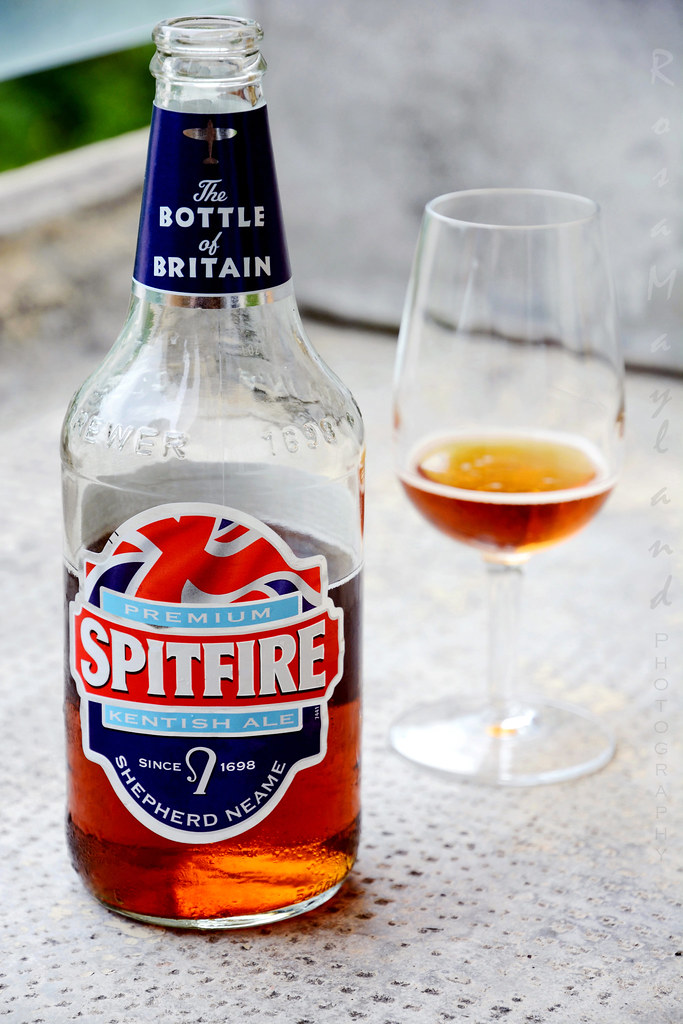
SPITFIRE PREMIUM KENTISH ALE: COMPLETE PROFILE

A quart of Ale is a dish for a king.
- William Shakespeare
Origin: Kent, UK. 
Produced By: Britain's oldest (founded in 1698) and most popular brewery (they produce more than 5.5 million gallons of beer a year), Shepherd Neame Limited from Faversham.
Status: Spitfire Premium Kentish Ale is a standout brew and is the biggest ale success story of the last decade (Shepherd Neame's biggest-selling cask conditioned ale). Besides, it also has Protected Geographical Indication, just like Champagne and Parma Ham.
History: Originally produced in 1990 to commemorate the 50th anniversary of the Battle of Britain, Spitfire is now a permanent feature on the Shepherd Neame portofolio.
Awards: Winner of a gold medal and Best Strong Cask-Conditioned Beer of the World at the Brewing Industry International Awards.
Colour: Clear, rich, darkish amber with orange and copper hues.
Smell: Clean, dry, malty, slightly bitter with hints of buttery popcorn, nuts, grass, fruits (apricots & bitter oranges) and flowers.
Flavour: This traditional British beer is wonderfully hoppy and minerally, and has aromas of bread, yeast, apricots, nuts with hints of cinnamon, toffee, raspberries, red grapes, marmalade, pepper and a enjoyable bitter as well as a grassy aftertaste and a sweet honey and caramelly flavour that lingers for an eternity.
Body: Medium, but with a nice dryness.
Carbonation: Medium with rather sharp bubbles.
Alcohol Content: 4.5%
Cost: Not the cheapest beer on the market, but not ridiculously expensive either.
Food pairing: Perfect with good old English grub like fish and chips, cheese and onion crisps, cheese (Cheddar, Red Leicester, Lancashire, Caerphilly, etc...) and crackers, pies, coronation salad, roasts, fish (poached salmon & haddock), grilled meats and even oatmeal cookies or shortbreads. It also pairs splendidly with Asian food (as long as it's not too fiery) and dishes such as quiches, pâtés, terrines, omelets, savory crêpes or continental cheeses that are not too overpowering (Edam, Tilsit, Cantal, young Gruyère, Comté, Beaufort, etc...).
Verdict: Refreshing, smooth, elegant, well-balanced, intensely flavorful and pleasant. A magnificent and highly recommendable ale.

Friday, August 10, 2012

SEA ISLAND COFFEE - A REVIEW

Sea Island Coffee 2 bis
The smell of coffee cooking was a reason for growing up, because children were never allowed to have it and nothing haunted the nostrils all the way out to the barn as did the aroma of boiling coffee.
- Edna Lewis


I have measured out my life with coffee spoons.
- T.S. Eliot
I have been enjoying coffee most of my life. My fondness for the brew started when I was a child. Already then, I found its amazing frangrance enticing and I was a sucker for desserts that were perfumed with it. Of course, at this time, I wasn't granted the access to this magic potion reserved for adults, so I contented myself with a substitute. It may not have been the real thing, but this kid-friendly ersatz sure tasted very close coffee and it dispensed a lot of happiness too. Those characteristics were suffucient for me and, in my defense, I must point out that my Mémé (Swiss grandma from Vaud) was the queen of coffeeweed. Her legendary chicory au lait was remarkably delicious and comforting. Heaven in a mug!

Not long after, around the age of 14, I finally ingested my first sips of that much coveted coffeinated drink. At the beginning though, this dark brew's main purpose was not really to provide me with gustative indulgence. Instead, I employed it to give myself energy, increase my confidence, boost my intellectual faculties and calm my nerves during exam periods as tests traumatized me to the highest point. But, as I grew a little older it became a symbol of maturity, a way of showing people that I had grown up and wasn't a baby anymore. In my late twenties, I discovered that it wasn't just a pleasant beverage you drank on café terraces with friend while philosophizing, but that it actually had terroir, a soul of its own and could be savored just like a wine. That's when I began to search for gourmet blends and stopped being satisfied by the astringent "piss" that restaurants and tearooms frequently served. Nowadays, I choose my coffee carefully and since I have a considerably more selective palate than before, I've moved from rot gut to refined.

At home my mother prepared coffee with an aluminium moka machine that dated back to the 70's and ground her whole beans directly at the supermarket. The year I moved in with my partner P., his parents gifted him an espresso machine (no capsules). Sadly, it broke down rapidly despite its significant initial cost and promising brand name. So, the day we moved into our second lovenest, we opted for a classic Italian stovetop pot from IKEA. Uncomplicated and low-maintainance. Each method we tested was good and gave gratifying results, yet none was particularly exceptional. However, I felt that there must be another manner of producing coffee which is not acutely bitter or acid, and which is round as well as fragrant. It still had to come across the right one, though...

No one can understand the truth until he drinks of coffee's frothy goodness.
- Sheik Abd-al-Kadir

Coffee should be black as Hell, strong as death, and sweet as love.
- Turkish Proverb
Until 2010, I was a frustrated "battery acid" addict who had not yet unearthed the coffee Grail and was accustomed to mediocrity for lack of finding better. I had a love-hate relationship with this decoction. Luckily, my big revelation came one April evening, two years ago, thanks to a lovely blogger called Zarpandit (check out her site "Cikolata Kavanozum") who sent me a heartwarming package containing a pretty card portraying the Topkapi Palace, a miniature copper cevze, a set of two adorable espresso cups and saucers, a packet of Turkish coffee and a box of exquisite lokums. An extremely kind and generous gesture which made me gleeful and uplifted my mood (at this period, my job was negatively challenging and awfully stressful).

A few hours later, my "kavhe" virginity was forever lost. That dinky ibrik
was so cute - a foodie toy par excellence! - and the fine-ground coffee looked terribly tempting in it's somewhat exotic and retro packaging that I had to play with them IMME-DIA-TELY!

After surfing the internet for information on those unfamiliar items, I entered the kitchen like an pioneer on a mission, brimming with curiosity, and shyly poured water in the pot. With a trembling hand I added a few teaspoons of the precious bean powder and a little sugar into my minuscule brass pot, then stirred well and with great anticipation, I slowly heated the mixture (see my recipe & check out this article). Once the surface started to foam I excitedly poured the opaque liquid into my tiny cups.

Needless to say that I immediately enamored myself with this strong beverage's exhalirating aromas, pungent richness as well as intense, luscious, fresh, full-bodied and divine flavor. Quite mind-blowing and totally irresistible! And to top that fabulous experience, the whole preparation process enraptured me - it can be compared to meditation as it requires patience, relaxes you, builds up your craving and puts you in the right mindset for reaching "kaffa" nirvana. The Turks really understand how the mechanisms of gustatory pleasure work...

I cannot imagine living without this marvelous fluid as it is vital for my overall well-being and dear to the sensual gourmet I am, hence I solely purchase quality coffee and steer clear from bad products. Therefore, when I was approached by Sea Island Coffee my foodie geekness was awakened. How could I refuse the opportunity to try two of their luxurious samples? There was no way I was going to decline their enticing offer.*


For those who are not familiar with this small enterpriseSea Island Coffee is based in Knightsbridge, London (UK) and is one of Europe’s leading importers of specialist coffees from around the world. Their aim is to supply rare, exclusive, exotic, intriguing and top-notch coffees which deliver a wonderful and exceptional combination of taste, body and provenance.

Generally, I am always careful when people promise us the moon and never buy into any company's advertisement propaganda as generally their words are just empty/hollow and their affirmations are pure commercial ramblings, so I circumspectly read through Sea Island Coffee's leaflet and tried to not let my tasting session get influenced by their pamphlet. You see, I believe that neutrality is crucial when you are writing a serious and unbiased review.

Anyway, both the coffees I was given to judge were so impressive and tantalizing that I got blown away by their
overwhelmingly distinctive personality, sheer uniqueness and top-class sublimity. Definitely nothing meanstream or cheap here, trust me. As a matter of fact, pure mouth-orgasm is guaranteed with every swig!

Sea Island Coffee 5 1 bis
Geisha - Costa Rica
This ancient and very rare Ethiopian wild coffee variety is grown on the Coffea Diversa plantation in Costa Rica (
close to the Panamean border) which has pioneered the botanical garden approach to coffee cultivation. Aromatically complex, yet mild, this stunning coffee delivers notes of lavender, cocoa and hints of molasses.

Jamaica Blue Mountain - Jamaica
Cultivated on Clifton Mount, one of the oldest functioning coffee estates in Jamaica, this world-reknown coffee is considered by many connoisseurs to be one of the best on the market. It is exquisitely well-balanced (aroma, body and acidity in equal parts), incredibly smooth, spectacularly pungent and has a creamy aftertaste as well as hints of chocolate with floral, caramel and vanilla undertones.

* Please note that I only promote things that stay true to my tastes, convictions and interests. The opinions expressed on Rosa's Yummy Yums are purely my own and based upon my personal experiences with SEA ISLAND COFFEE. I was not paid nor asked to publish a positive review.

Coffee-Flavored Recipes:

Saturday, July 31, 2010

SOUTHERN-STYLE ICE TEA - THÉ FROID

Ice tea Picnik-Collage 3 bis bis
When I was a teenager in the 90's "Ice Tea" was really very trendy. Switzerland had discovered this beverage at the end of the 80's, but it was only a few years later that it got extremely popular...

I remember that "Ice Tea"
(here, herbal iced teas - peppermint or alpine herbs - are also labeled as "Ice Tea" - not only the black tea or green tea versions) was the only thing that kids drank (together with Coke, of course - I never loved that drink though) and I was no exception to the rule. At home, we stocked gallons of that beverage (bought in Migros only - my favorite brand). If all cartons disappeared and no "Ice Tea" was left, then you could have been sure that I would make real tantrum. My worst nightmare (LOL). I was so addicted to it that I could not drink anything else. Of course, ingesting so much sugar (so many calories) on a daily basis cannot be good for your body and I believe it is one of the reasons (this and eating a little too well) why I got a little "stocky" (baby fat) when I was 16-18 years old (thankfully it is not the case now anymore, phew).

At this time, certain countries like France or England didn't know what commercial "Ice Tea" was. Once, in Annecy, at a tea room I ordered an "Ice Tea" naively thinking that they were going to get it out of either a carton or a bottle, but to my big surprise the waiter looked at me with big suprised eyes as if I had asked for the most exotic of drinks! He asked me what I meant and I explained what it was. So after a while he came back with a freshly brewed glass of "Ice Tea" that the bartender had made specially for me. It was the most delightful "Ice Tea"I ever had. They had even added a ball of homemade lemon sorbet to it. Fantastic! This little adventure still makes me laugh...

My love for "Ice Tea" has not died, but my I am no longer a fan of the bought kind and I drink lots of water now. My tastes have changed since I have grown older. Industrial "Ice Tea" does not please me anymore. I find it far too sweet, bland, unhealthy and chemical. As my grownup tastebuds demand quality foods, I resolved myself to making my own "Ice Tea". In that way, all my needs and craving can be fulfilled.

After having tested different brands of black teas, I have come to the conclusion that the best one to use when preparing "Ice Tea" is Lipton. Although it is far from being my favorite black tea for making a good cuppa (Twinnings or Palais des Thés black teas are far better as they have more character and are more complex - a totally different class of teas), Lipton "Yellow Label" is perfect when used for making "Ice Tea" as it's not too strong and has light aromas.

I always use a lot of lemon juice and rind to add some character to the brew which would be too boring without that gorgeous citrusy touch. Then I sweeten it with a little light brown sugar and light runny honey in order to give more deepness to my "Ice Tea". Finally, I always integrate a little lemon essence to that drink as it brings an extra lemony kick and freshness to it.

The recipe I am posting today is mine. I tested many different variations and experimented a lot before I found that perfect combination. My "Ice Tea" is neither too sweet, to strong nor insipid. The acidity of the lemons counterbalances wonderfully the sugariness of the sugar and honey, and the exhalirating fragrance of the essence just lifts up the whole flavor in a delightful way. So refreshing and delicious!


Ice Tea Picnik-Collage 1 bis
~ SOUTHERN-STYLE ICE TEA ~
Recipe by Rosa @ Rosa's Yummy Yums 2010.

Makes about 2.8 litres ice tea.

Ingredients:

3 Bags Black tea (I used Lipton "Yellow Label")
2.6 Litres Water
220-240ml Lemon juice (organic/about 2 lemons)
The zest of 1 Organic lemon
5 Tbs Light brown sugar
4 Tbs Runny Honey
1/3 Tsp Natural lemon essence

Method:
1. Heat water in a big pan and bring to a light boil.
2. Add the tea bags and let infuse for about 8-10 minutes, then dispose of the bags.
3. Add the rind of one lemon, the sugar, honey and essence. Stir well until the honey and sugar are dissolved.
4. Let cool completely.
5. Sieve the preparation.
6. Put the jugs in the fridge for at least 2-3 hours or until cold.
7. Serve.

Ice Tea Picnik-Collage 5 bis
Remarks:
Don't let the tea infuse for too long or the ice tea will have a bitter taste.
If you find that the ice tea is not sweet enough, then feel free to add a little more sugar or if it is too sweet then add a little water.

Serving suggestions:
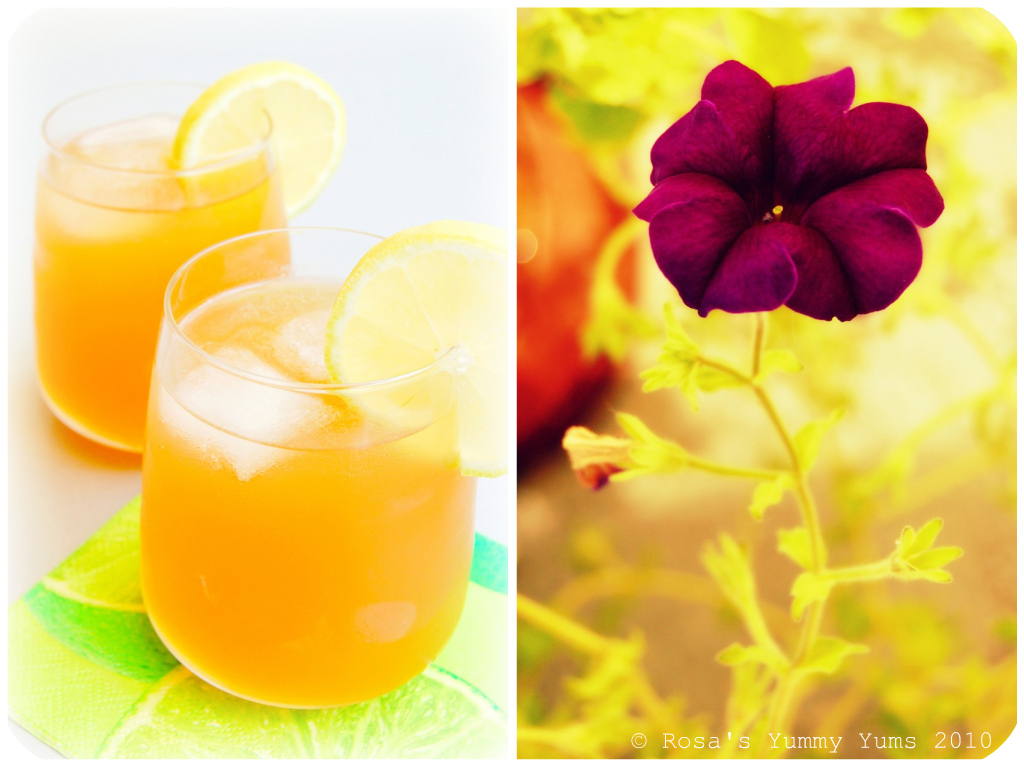
Serve at any time of the day or night with ice cubes and slices of lemon or add a ball lemon sorbet to the ice tea.

~~~~~~~~~~~~~~~~~~~~~~

Ice Tea Picnik-Collage 2 bis
~ THÉ FROID US ~
Recette par Rosa @ Rosa's Yummy Yums 2010.

Pour environ 2.8 litres de thé froid.


Ingrédients:

3 Sachets de thé noir (j'ai utilisé du Lipton "Yellow Label")
2.6 Litres d'Eau
220-240ml de Jus de citron bios (~2 citrons)
Le zeste d'un citron bio

5 CS de Sucre brun clair
4 CS de Miel liquide
1/3 CC d'Extrait naturel de citron

Ice Tea Picnik-Collage 4 bis
Méthode:
1. Porter l'eau à ébullition (petit bouillons).
2. Ajouter les sachets de thé et laisser infuser 8 à 10 minutes, puis retirer les sachets.
3. Ajouter le zeste, le jus de citron, le sucre, le miel et l'extrait de citron. Bien mélanger afin que le sucre et le miel soient dissouts.
4. Laisser refroidir complètement.
5. Passer au tamis.
6. Transférer dans un pot et mettre au frigo au moins 2 à 3 heures ou jusqu'à ce que le thé froid soit froid.
7. Servir.

Remarques:
Ne laissez pas le thé infuser trop longtemps autrement votre thé froid aura un goût amer.
Si vous trouvez que le thé n'est pas assez sucré alors vous pouvez ajouter soit du sucre ou du miel et si, au contraire, vous le trouvez trop sucré, alors ajoutez un peu d'eau.


Idées de présentation:
Servir ce thé froid à n'importe quelle heure de la journée ou de la nuit avec des glaçons et une tranche de citron ou avec une boule de sorbet au citron.

Ice Tea Picnik-Collage 6 bis

Friday, January 22, 2010

TURKISH COFFEE - CAFÉ TURC


"Ah, how sweet coffee tastes! Lovelier than a thousand kisses, sweeter far than muscatel wine! I must have coffee....", Johann Sebastian Bach in 1732.

Until now, I have very rarely blogged about beverages. It is not that I don't like to drink, it's just that I never really think about writing on that subject. Well, thanks to Zarpandit from "Cikolata & Istanbul" (Turkey), I'm about to change things a little...

Since she sent me a packet which contained two little cups and saucers as well as some "Turkish Coffee" and a "cezve", there was no way that I was not going to grab the opportunity to blog about that unique drink.


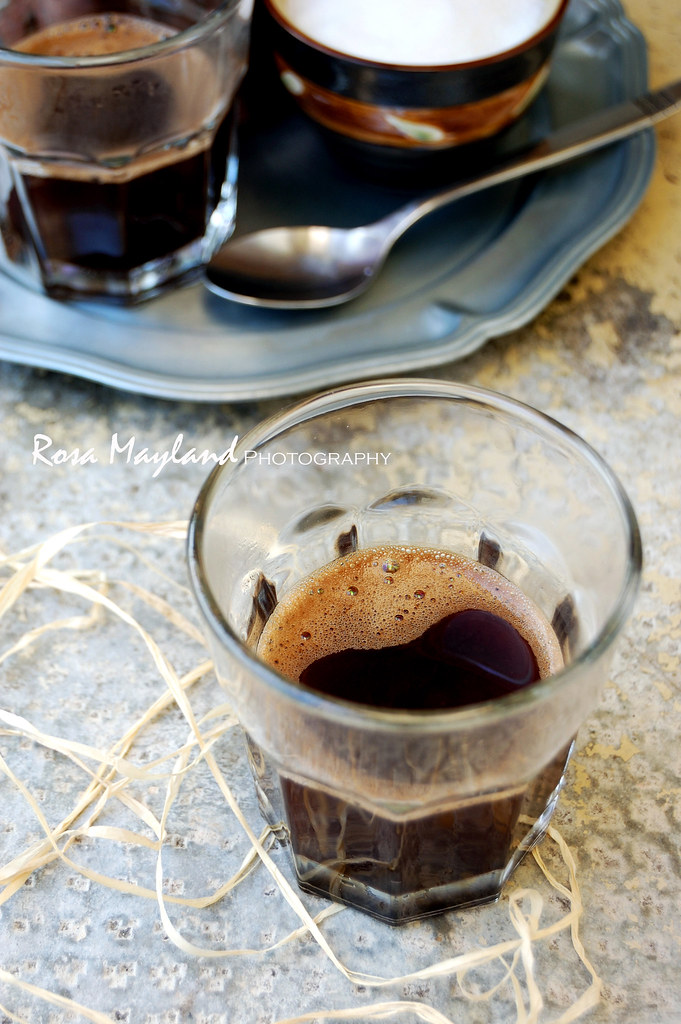
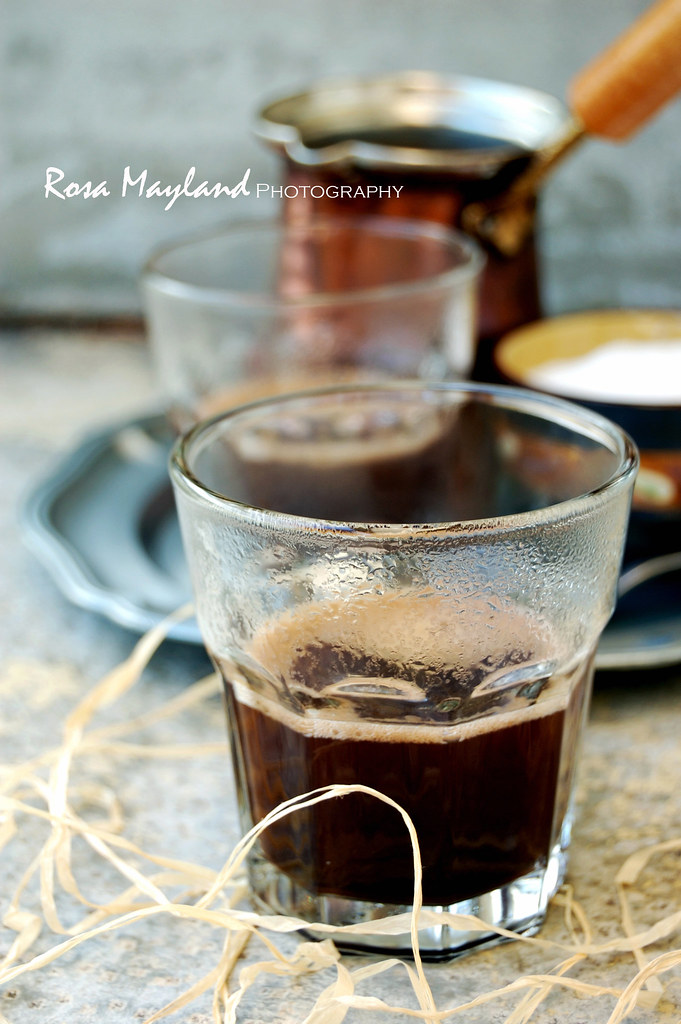
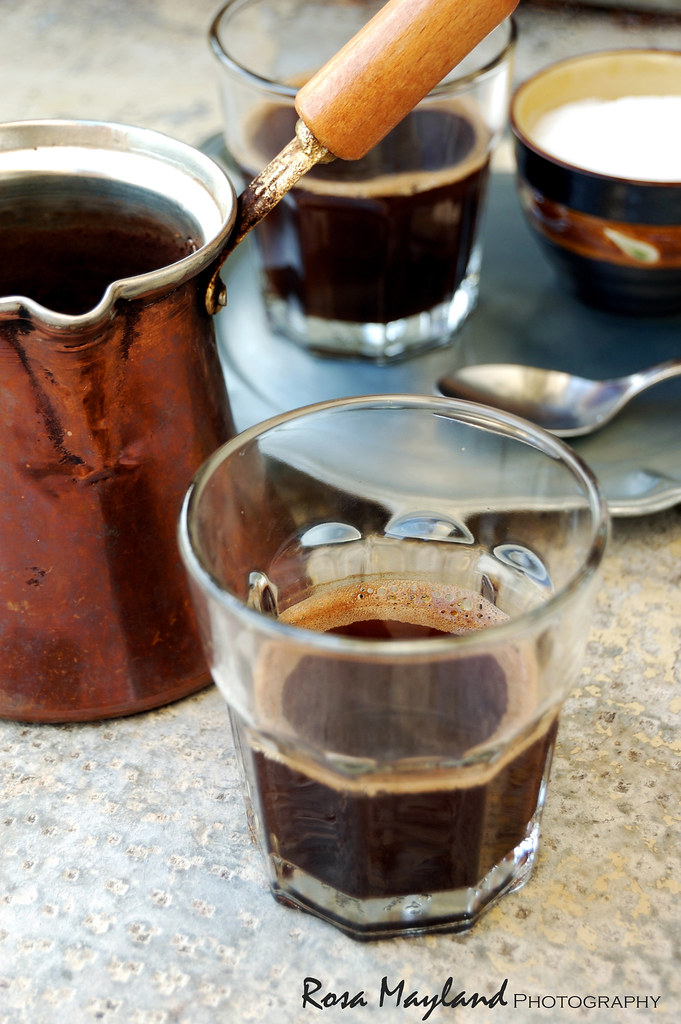
"Turkish Coffee" is a very fragrant, strong and dark coffee prepared in a "cezve", a small pot
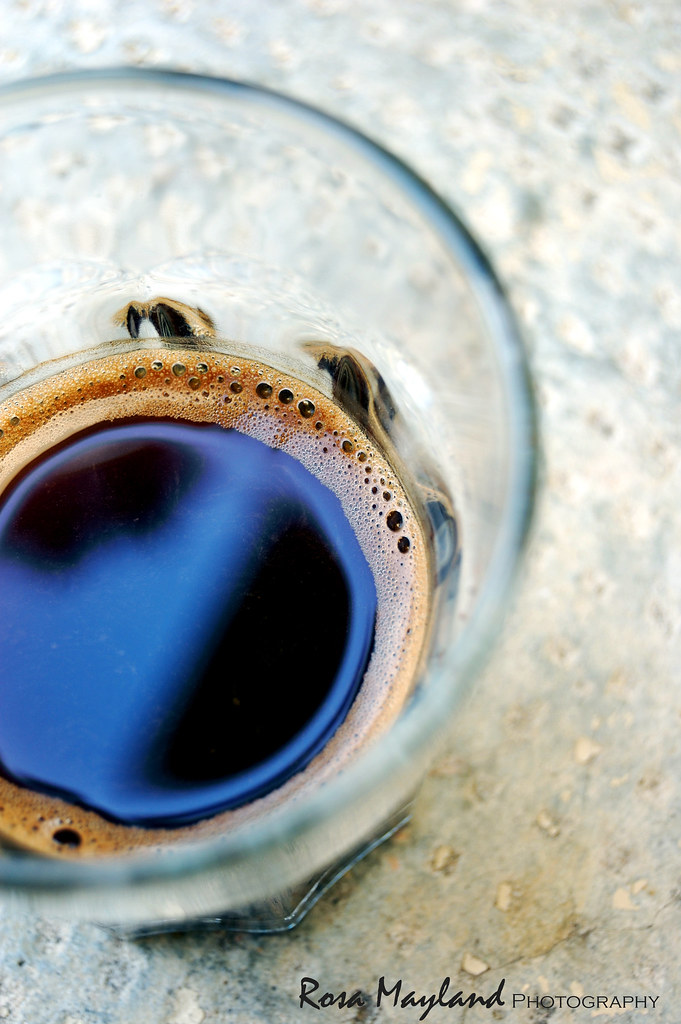
that holds either one or two servings. Compared to other coffees, this one is made by putting water, sugar and ground coffee in a pot, bringing that mixture to the boil and serving it unfiltred.
This way of making coffe was introduced to Turkey over four and a half century ago, not long after a Turkish governor brought back beans of coffee Arabica from Yemen. Within a century, first Venice, then London and Paris were introduced to coffee via the Ottomans, which naturally acquired its epithet “Turkish” to become “Turkish Coffee”.

At the origin, coffee comes from Ethiopia, the true home of the plant, where it still grows wild in the forest of the highlands. It is believed that its cultivation as well as use began as early as the 9th century and that Ethiopian ancestors of today's Oromo people were the first to have discovered and recognized the energizing effect of the coffee bean plant. Knowing that, one can imagine that it is their coffee ceremony that has been exported to Turkey, Greece, the Middle East, North Africa, the Caucasus and the Balkans where similar methods of preparation exist.

I am a real sucker for good coffee and I must say that since I have discovered "Turkish Coffee", I can't drink any other coffee without thinking that it is less flavorful and pleasant. Divine!


~ Turkish Coffee ~

Recipe for one cup.

Ingredients:
1 Cup Water

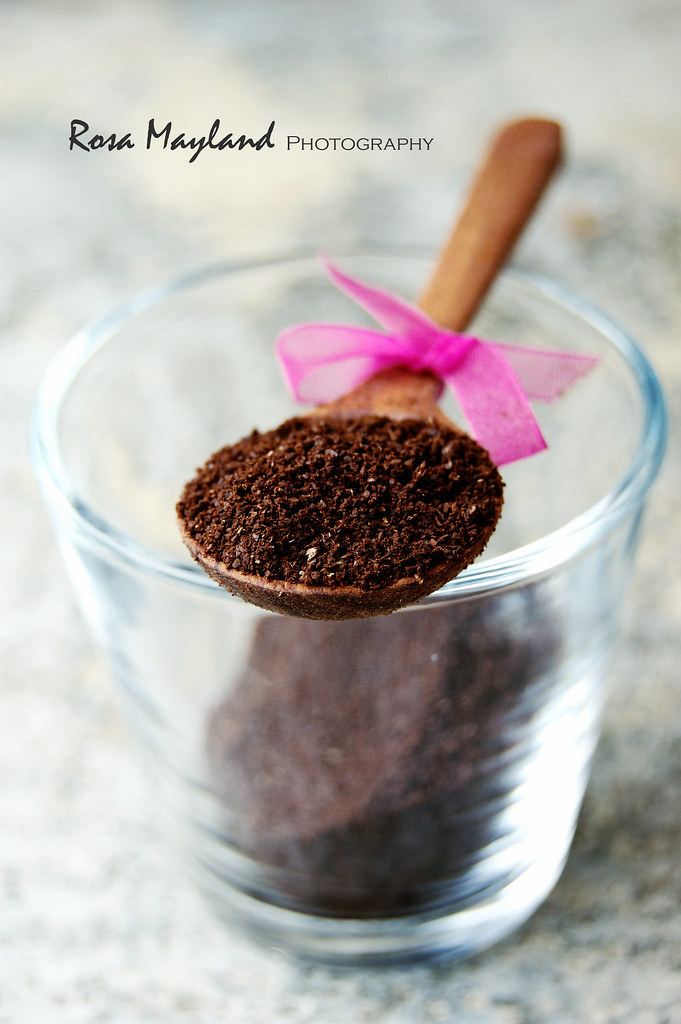
2 Tsps Ground Turkish coffee
Cristallized sugar, to taste
A "cezve" or Turkish coffee pot

Method:

1. Place the water in the "cezve".
2. Add the coffee and the desired amount of sugar.
3. Stir well.
4. Place "cezve" on low heat.
5. Slowly bring to a boil (the coffee is ready when a layer of foam appears on the top of the pot)
.
6. Serve.

Remarks:
Don't put
the pot over high heat, leave it alone otherwise you'll have no control over the high-rising foam.

Seving suggestions:

Turkish coffee is always served with a glass of water. You need to drink the water first to clean your palate!
Find a comfortable spot in which to savor your delicious coffee and remember, drink it sip by sip.


***************

~ Café Turc ~

Recette pour une tasse.

Ingrédients:

1 Tasse d'Eau

2 CC de Café moulu turc
Sucre cristallisé, selon goût
Un "cezve" ou pot à café turc


Méthode:
1. Mettre l'eau dans le "cezve".

2. Ajouter le café moulu et ajouter la quantité désirée de sucre.
3. Bien mélanger.
4. Mettre le "cevze" sur le feu et faire cuire à feu très doux.

5. Porter lentement à ébullition (
le café sera prêt quand une mousse se formera en surface).
6. Servir.


Remarques:
Ne pas faire cuire à température trop élevée et ne pas laisser le pot sans surveilleance autrement vous ne pourrez pas contrôler la mousse qui débordera.


Idée de présentation:
Le café turc est toujours servi avec unverre d'eau car il faut la boire avant afin de se rincer le palais!
Afin de pleinement apprécier votre café, installez-vous comfortablement et n'oubliez pas de le boire à petites gorgées.